

The conditions of health workers affect everyone. Ongoing state and federal cuts to health funding and the consequent degradation of working conditions in the sector are increasingly compromising access to safe and reliable health care—the right to which the workers’ movements won in the 1960s and ’70s.
Over the last four months, a group of hard-headed allied health workers have fought and won a battle with their union leadership over democracy. It is a story of a union leadership’s extraordinary resistance to member participation and the equally extraordinary rank-and-file organising in response.
Allied health refers to any health professional who isn’t a doctor, nurse or dentist. It is a critical section of the health workforce that often goes under the radar, making it easier for governments quietly to rip through these services and undermine workers’ conditions. Yet according to Allied Health Professions Australia, there are 300,000 allied health professionals in the country.
These are essential workers, who represent almost a third of the health workforce and deliver more than 200 million health services annually. They include paramedics, radiographers, radiation therapists, social workers, optometrists, physiotherapists, occupational therapists, speech pathologists and many more. They provide physical and mental health services across diagnosis, treatment, prevention and rehabilitation. Their work includes support for chronic illness and disability, and is delivered in hospitals, clinics and community settings.
The Health Services Union (HSU) is the main union covering health workers. It is a federated union, which means it has individual branches in different states and territories, each covering different groups of workers depending on their workplace or job type. Two of these branches cover a majority of allied health workers in Victoria: the Victorian Allied Health Professionals Association (VAHPA), covering allied health workers in public, private and community health, private practice and aged care; and the Health and Community Sector Union (HACSU), covering health workers employed in disability, mental health and alcohol and other drug services.
A planned merger between VAHPA and HACSU became public in October last year. The announcement triggered a rapid, organised and significant rebellion from VAHPA members, led by the rank-and-file network VAHPA Pulse.
VAHPA Pulse was formed in early 2025 to support VAHPA members’ communications and union activity. It aimed to create a space to share workplace stories, issues and strategies and build members’ confidence. The network was established after years of frustrations at the union’s failure to facilitate communication between members or to respond respectfully to these member complaints.
This was becoming increasingly important for the upcoming enterprise bargaining agreement, in which short staffing, unfilled positions, crushing workload and low pay are burning issues crying out for a serious industrial fight. The current Victoria public sector agreement has given annual headline pay increases of just 2 percent annually over the past four years, a total of 8.2 percent. Meanwhile inflation (as measured by the consumer price index) has surged by a total of 18.8 percent over that time.
The union leadership opposed the establishment of VAHPA Pulse. It repeatedly made claims and insinuations about the network undermining the union. At a union delegates’ conference, a union official went so far as to yell at a network organiser and accuse VAHPA Pulse of “bullying” the union secretary—to the horror of members watching on.
Nevertheless, the network grew. It launched a website, newsletter, WhatsApp chat and Instagram account. Within months of forming, it became the rallying point against the proposed VAHPA/HACSU merger and the fight for union democracy.
Cecilia is an allied health professional in a public hospital, a workplace delegate and one of the VAHPA Pulse organisers. “There’s nothing inherently wrong with two union branches looking at merging”, Cecilia told Red Flag. “It’s not like members were like ‘never, no way’. But there are many reasons it didn’t make sense from an industrial perspective. And the way VAHPA and HACSU have gone about it is utterly appalling.” When asked what members’ reservations were, she said:
It was one red flag after another. But in short, the process was undemocratic, lacked transparency, the timing and reasoning provided [for the merger] was really questionable and misinformation was rife. Once members raised questions and concerns, the leadership seemed intent on railroading us into it.
First, VAHPA members (and HACSU members for that matter) were not consulted about the proposed merger. They weren’t even promptly informed. VAHPA members found out about it through the rumour mill and then from workmates in HACSU, who had been informed by their union. Once VAHPA members began contacting VAHPA leadership, the union issued a media release. No apology was provided to members for the poor communication.
“From the get-go, VAHPA leadership seemed unconcerned with including and representing members. And they just got worse from there”, Cecilia said. “The statements put forward in VAHPA’s media release were vague and didn’t add up. It left everyone wondering if it was member or leadership benefits that were really at the heart of the merger.”
The VAHPA media release put forward very general arguments: that the merger would provide greater union resources, and that the combined membership would lead to increased union size, reputation and bargaining power.
Regarding these arguments, Cecilia says that “members aren’t confident in the ‘trust us, it’ll be great’ approach VAHPA is taking. Take the resources, for example: members have been asking the union for more organisers for years. But a member did the numbers and it seems like the organiser-to-member ratio may well go down”.
With regard to bargaining power, she agrees that
in theory, a bigger workforce can have more industrial power. But that is only realised if that power is actually wielded. Size isn’t the only power—unions need to take seriously and adequately support member activity, and the track record on that recently has not been great for either of them. Members feel like we’re just looking at a bigger and more powerful do-nothing bureaucracy than we already have.
Both unions have an underwhelming track record when it comes to fighting for members. There is a significant history of complaints against VAHPA from members, including for slow or missing replies to requests, poor general communications and high turnover and loss of organisers.
In the case of HACSU, its recently negotiated agreement left allied workers in the dust. In 2024, HACSU won one of the best pay increases in Australia—28 percent over four years—but only for its nurse members. This matched the pay rise won by Victorian public sector members of the Australian Nursing and Midwifery Federation in 2024, after a rank-and-file revolt torpedoed an annual 3 percent headline pay deal between the Victorian government and the nurses’ union leadership.
The leadership of HACSU called off industrial action very soon after the government matched this offer to their mental health nurse members. This left their allied health members with headline annual pay increases of just 3 percent per year – less than half what the nurses won. This continued a widening of the existing disparity between allied health and nursing staff wages – often for workers on the same team doing similar work—and represented a major motivating factor in the opposition to the merger. Cecilia said:
This was a win for nurses and we wholeheartedly support what they’ve won—they deserve this and much more. But HACSU prioritised one set of workers over another and kicked our colleagues in the teeth. Now they [VAHPA leaders] are telling us how great it’s going to be to join with this union.
Other members’ concerns included that the merger seemed more akin to a takeover of VAHPA by HACSU than a genuine merger; limited allied health representation in the post-merger leadership; VAHPA members falling immediately under the existing HACSU agreement and therefore losing their current bargaining opportunity; the questionable timing of the merger; and concerns about HACSU’s formal affiliation with the Labor Party and how this will be managed post-merger. “Too much was in the air”, Cecilia said. “It was clear members needed to have a say.”
When members raised concerns with leadership, they were told that members would be consulted on the process only, but the merger itself was a done deal. This was not true. When they were told this, the merger still required a Committee of Management vote, a National Committee vote and Fair Work approval—which requires the union to demonstrate it has the members’ support.
Wanting members to have a say on the merger, a VAHPA Pulse member discovered a clause in the union constitution: if 200 members petitioned the leadership, an extraordinary special general meeting would have to be called. They immediately started a petition and a publicised campaign for member input on the merger and quickly gathered 400 signatures.
“We actually submitted three petitions before the leadership accepted it!”, Cecilia said. “The first two were rejected for errors. We ended up having an industrial lawyer see the campaign and offer to help us. This says a lot about barriers to democracy in the union!”
Meanwhile, the leadership was fast-tracking the merger process, hoping to outrun the petition. They brought their Victorian Committee of Management vote forward by a week. And once they received the third petition, which they couldn’t reject, they scheduled the SGM for a week after the National Committee merger vote.
The leadership also called some “town hall” meetings and suggested this was all that was needed. As Cecilia describes, “Members felt this was cynical. The meetings are discussion spaces; they don’t have the voting and decision-making authority that the SGMs do. Yet suddenly people are being told that we don’t really need the SGM any more, the one thing which could actually force the leadership to change course”.
Nevertheless, the extraordinary SGM was scheduled for 11 December. “We knew it wasn’t enough to have won the right to have the meeting”, Cecilia said. “Without at least 200 members at the meeting, any vote wouldn’t be valid. We campaigned like fury to get members along. The support amongst members was strong; people really wanted to have their say.”
VAHPA members span regional areas of Victoria, and many were struggling to get time off work and cover costs for missed shifts and travel in order to get to the SGM.
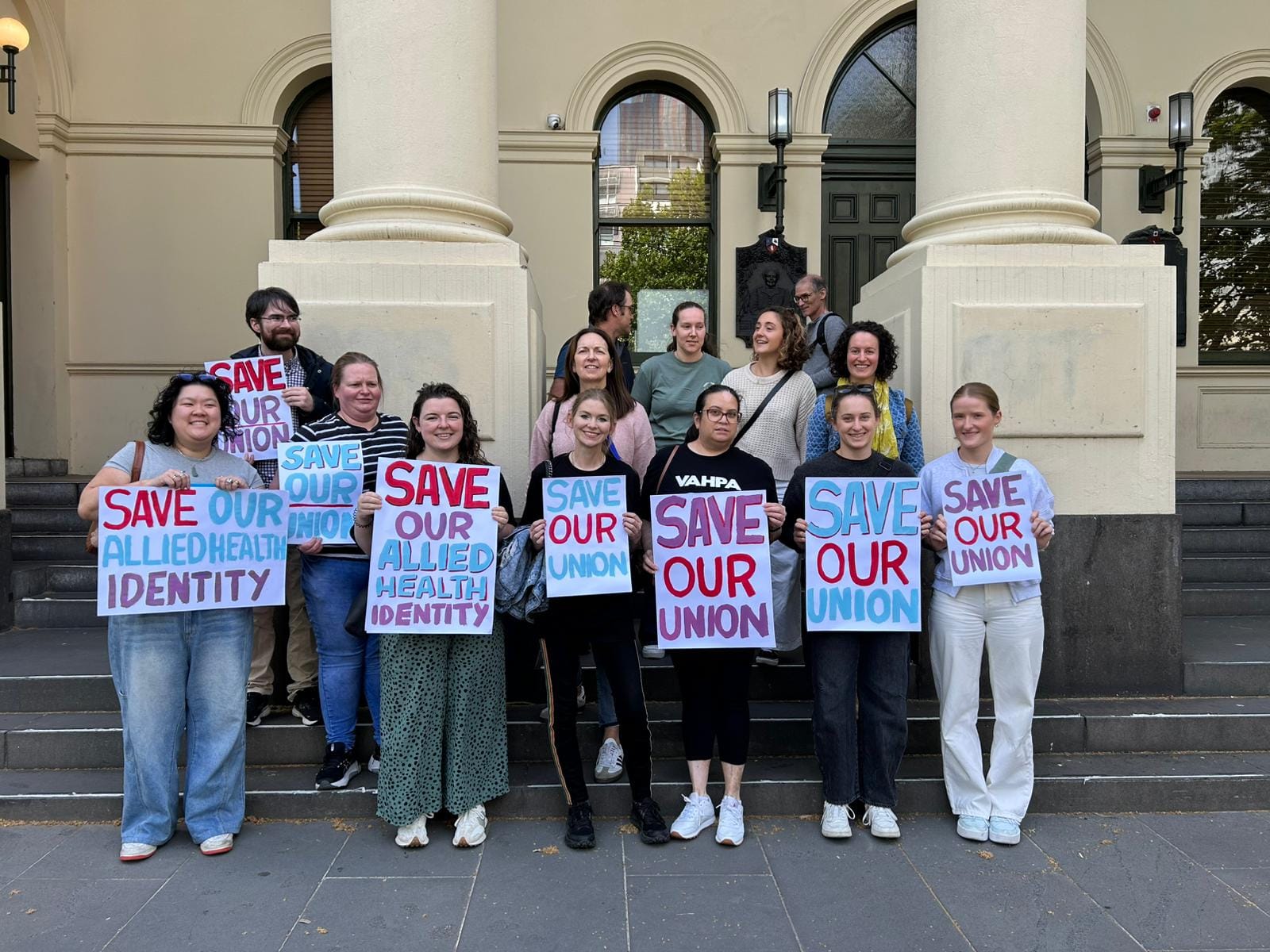
The union refused to help get members to the meeting, so VAHPA Pulse started a GoFundMe campaign instead. “Over $3,000 was raised through Go Fund Me”, Cecilia said. Fifty union and community members contributed:
But along with raising money, the campaign really laid bare how hostile the union was to members having a say—and people really backed us. We even got support from social media celebrities and an artist. It created solidarity and boosted our confidence to push on.

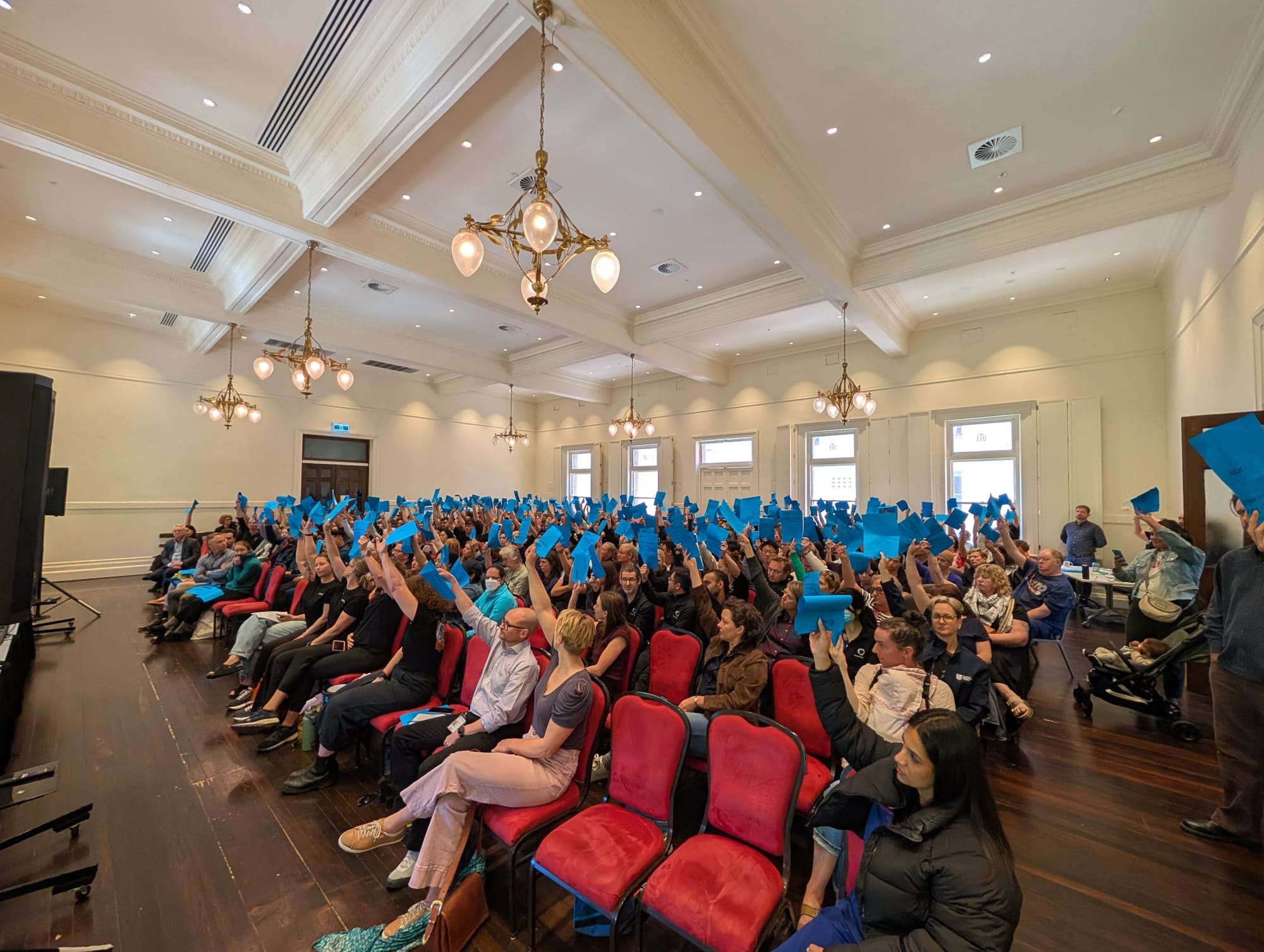
In the end, 276 members attended from across Victoria—coming from as far away as Gippsland, Warrnambool and Wangaratta. “People moved heaven and earth to get there, some losing up to a day’s pay”, Cecilia said.
At the opening of the meeting, members were informed about the presence of non-VAHPA observers, including HACSU Secretary Paul Healey and officials from the national HSU office. An attendee raised a point of order that the inclusion of observers needed to be voted on. Members voted to kick out the observers. “The tone for the meeting was just set from the get-go”, Cecilia said. “Members were really making it clear—this is our meeting, our union, and we will choose how it runs.”
The meeting moved on to discussion of the merger, and it was obvious that the room was overwhelmingly against. Of the five people who spoke for it, four were from the VAHPA Committee of Management. The cheers for the many speakers against were loud and long, at one point prompting the chair to ask people to settle down.
Cecilia recounts that the speakers for the merger made claims that were “manipulative and without strong basis in fact”, one implying that those opposing the merger would be responsible for VAHPA staff being overworked, and another announcing that a communication worker would have to be laid off if the merger didn’t go ahead. That worker was in the meeting and became noticeably distressed. “It was so out of line”, Cecilia said, “and we later got word that this claim wasn’t even necessarily true”.
In the end, the merger was voted down overwhelmingly—267 against, six in favour and three abstentions.
Showing contempt for democracy, the union officials dismissed the outcome. Workplace Express published responses from union Secretary Craig McGregor that “he expected the amalgamation to proceed” and that only a vote from the National Committee or a member plebiscite could stop it. Cecilia said:
The union’s attitude basically was ‘nice that you voted, but the merger is a done deal—it’s been endorsed by the union’s committees’. They planned to seek final approval from Fair Work by arguing that the union leadership is elected by members, so therefore their views represent those of the membership. Just appalling.
Members filed to Fair Work to have a rank-and-file representative at the hearing. They also started gathering stat decs from members who couldn’t attend the SGM. They were not going to back down.
On 12 January, they won. The withdrawal of the merger was announced. HACSU published a media release referencing the importance of listening to member voices. VAHPA didn’t formally comment; it simply pulled the merger announcement from its website. VAHPA Pulse published an emotive announcement saying this “is a direct result of all the rank-and-file member power ... we have shown over the past couple of months that we can fight and we can win!”
This successful but unexpected battle came right in the middle of bargaining for a new agreement for allied health workers. VAHPA Pulse is hoping to build on the increased member interest and participation in the union to strengthen the campaign for a better agreement. “[N]ow is the time for all members to turn their attention to our EBA”, argues the group’s latest article. “This is an important fight ... that will have a major impact on the future of Allied Health ... We need to continue our fight—for our professions, for our patients and for our communities!”
Cecilia reinforces the point: “We can’t afford to be passive with the working conditions we are facing. The fight against the merger is a powerful example of what organised members can do. It’s great we have that success to draw from. We need to use it to improve our conditions and in so doing, the quality of the health system overall”.

