
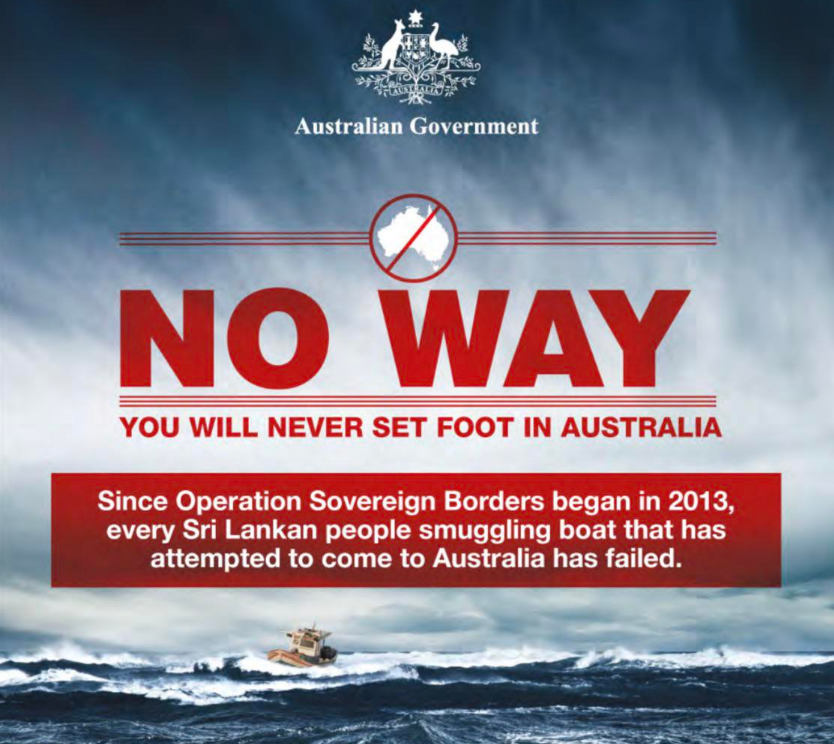
NO WAY
YOU WILL NEVER SET FOOT IN AUSTRALIA
The poster was glued to a wall or a column—I can’t quite remember—at Vavuniya train station in northern Sri Lanka. At the top, an outline of Australia crossed like a no-smoking sign. A small fishing vessel was pictured on perilous seas below it. Bold font was used for the type in the middle. Though the elements had drained the paper of its original hues and mellowed the once dramatic contrasts, the message was still clear, even if most people in the area couldn’t read English. It was 2017. The Australian government had begun producing the posters a few years earlier for Operation Sovereign Borders, its militarised effort to prevent refugees claiming asylum.
Vavuniya (pronounced Woh-niah) seemed apt, in its own grotesque way, for the poster’s placement: the district was the site of Manik Farm concentration camp, holding more than 200,000 internally displaced Tamils in a squalor of overflowing latrines, disease, malnutrition, harassment and worse. The camp had been decommissioned five years earlier. But the northern homelands of the Tamil people were still, as they remain, littered with barracks—one of the most intense military occupations in the world, following on from the slaughter of tens of thousands of civilians in 2009.
Australia was a leader among the “civilised West” in ferociously attacking people seeking safety on our shores. Before long, the far right across Europe had adopted the government’s slogan as their own. In the Netherlands, Party for Freedom (PVV) leader Geert Wilders appeared in a 2015 anti-immigrant video in which the material is unmistakably modelled on the Australian propaganda; the German History Museum in Berlin displayed one of the versions altered by neo-Nazis in a 2016 exhibition titled “Antisemitic and racist stickers from 1880 to today”.
I’m reminded of all this yet again as far-right Reform UK leader Nigel Farage cites the now mainstream, bipartisan Australian border regime as a model to be emulated in Britain—more than a decade after the political tussle over it ended here. This week, I think for the first time, far-right parties led national election polling in all four of Europe’s biggest economies: Germany, Britain, France and Italy. In the latter, Georgia Meloni’s Brothers of Italy (Fratelli d’Italia) has increased in popularity since taking office in 2022 as the head of a coalition government. Wilders’ party, now part of the ruling Dutch coalition, has also surged in the polls. But it’s Farage’s organisation that has had the most spectacular rise.
While much could be said about Europe, Australia’s “centre-right” and “centre-left” Liberal and Labor parties consistently fly under the radar in discussions about the appalling practices of contemporary far-right governments and the anti-migrant extremism of far-right parties. Again and again, the forces of the far right claim legitimacy by pointing to Australia, where social democracy today presides over the sort of “border protection” system European Nazis continue to advocate for.
We’re told that this country’s biggest export is iron ore. But politically, it’s border fascism, albeit of the sort that was sold at home as a form of humanitarianism to save refugees from people smugglers and dangerous voyages. In the mediocrity of Australian political life, this one odious achievement stands out. In no other field have Canberra’s politicians wielded such global influence than in supplying tested “solutions” to the “problems” of human movement: boat turnbacks, (alleged) federal police involvement in sabotage operations, deportations to underdeveloped states, concentration camps (some, again, hosted in dependent third countries), military deployments against fishing vessels, “territory excising” to remove the entire continent from its own migration zone—not to mention the systematic psychological torture of tens of thousands of asylum seekers, and potentially watching on as hundreds of people drowned in the Indian Ocean.
Even Donald Trump admitted to our “moderate” Liberal PM Malcolm Turnbull in 2017: “You are worse than I am”. On this, I think Trump was dead right.
The A-Z of Marxism
Have you ever listened to a lawyer, a politician or an academic and thought, “Why don’t they just speak in plain English?” Left-wing activists also occasionally use terms that aren’t much understood outside of our own circles—or we use terms in ways that are different from how they are often understood. So we’re creating a short dictionary, “The A-Z of Marxism”. Today’s entries are …
Right wing
Describes ideologies, organisations and people who support business owners’ interests and are generally hostile to the workers’ movement and progressive causes. The terms “left” and “right” were coined during the French Revolution, referring to the seating arrangements in the National Assembly. Those on the left supported the revolution, the creation of a democratic republic and the secularisation of society, while those on the right supported the monarchy.
Conservatism
As a political movement or ideology, conservatism is notoriously tricky to define. Perhaps the neatest definition is that it is the defence of hierarchy—the belief that some people should rule over others, be it husbands over wives, bosses over workers, rich over poor, or perhaps whites over blacks (although this last notion has gone out of favour, at least publicly). Conservatives generally oppose movements and political ideas that undermine “traditional” institutions of authority, such as the nuclear family or the church, or strive for more egalitarian (therefore less hierarchical) societies.
Fascism
A particularly authoritarian and nationalist political ideology and movement, which usually cloaks itself in radical-sounding rhetoric but ultimately serves the interests of business owners and views the political left and the workers’ movement as enemies to be eradicated. The term is derived from the Latin word “fasces”, a symbol of Ancient Roman authority consisting of a bundle of rods and an axe. It was first used in 1915 by Benito Mussolini, whose regime in Italy (1922–43) was the first fascist state. Adolf Hitler’s Nazi regime in Germany (1933–45) was fascist, and accompanied by virulent white supremacist racism, most notably antisemitism.
Fascism emerged in response to the political and economic crises that followed World War One, when the European working class was politically organised and generally socialist in outlook. The fascist movement was based on and mobilised the middle classes’ fear of working-class revolution, but (despite some anti-capitalist rhetoric) was financed and supported by big business. The Russian revolutionary Leon Trotsky wrote in 1944: “The historic function of fascism is to smash the working class, destroy its organisations, and stifle political liberties when the capitalists find themselves unable to govern and dominate with the help of democratic machinery”. Hence, fascist states attacked the working-class movement by arresting its Communist and Social Democrat leaders and banning trade unionism.
While some individuals, political movements and states have openly identified themselves as fascist, most don’t. Individuals can consciously or unconsciously recreate fascist political conduct while sincerely believing themselves to detest fascism; right-wingers might stridently deny any association with fascism while knowingly collaborating with and making use of fascist allies as part of a political or governing coalition. Political parties with fascist-like properties have characterised themselves as mainstream conservatives, or even as social democrats.
Parties very similar to traditional European fascism have formed governments without creating a one-party state that is often viewed as defining a fascist political order. On the other hand, nationalist dictatorships similar to Mussolini’s Italy can emerge without founding themselves on the kind of large-scale middle-class social movement often viewed as a defining feature of fascism. So whether an individual or party self-identifies as fascist doesn’t necessarily tell us much about their politics. (For more, see the Red Flag article “Trotsky and the fight against fascism”.)
Nazi
Historically, a member or supporter of Adolf Hitler’s fascist National Socialist German Workers’ Party (NSDAP, 1920–1945). The word is derived from the German Nationalsozialismus (National Socialism). (As the shortened version of Ignatz, it was also the standard name of a stock comic character: the Bavarian country bumpkin.)
The Nazis used the term “socialist” even while they were part of a right-wing nationalist political coalition, attacking Marxist workers both verbally and physically, appealing to big business and ultimately trying to eradicate the entire German left. By using the term “socialist”, the Nazis appealed to millions of Germans who had lost faith in the capitalist system. But Nazis had their own idea of what “socialism” meant: to be a pro-war German patriot who put the military needs of the country before personal interest.
Certain capitalists were attacked for being treacherous, and politicians for being “bourgeois” if they were too visibly corrupt. But at the same time, workers who fought for their own interests were also denounced as treacherous and misled by Jewish ideology. This “socialist” demagogy was played up in propaganda that targeted workers and disillusioned middle-class activists, but the volume was turned down when the Nazis were appealing to the ruling class. Nazi talk of a “social revolution” ultimately meant replacing worn-out, timid politicians with a new generation of aggressive, pro-war authoritarian activists who would have the guts to crush the left and launch a new war.
Neo-Nazi
Contemporary Nazis who attempt to rebuild Hitler-style fascist movements embracing anti-communism, authoritarianism and deep racism (often white supremacy, but local variants may focus on other forms of ethnic or religious purity). For decades after World War Two, Nazis were mostly confined to marginal secret societies and subcultures, but the rise of so-called “right-wing populism” since the mid-2010s has enlarged their audience and recruiting pool. Neo-Nazi ideas such as Holocaust denial are increasingly common. More than other fascist currents, neo-Nazis tend to glorify violence; they consider street fighting and physically bashing perceived enemies as a key part of their political practice.

