

Iran on fire: rebellion returns to the streets
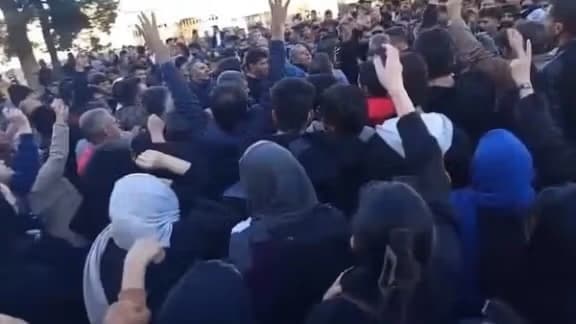
“Don’t be afraid, we are all together”—the chant rings out inside Tehran’s grand bazaar. A young woman, bravely unveiled, leads a march of hundreds through one of the oldest markets in the world.
The collapse of the rial, Iran’s official currency, has triggered the biggest protests since the Woman, Life, Freedom uprising in 2022. On Sunday 28 December, in the Iranian capital Tehran, the grand bazaar erupted. Merchants closed their shops and took to the streets chanting “shut it down”. Within 72 hours protests had spread to more than 21 of Iran’s 31 provinces, according to a report in the New York Times. From the Mashhad metro to the tiny town of Farsan, demonstrators converged on street corners and squares with the slogan “death to the dictator” —a reference to the 46-year-old Islamic theocracy—featuring prominently.
Rebellion on the streets soon reached the major universities. From Tehran to Tabriz, students joined rallies in their hundreds demanding an end to poverty and corruption. Activists at the Khajeh Nasir University warned “we will go until the overthrow and death of the dictator”. Echoes of the 2022 Women, Life, Freedom uprising were everywhere, such as women with headscarves in their hands declaring “no headscarf, no veil, freedom and equality” and “women, life, freedom”.
Protests have grown over the past five days despite severe state repression, with reports of police using live ammunition against demonstrators, raiding people’s homes and kidnapping them off the streets. According to the human rights group Hengaw, at least three protestors, including a child, have been killed in Iran’s Lorestan province. Meanwhile, Said Pourali, the deputy governor of Lorestan, claimed that protestors had killed a member of the Basij, the paramilitary militia within Iran’s Revolutionary Guards.
Roots of the rebellion
This is the latest in a series of uprisings that have rocked Iran over the past decade. In 2017, workers went on strike across the country to demand bread, jobs and freedom. They burned down police stations and attacked banks. The sugarcane workers in Khuzestan established workers’ councils to fight for control over production. The 2017-2018 general strike precipitated the 2019 November uprising, sparked by a 200 percent increase in the price of fuel. Students rioted under the slogan “strike and revolution”. The strike committees active in 2017 re-emerged, and new sections of workers joined the struggle. The regime drowned the rebellion in blood but could not crush the will of the people for long.
Strikes continued to ebb and flow in the first year of the pandemic. Then in 2021, protests erupted in Khuzestan in response to severe water shortages and soon spread to other cities and towns. A few months later, oil workers went on strike to protest the sham election of Ebrahim Raisi as president. Protests and strikes continued through 2022, from the smallest province Khorasan to the capital Tehran. This cycle of revolt reached its climax in the 2022 Woman, Life, Freedom uprising, triggered by the police murder of 22-year-old Kurdish woman Gina Mahsa Amini. This was the largest uprising since the 1979 Iranian Revolution which saw the overthrow of the US-backed Shah dictatorship.
The successive rebellions in Iran have deep economic and political roots. Runaway inflation and a collapsing national currency have been compounded by decades of government corruption and Western sanctions. Despite having the world’s second largest gas reserves and third largest oil reserves, nearly 70 percent of the Iranian population live below the poverty line, according to a report by the Iran Human Rights Monitor. The minimum wage for Iranian workers is the worst in the region, behind even Afghanistan and Yemen, and the labour force participation rate has fallen to 41 percent, as documented by the Middle East Forum Observer. The collapse of the rial, down around 20 percent in the last month alone, has further eroded ordinary people’s purchasing power, making it even harder to buy already hyper-inflated goods like food and medicine.
Meanwhile, the cabal of criminals who run Iran live in luxury. Oil tycoons, steel magnates, politicians and the elite military and police make billions in profit from exploiting and oppressing the working class. According to Iranian based economist Ali Heidari, nearly one-third of the country’s wealth is now concentrated in the hands of just one percent of the population. The regime has responded to the crisis by doubling down on austerity measures: gutting healthcare and infrastructure and attacking workers’ wages and conditions.
A regime in crisis
All this has further fuelled a longstanding crisis of legitimacy for the regime. It has no popular support, instead maintaining its rule through sheer force with over sixteen intelligence agencies and one of the largest civil militia organisations in the world. But Iran’s rulers know that despite their best efforts, they can’t completely crush dissent. The election of Reformers’ Party candidate Masoud Pezeshkian to the presidency in July 2024 signalled an attempt by the state to soften its image after crushing the Women, Life, Freedom uprising. Pezeshkian paid shallow lip service to the movement demanding an end to the mandatory hijab and criticised the morality police, who enforce the sexist policies of the state.
But the hopes that some Iranians had in his presidency were quickly dashed as it became clear he’d continue the policies of his predecessors. Pezeshkian’s recently proposed annual budget will hold minimum wages far below the inflation rate, raise taxes by 62 percent and increase the price caps on fuel, according to Al Jazeera. The government proposes to spend the same amount of money bolstering its propaganda apparatus as it will on the entire education sector.
The regime also suffered a humiliating defeat at the hands of Israel and America, which last June launched a twelve-day war that largely destroyed Iran’s most important nuclear sites, destroyed or damaged crucial oil, gas and water resources and targeted civilian infrastructure, killing over 1,000 people. The fallout of the war contributed to the collapse of the rial, the value of which has declined by at least 40 percent since June, according to a report by the Financial Times. Israel’s all-out assault on the region—its Gaza genocide, war on Lebanon and bombing campaigns in Yemen, Iraq and Syria, weakened Iran’s regional allies. Added to that, the overthrow of the dictatorship of Iranian ally Bashar al-Assad in Syria left the regime a sitting duck.
Some on the left argue that we should support the Iranian regime because of its hostility to Israel and America. This position denies the right of Iranian workers and the oppressed to resist after decades of suffering under the boot of a capitalist dictatorship with Islamic colouring. Socialists should stand unequivocally with the resistance in Iran, while also rejecting attempts by the Western imperialists to exploit the movement for their own gain.
The dynamics of the current movement
The dynamics of the current protests can’t be understood without this context. The crisis is so deep that it has started to break one of the regime’s historically loyal support bases—the bazaaris, the traditional merchant class. The alliance between the merchants and the regime has deep roots going back to before the 1979 revolution. They formed an alliance against the US-backed Shah dictatorship in 1963, establishing the Islamic Coalition Party. During the 1979 revolution the bazaaris provided important financial support to the clergy, who under the leadership of Ayatollah Khomeini eventually defeated the revolution and established the Islamic Republic.
The clergy relied on the bazaaris to get them into power and for many years maintained a strong, albeit at times unstable, alliance. But the worsening economic situation and the growing financial dominance of Iran’s repressive state forces gradually weakened the influence of the bazaaris. This was particularly the case during the hardline presidency of Mahmoud Ahmadinejad (2005-2013) but has continued to today. The bazaaris no longer enjoy the relative privileges they once had.
In response they have organised increasingly frequent protests, including participating in the 2018 general strike where they raised slogans that for the first time transcended their own commercial interests. The bazaaris’ initiation of the current protests is not unprecedented but represents a significant breakdown in the relations between the traditional middle class and the Iranian regime.
Meanwhile students and the youth have swung back into action after being the epicentre of the Women, Life, Freedom uprising. Through their Telegram channels, students circulated footage of protests on multiple university campuses in Tehran, Isfahan and Yazd. They gathered in their hundreds chanting “freedom! freedom! freedom!” and “don’t be afraid! We are all together”. At night when security forces came to kidnap students from their dormitories at Tehran University, they bravely fought back, inspiring more students to rise up. At Ferdowsi University in Mashhad, students declared “protest is our right, sit-ins are our tool, and resistance is our path. The young generation will not accept injustice and will not surrender the future at the cost of fear”.
Many student groups, including independent student unions, that were active in the Women, Life, Freedom uprising have re-emerged. The memory of this rebellion is fresh in their minds—they turned the universities into hubs of resistance, defying gender segregation rules, burning their hijabs and occupying buildings. Students joined forces on a national scale, and compelled teachers to go on strike in solidarity with their struggle. Their participation in this moment can inspire wider layers of society into action. In the words of the students at Khajeh Nasir University, their protest “is a warning from students to the rulers who have become comfortable with corruption, we remind them that the normalisation of misery has failed, and the student is still standing”.
Much of the mainstream media reporting focuses on the bazaaris and the students. While it’s true that they’ve been at the centre of the current protests, workers have been on the battlefield for many months. They feel the economic crisis most acutely. Teachers, nurses, truck drivers, gold miners, steel, oil and gas workers have been striking and protesting to demand wage increases, health and safety measures and the abolition of the predatory contract labour system. It’s workers who are the beating heart of Iran’s economy and who have the power to topple the regime.
We’ve seen glimpses of this potential. In early December, videos posted on Telegram captured 5,000 contract oil and gas workers on strike in the biggest industry-wide mobilisation since the 1979 revolution. These workers are stationed in Asaluyeh, at the world’s largest natural gas field. They provide more than half of the country’s income. It’s why they were targeted by Israeli airstrikes back in June.
In the aftermath of the Israeli attack, politician Hassan Nowruzi tried to deter workers from protesting, arguing that bosses and workers are “in the same boat”. But this attempt to cohere national unity failed miserably—the oil and gas workers continued to strike. Their independent union pushed back, replying “No sir! We workers and you plunderers are not in the same boat. You and your government have punctured the boat that carries our livelihood, and through these holes you are looting everything we have”.
Challenges and prospects
For the struggle on the streets to deepen, students and bazaaris must unite with the working class. In the case of oil and gas workers, they are geographically isolated from the big cities and forced to live on or near the plants in terrible camps. But recent years have shown that this barrier can be overcome. During the Women, Life, Freedom uprising workers and students consciously forged solidarity, recognising that freedom from oppression is bound up with the class struggle. The Haft Tappeh union at the time declared, “this great uprising should be linked with the strike of workers’ everywhere … to have bread and freedom, let us not leave the women of the revolution alone”. Today, the economic grievances of the working class are directly linked to the protests in the bazaars and on the university campuses.
As for the regime, it has responded in typical fashion: with repression. But unlike previous rebellions, it has been forced to pay lip service to the grievances of the masses. This was reflected in Pezeshkian’s social media address on Monday, writing that he asked the interior minister to engage with the legitimate demands of the protestors. Fatemeh Mohajerani, a spokeswoman for the government, told reporters that Tehran planned to set up a dialogue that would include protest organisers. “We see, hear and recognise the protests, crises and constraints”, she said. At the same time, the government announced the closure of universities, government offices and commercial centres in 18 of Iran’s 31 provinces and security forces are crawling the streets hunting down dissidents.
The Iranian regime is caught in a perpetual crisis with no clear solution. But one thing is for sure—the fire will continue to burn so long as the Islamic Republic still stands. The decade of crisis and class struggle has made clear that its days are numbered.
