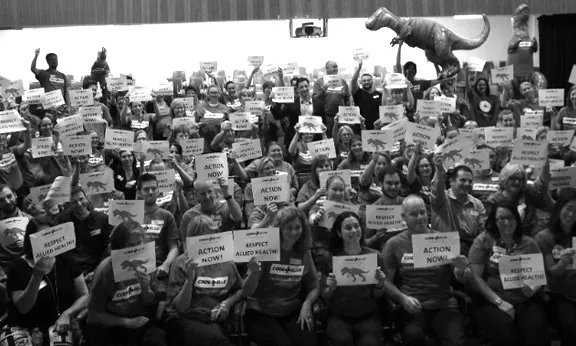
A group of rank-and-file unionists have ousted the leadership of the Victorian Allied Health Professionals Association (VAHPA) in a landslide election. The VAHPA Pulse ticket, made up of rank-and-file union activists, gained almost twice the vote of the incumbents, VAHPA Unity, and won all the positions.
The VAHPA Unity team has controlled the union for fourteen years and was backed by significant anonymous donations. By contrast, VAHPA Pulse, which I am part of, relied for our support on conviction and our reputations as experienced and uncompromising delegates and activists. Our victory is the culmination of many years of hard work and solid rank-and-file union activity.
The outgoing leadership took control of VAHPA with the ticket name “Clean Sweep”. Clean Sweep faced off against cronies of former national secretary Kathy Jackson, who was responsible for disgraceful corruption and whose actions gave bosses and anti-unionists ammunition to attack unions. Defeating them was an important victory.
However, after the new leadership stemmed the haemorrhaging of members and rebranded the union from HSU Branch 3 to the Victorian Allied Health Professionals Association to signal the beginning of a new era, there has been little in terms of concrete improvements for allied health workers.
I started working in public health just a few months after Clean Sweep came into office. Coming from the community sector, I was excited at the prospect of better pay and conditions in the health system. Today, members are leaving public health for the community sector for the same reason.
However, it’s not just our pay and conditions that have gone backwards under Clean Sweep. Members have also become increasingly frustrated and angry with the lack of communication and transparency on the part of the leadership, as well as its hostility to rank-and-file activity.
After working on the front lines throughout the pandemic, allied health workers had an enterprise agreement pushed on us in 2022 that contained a pathetic 2 percent pay “rise”. As the cost-of-living crisis intensifies and the workload increases in quantity and complexity, VAHPA members increasingly find themselves unable to remain in the sector, whether for financial reasons or their own mental health, often both.
At the 2023 delegates conference there was hope that the situation facing allied health workers might start to turn around. A new public sector organising team presented its three-year plan to rebuild delegate structures and networks in the lead-up to our next round of bargaining. There seemed to be a willingness to involve members and an understanding of the central role delegates play in not only recruiting members but also helping them become active unionists.
We all left excited. Delegates formed new working groups. In particular, professional reference groups were established to provide a mechanism for different occupational groups within VAHPA to raise their particular issues within the union. Given VAHPA represents around 50 different professions within the complex health system, this work was vital not only to assist the union organisers to understand the issues on the floor, but also to strengthen our identity and ultimately our industrial confidence. All this work was to help inform our strategy before negotiations began on our next agreement.
These exciting developments were unfortunately short lived. We were told by the union leadership, and directly by the secretary, that this work was undermining and divisive to the union as a whole. Radiation therapists, arguably our most organised profession within the union, had been taking initiative in organising across the state and reaching out to their interstate counterparts to learn from their industrial victories. This was attacked by the leadership, which accused these workers of leaving other professions behind.
The message was clear: the leadership calls the shots.
The 2025 delegate conference was very different. Even friendly attempts by members to connect with each other were responded to aggressively by the leadership. I was rudely shouted at by the secretary on the conference floor after I asked for clarification about staffing. Later, I was attacked by an organiser and a delegate (who ran for assistant secretary on the VAHPA Unity ticket) in front of other delegates when I, on behalf of a core group of rank-and-file delegates, offered to start up a rank-and-file WhatsApp chat to increase communication between members.
These attempts at intimidation did not have the desired effect. Allied health professionals are a smart lot, and many were outraged by the way the leadership behaved. Members flocked to our WhatsApp chat, and the group of delegates I was a part of became more active and vocal about the direction we were proposing for the union. Despite a revolving door of organisers that followed, we continued to discuss how we could improve connections within the union and to identify the key issues within our sector to form the basis of our upcoming log of claims. From this, we decided to start a members’ newsletter to establish a forum and platform to share stories and learn from others’ victories. It was at this point that we chose to give ourselves the name VAHPA Pulse.
Soon after we set up our newsletter, we learnt of a sexual harassment scandal involving our secretary, and then we found out that VAHPA was looking to merge with the Health and Community Services Union (HACSU). Both VAHPA and HACSU are sub-branches of the Health Services Union. Not only were the leadership not seeking to involve members in this decision, but they also spent an awful lot of time and energy trying to deny us input. Plenty has been written about this attempted undemocratic merger, but thanks to a mammoth effort from VAHPA Pulse and supporters both within and outside of our union, we put a stop to it earlier this year. Watching HACSU officials being forced to leave our special general meeting, and watching the anxiety grow on the HSU national secretary’s face as the meeting progressed and it became obvious there was overwhelming opposition to the merger, will live rent free in my head for the rest of my life!
This was a major victory and emboldened both members of VAHPA Pulse and our supporters in the broader membership. After that, our focus shifted to the upcoming agreement negotiations, which is the key way to reverse the deterioration in our pay and conditions over the last few years.
At the same time, we also recognised that, with our union leadership elections approaching, we needed to organise seriously an alternate ticket to challenge the current leadership. As our secretary had goaded us at our 2025 delegates conference, “If people aren’t happy with what I’m doing, they can run an oppositional ticket in our election!”
We knew that unless we directly challenged the leadership, all our hard work and victories would be for nothing. Without an opposition ticket, the leadership would just be able to roll over their current positions for another four years and with a renewed sense of confidence that when it comes down to it, their authority within the union was unchallenged.
In the midst of organising in our workplaces and doing our jobs with their skyrocketing workloads and complexity, VAHPA Pulse members managed to organise a ticket that was entirely rank-and-file members.
While the secretary, president and vice-president chose not to stand again for their positions, the incumbent ticket was headed by either current or past members of the union leadership, who were known for their support for the outgoing secretary.
Their secretary candidate was Andrew Hewitt. Previously our assistant secretary before retiring several years ago, Hewitt had come back to the union under a seemingly ever changing job title. He previously worked as a sonographer and is widely respected for the work he has done for members in that profession. However, he also is known for covering and enabling some of the secretary’s worst behaviours, including being missing in action for months at a time.
VAHPA Pulse didn’t have the large and anonymous donations VAHPA Unity did. All we had was our relationships with members, our reputations as formidable delegates and our track record of leading a democratic campaign to stop the proposed merger. We got the word out about our ticket in whatever way we could—phone calls, text messages, emails, letter box drops, door knocking and using every possible network or connection. Our argument was clear: our union needs to be accountable and transparent to the membership, it should be encouraging members to be active, and it should be fighting to improve our pay and conditions. We represented the future of our union, while VAHPA Unity represented the past.
This week, our hard work paid off. VAHPA Pulse won two out of every three above-the-line votes, and a similar result from the below-the-line votes. We have won all positions outright and with a very convincing margin.
But as the old saying goes—now the real work begins. Our bargaining campaign is ongoing, and with caretaker mode just around the corner, we have an opportunity once again to ratchet up our industrial action and fight for higher wages and better conditions.
VAHPA Pulse is made up of members from different professions, with different levels of experience and different political backgrounds. We are united in our vision for a union with an active and combative membership; however, how we get there strategically is something we will continue to debate. From my perspective, as a member of VAHPA and VAHPA Pulse, I think that now is the time for the gloves to come off. We need to escalate our industrial action in the lead-up to the state election in November, and this must involve further strike action. The teachers’ campaign shows that this is the sort of action that gets results.
Allied health professions perform a vital role in our health system, and our pay and conditions should reflect that. VAHPA Pulse’s victory over the old leadership, which not only oversaw but contributed to the deterioration in our working conditions and fought hard to silence any opposition, is something to be celebrated. Now we need to show that a more combative approach can improve our working lives. To do this, we will need to build the membership, involve more members in action and use our industrial power to win concessions from the government.
Cecilia is a VAHPA delegate and newly-elected member of VAHPA’s branch committee of management.