

Yarmouk refugee camp, in the south of Damascus, January 2025 CREDIT: Omar Hassan
After nearly fourteen years of counterrevolution and slaughter at the hands of the criminal regime of Bashar Al-Assad – which was propped up by Russia, Iran and Lebanon’s Hezbollah – the Syrian government swiftly and unexpectedly fell in December 2024. In the years following the 2011 revolution, more than 500,000 people were killed, according to the Syrian Observatory for Human Rights. And more than half of the country’s pre-war population of 22 million was forced to flee their homes, many of them more than once, creating the world’s largest refugee crisis.
But just when it seemed that Assad’s rule was stabilising, on 27 November, Islamist militia Hay’at Tahrir al-Sham and the pro-Turkey “Syrian National Army” launched a surprise attack against the army in the northern province of Aleppo. In just 11 days, the rebels captured city after city before marching into the capital, Damascus. Assad and his inner circle fled to Russia as the army surrendered and residents flooded the streets to celebrate.
CONTENTS
ENTERING FREE SYRIA
A GHOST TOWN
AN ENCOUNTER WITH THE LEFT IN DAMASCUS
LEFTISTS CONTINUE TO ORGANISE
YARMOUK: ASSAD’S OBLITERATION OF A PALESTINIAN REFUGEE CAMP
ACTIVISTS IN THIS CITY PLAN TO SHAPE THE FUTURE
HEROES OF THE REVOLUTION PLAN AMID THE RUINS
CAN THE SYRIAN PEOPLE RESIST A NEW CAPITALIST REGIME?
THE ORGANISING IS ONLY GETTING STARTED
ENTERING FREE SYRIA
THURSDAY 2 JANUARY 2025 | Under Bashar Al-Assad’s regime, crossing the Syrian border from Lebanon was an unpredictable process, requiring a bit of bribery and a lot of luck. That was doubly the case for Syrians, who were treated with permanent suspicion by the government. Yet as we approach the border on New Year’s Eve, the taxi driver insists that things will be smooth: “The new system is different—Free Syria is open to all”. Sadly, that doesn’t prevent what should be a 45-minute trip from Chtoura, a Lebanese border town, to Damascus taking well over three hours, most of it spent lining up for car searches and identity checks.
But the queues give us a chance to talk. Three other passengers in the taxi are Syrians who provide context for the somewhat tedious procedure. “They used to interrogate you until you felt like a criminal. Only money would make them stop”, one says. “It used to cost 300,000 lira just to bribe the border officials to let us through—before you even thought about paying for a visa”, the driver chimes in.
The youngest of the other passengers is the most politically engaged and articulate. As a member of the Alawi religious sect, which the Assad regime manipulated and used as its shock troops against the 2011 revolution, he was doomed to be conscripted into the military.
“How could I accept killing Syrians for the sake of that regime?”, he asks. He studied for as long as possible to avoid this because students tended to get exemptions. But when that no longer worked, he paid thousands in bribes to get to Lebanon. He’s been unable to visit his family in nine years. “You would not believe the feeling of returning to a free country, to be treated with respect by the officials”, he says.
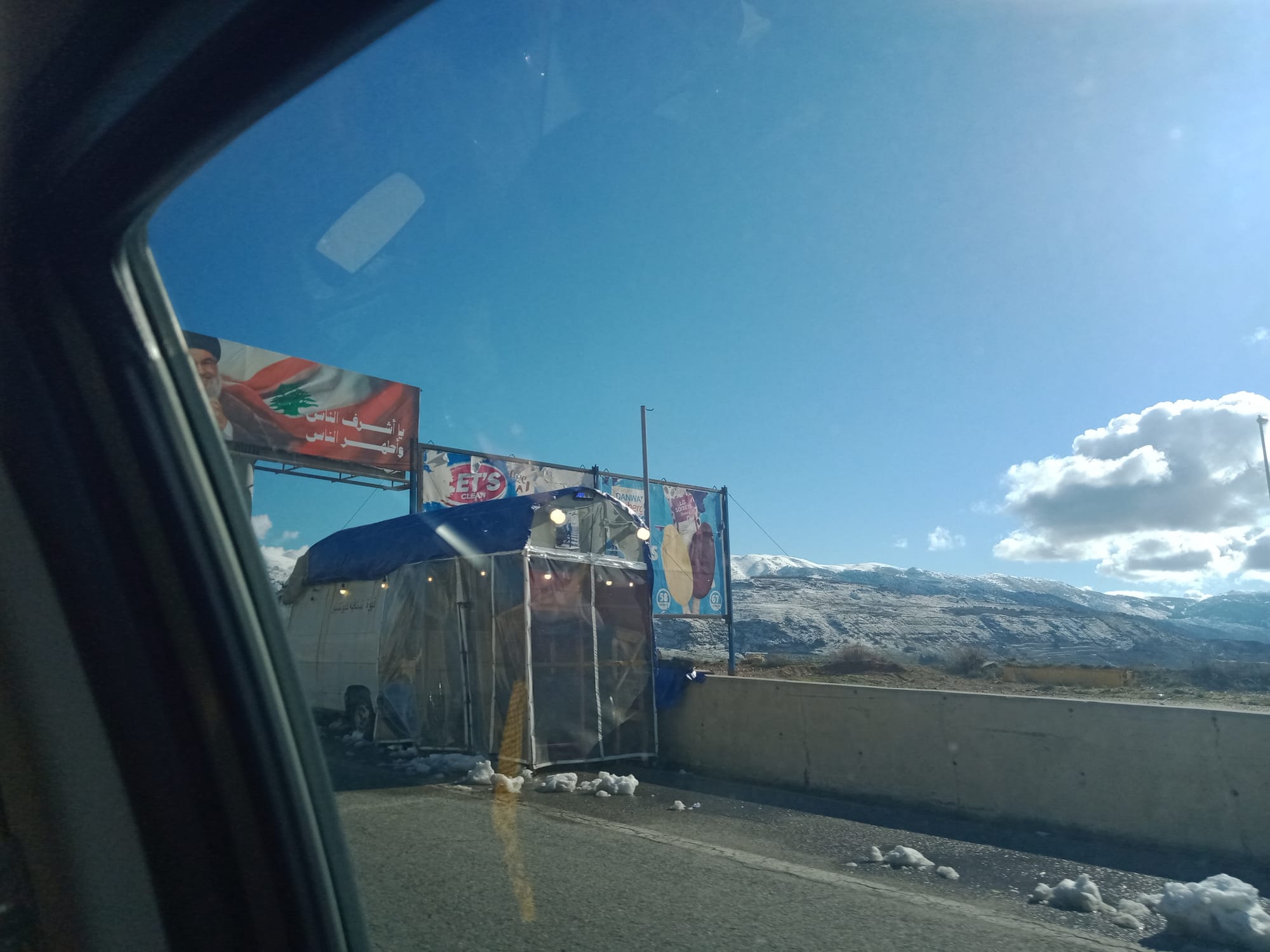
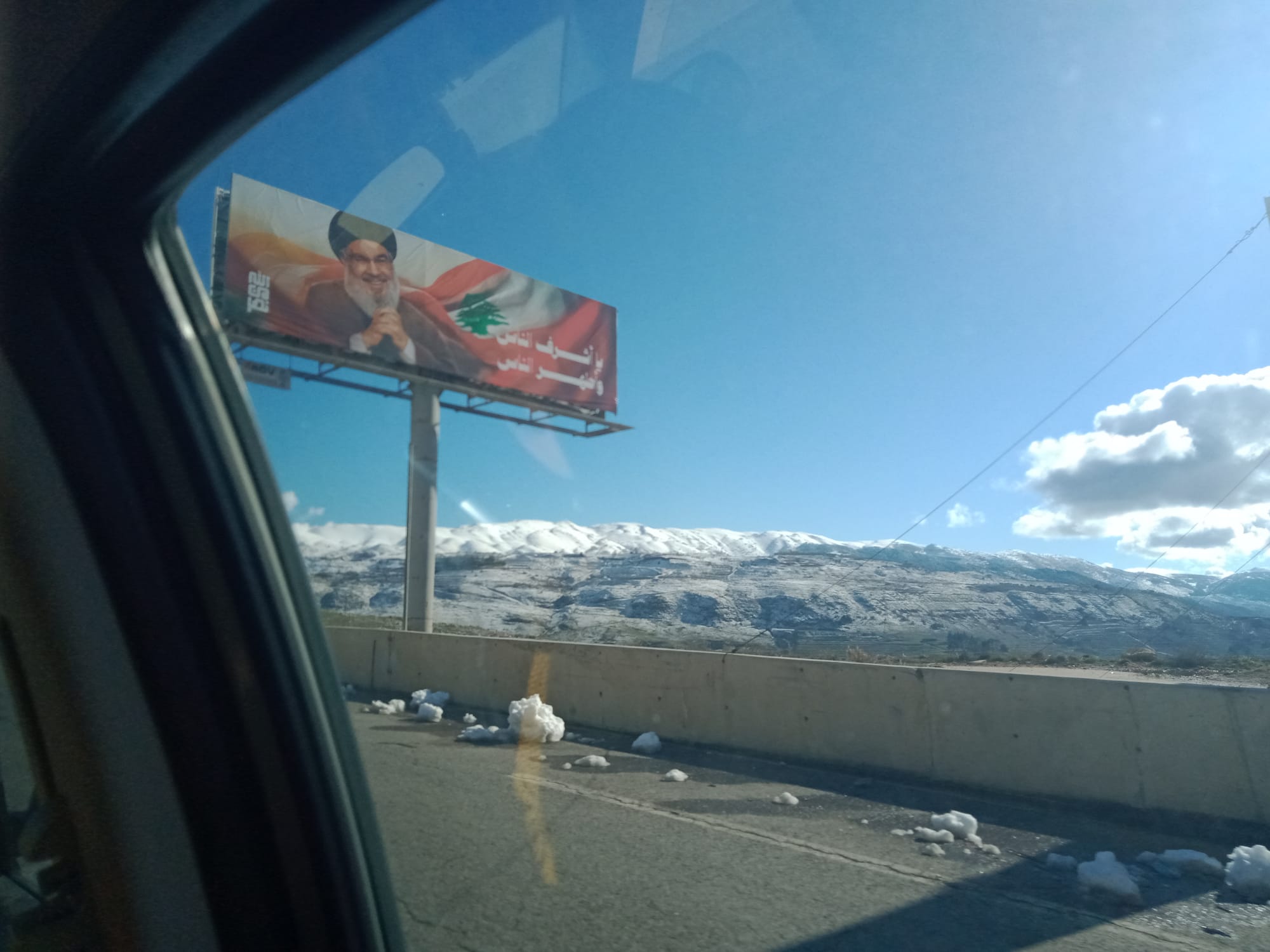
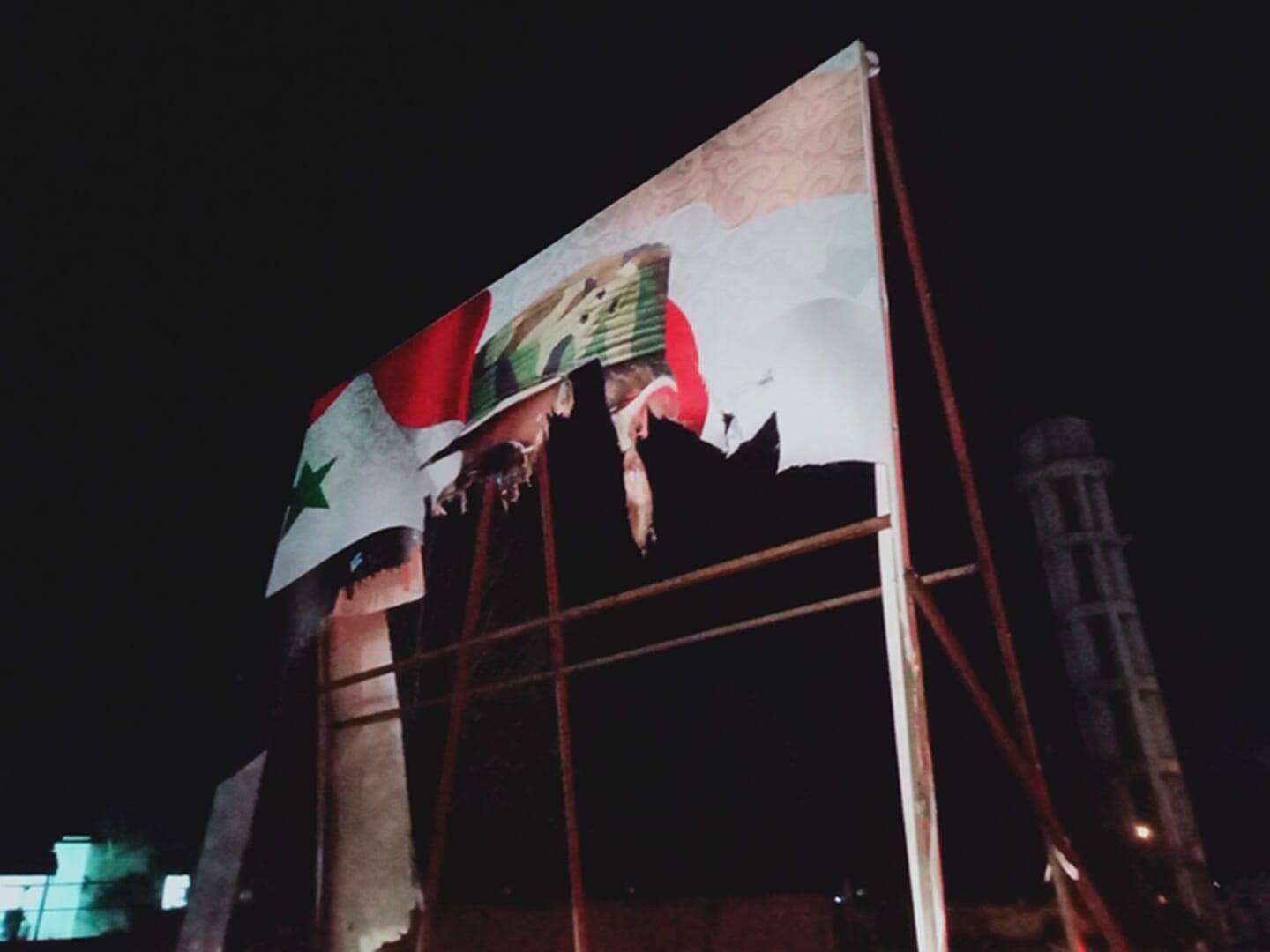
Entering Syria from Lebanon CREDIT: OMAR HASSAN
Though it’s nearly dark by the time we reach the Syrian side of the border, there is more than enough light to see vandalised posters and symbols of the former regime adorning the highway. When I try to get out to take a photo, the driver objects, though with a smile: “You’ll see plenty of that in Damascus!” (Some things aren’t so easily destroyed: Bashar’s murderous face is on every 2,000 lira note, while the 1,000 note is cursed with a picture of his father Hafez, who governed for 30 years before him.)
When we reach the capital, New Year’s celebrations are in full swing and masses of people are on the streets. The new government reportedly discouraged fireworks, but the decree has no visible impact; the sounds of these friendly explosions fill the night air for hours. Spirits are high, and in the relatively trendy neighbourhood of Bab Touma, the small number of armed guards seem relaxed.
Yet grievances are raised time and time again. Everyone I speak to says that their relationship to the former government was defined by two things: oppression and economic coercion. “The government was stealing from us constantly”, says one man in a Damascene market.
“If you looked at a soldier wrong, or just in a bad mood, they could demand you pay a bribe on the spot, else be arrested for a crime you didn’t commit”, a young woman explains. “Every checkpoint was an opportunity to extract money from the public. And there were checkpoints everywhere.”
In recent years, Assad and his cronies relied more and more on the drugs trade for their economic survival, selling weed for domestic consumption and Captagon, a type of amphetamine, in the Gulf markets. Meanwhile, the government pursued an aggressive “war on drugs” policy on the streets of major cities, helping it to raise revenue by arresting and fining lowly traffickers and users.
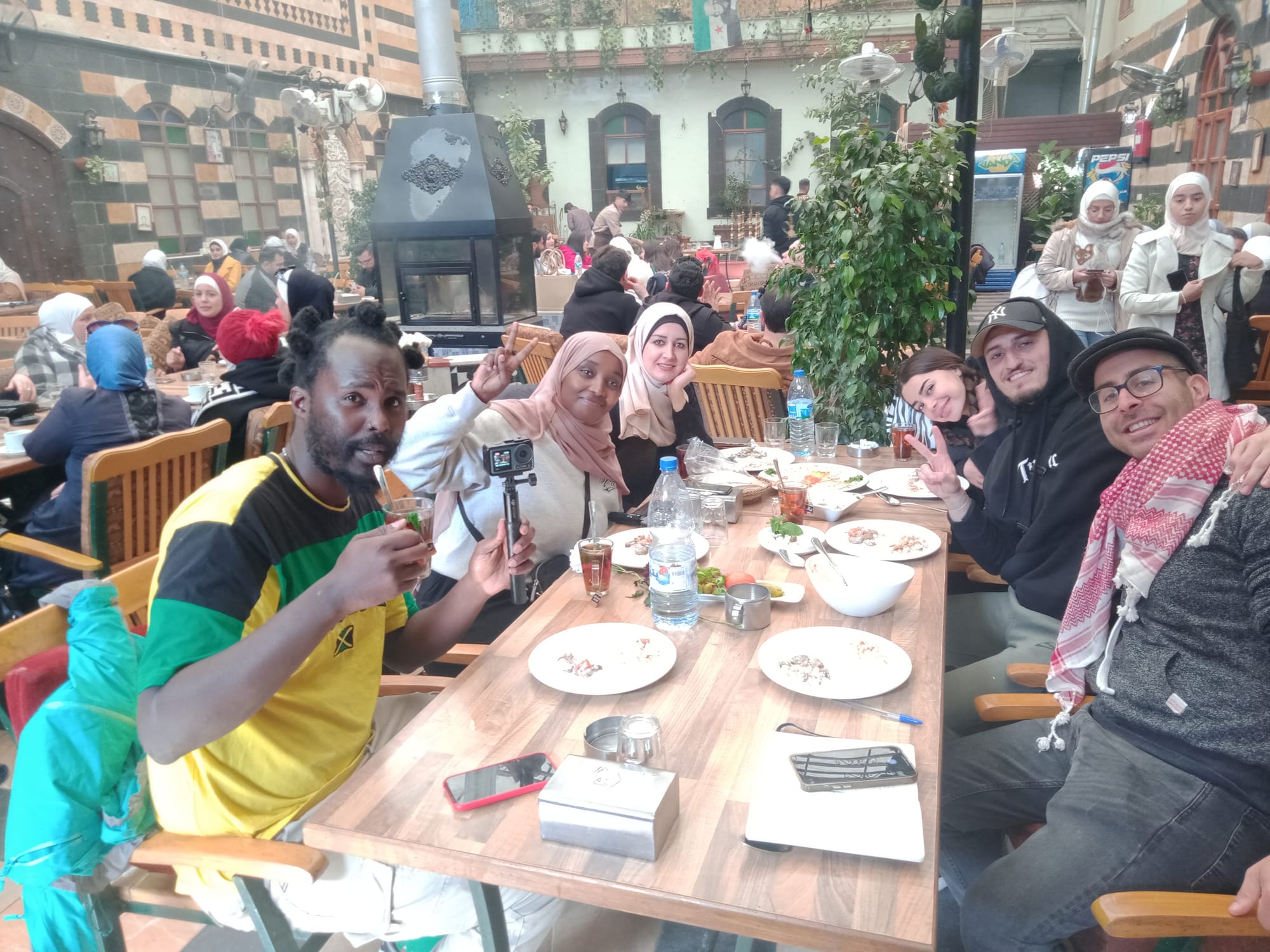
Wandering through one of Old Damascus’s many markets the next morning, I am accosted by three people with cameras. Two are travel vloggers; the other is Nagham, an experienced revolutionary from Daraa, a revolutionary city in Syria’s south. Keen to hear more about Daraa, I join them for lunch at a local restaurant.
On the wall as we enter is a large Free Syria flag and a picture of one of the revolution’s many martyrs—a small reminder of what has been lost and won in the past fourteen years. Before we can sit down, we’re hailed by a young couple, who insist we sit with them. As we order, a revolutionary song comes on the radio and everyone begins to sing.
The couple turns out to be young doctors from solidly middle-class families. Nour works in a public hospital, earning US$15 a month. “We never had any medicines, any syringes, nothing. We couldn’t even give our patients Panadol. They had to buy it themselves, and people just didn’t have the money”, she says.
Her hospital had a special wing, the Arabic translation of which is “room of the friends”. In it, fighters from Iran, Iraq and Lebanon (Hezbollah)—who were in Syria to crush the revolution and protect the Assad regime—enjoyed free treatment. Nour says that she once walked in and discovered that all the medical supplies that the rest of the hospital lacked were there in abundance. Now, she says, “the whole hospital has supplies”.
There are echoes of this story everywhere. While there is still enormous poverty, in central Damascus the markets are bustling. One man is at pains to explain the difference in the provision of bread: “Under Assad, we would have to line up for hours, and the bread was stale ... Now it’s more available and much better quality”. He says that the living standards in regime-held parts of the country were much poorer than those with greater freedoms.
They share more such stories. When the feared Sednaya prison was opened, many inmates came to her hospital for attention after years of torture and abuse. The medics did their best, but some of the patients’ problems were beyond their capabilities. “One man came in, he couldn’t speak. He kept repeating the name, ‘Bashar Al-Assad’, followed by ‘there are 44 bodies in the freezer’”, she says.
What is their vision for the future? After a pause, a young man, Abdullah, speaks up. “In my view, we need to go back to the old ways. We have so many different religions here; they all need to be treated with respect. The only way is through a Caliphate, as was written by the prophet”. He insists that this would still allow women their rights, and people could drink and smoke and so on as they chose. Nour, a trendy young woman who does not wear a hijab, seems to hesitate on that, but agrees that religion should play some role in the new state. Nagham seems to have other ideas, but the conversation moves on.
Islam is clearly a salient part of people’s identity. Perhaps more so now than before the revolution turned into a civil war in which the major players gradually became more influenced by Islamism, for a variety of reasons. But contradictions abound. Nour says that in the summer she wears crop tops even though some people don’t like it. Abdullah whispers that he doesn’t recommend going to Idlib because things are a bit extreme up there.
Later, I’m lining up to recharge my sim card. What do people in the queue think about the economy and how things should change? Wages need to go up—on that everyone agrees. But after years of government theft, many are content, for now at least, to be free from a system characterised by bribery and arbitrary taxation. I can see why that would seem a step forward after living under a totalitarian regime that, despite demanding endless payments, offered few public services.
All of this is just first impressions and first conversations. It would be silly at this point to draw conclusions about “what the Syrian people think” or make generalisations about class consciousness. Aside from Nagham, who promises to talk more seriously in Dar’aa (in coming days), none of the people I have spoken to have been politically active in recent years.
From a handful of Damascus residents, I get a sense that the fall of Assad was something that happened around them, not something they did themselves. After all, it’s been more than a decade since the height of the revolutionary mobilisations, which were crushed so brutally by Assad and his Iranian and Russian allies. Popular protest and democratic resistance survived in some places, but in Damascus, which the regime held, such things were almost impossible.
Nevertheless, and for now, people are revelling in Assad’s defeat. Who could blame them? After 54 years of a dynastic dictatorship, the Syrian people are enjoying their first taste of freedom. Everywhere, there are joyful expressions. A dragon has been slain. Or, as the people say, a donkey has gone. (Assad means “lion”. So, “donkey” ... you get it.)
“Finally, we can breathe”, my young companion in the taxi said. “Whatever comes next, nothing can be worse than Assad.”
“How lucky you are—how wonderful it is to have a liberated country”, replied the Lebanese woman in the front seat, heading to Syria for a New Year’s Eve party.
“Inshallah, one day it will be our turn.”
A GHOST TOWN
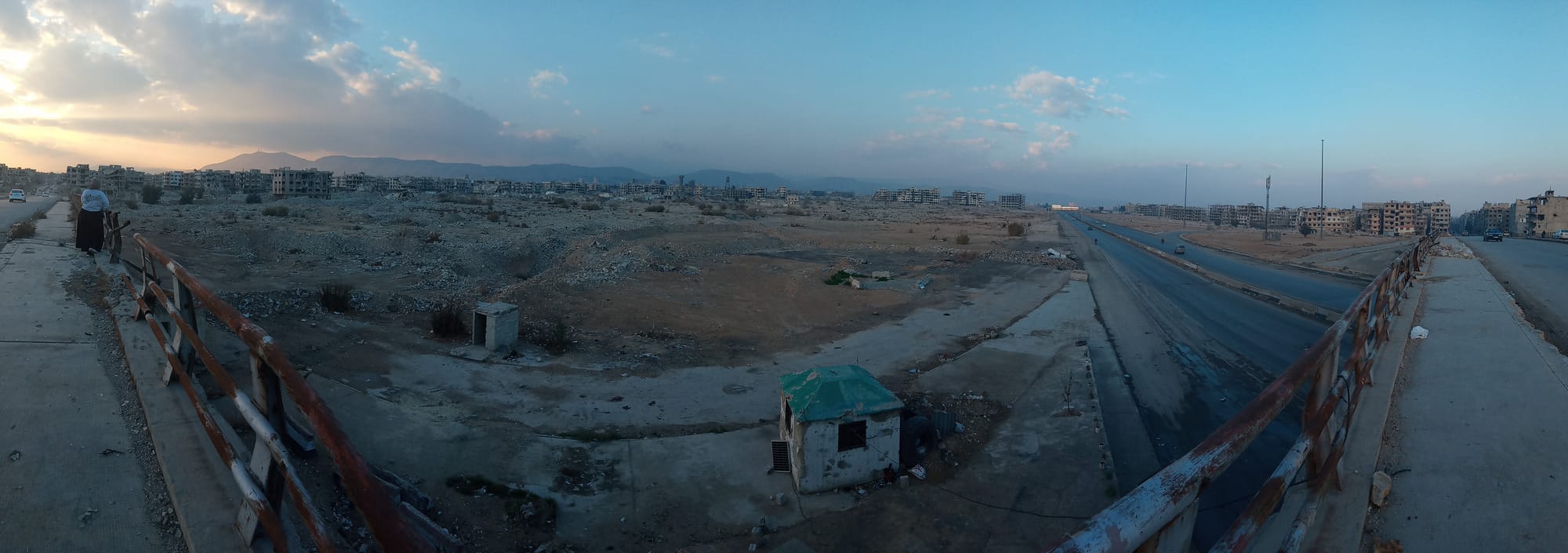
FRIDAY 3 JANUARY 2025 | Standing in the ruins of the Syrian suburb of Harasta is an experience like no other. This was a town of tens of thousands of people, a centre of life and commerce in a region known as Damascus’s breadbasket. It’s now mostly rubble.
Many of the apartment buildings are totally demolished, collapsed in on themselves under the weight of years of bombardment from Syrian and Russian forces. Those that remain standing intact are mere shells—broken concrete facades, all the windows and doors shot out, the steel rods used to strengthen the concrete exposed everywhere. Every block as far as the eye can see is like this, barely standing buildings and mounds of debris and garbage.
Harasta feels like a ghost town, with most buildings emptied of all life. Every now and again you see the odd sign of life, a family that has nowhere else to go. Their determination to go on living evident in their attempt to turn these broken buildings into a home, plugging holes with cardboard and bricks. Passing through this area does something to one’s soul; standing on the shattered streets I feel rage, disbelief and tears welling up in turns.
Jobar, gateway to the eastern Ghouta, near Damascus CREDIT: Omar Hassan
Yet for those that have been forced to eke out an existence here, the situation is far worse than we can ever imagine. For them, this isn’t simply a landscape of anonymous destruction. It is the place where they grew up, played soccer in the streets, messed about in school. Where they first found love, visited their cousins on weekends, and raised their children. They are living in the ashes of a life and community that has been obliterated and scattered to the four winds. I pity the children growing up in this place, who will think this devastation is somehow normal.
We park the car and approach some locals to talk. They warn us about an unexploded Russian bomb less than two metres from where we stand. “They flattened this whole area”, one man says bitterly, “but some of their bombs didn’t explode. Later, Russians soldiers came through and instead of removing them, they just put up posters warning us not to step there. But these were our homes, and those of our neighbours”. The hatred etched on this man’s face is overwhelming in its purity.
In the distance, we see a few old men picking something from the ground, carrying huge sacks on their back. “Firewood”, explains our driver. “They either use it to stay warm themselves or sell it to buy food.” He doesn’t say more, but his words can’t hide the shame of living in a country where men old enough to be grandparents must do such things to survive.
One of my companions points out that this is what Gaza must feel like. The comparison is apt. Indeed, Assad killed at least 500,000 people, more than Israel has managed. These scenes are replicated around the country, usually in working-class and poor areas.
Harasta itself is just one small part of a wider zone of annihilation that stretches for kilometres around the eastern outskirts of Damascus. These were one of the heartlands of the revolution, a place where mass protests and demonstrations flourished, where rank-and-file soldiers, forcibly conscripted according to the rules of the country, decided that they could not fire on their friends and families, and so mutinied to form a branch of the Free Syrian Army.
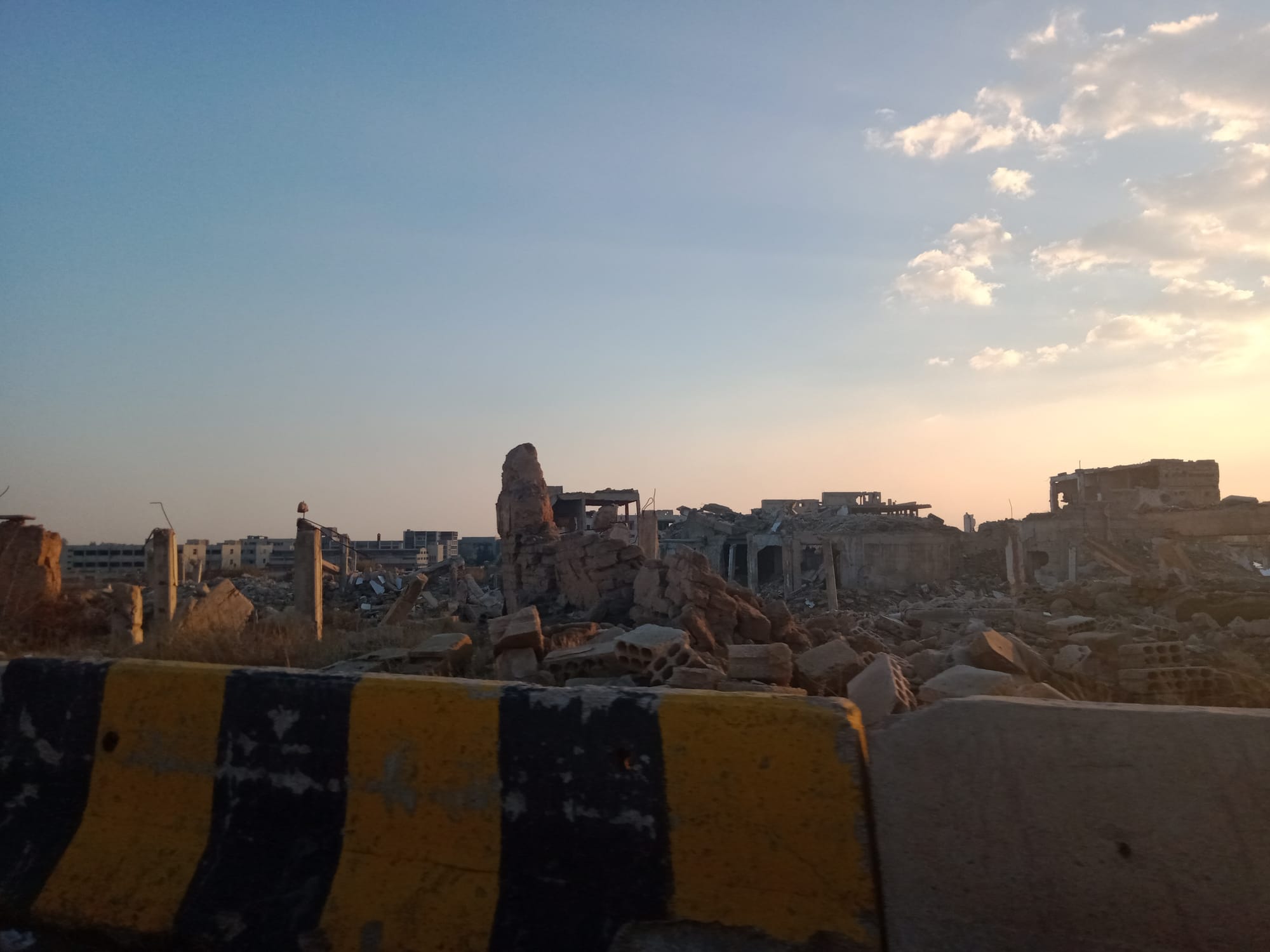
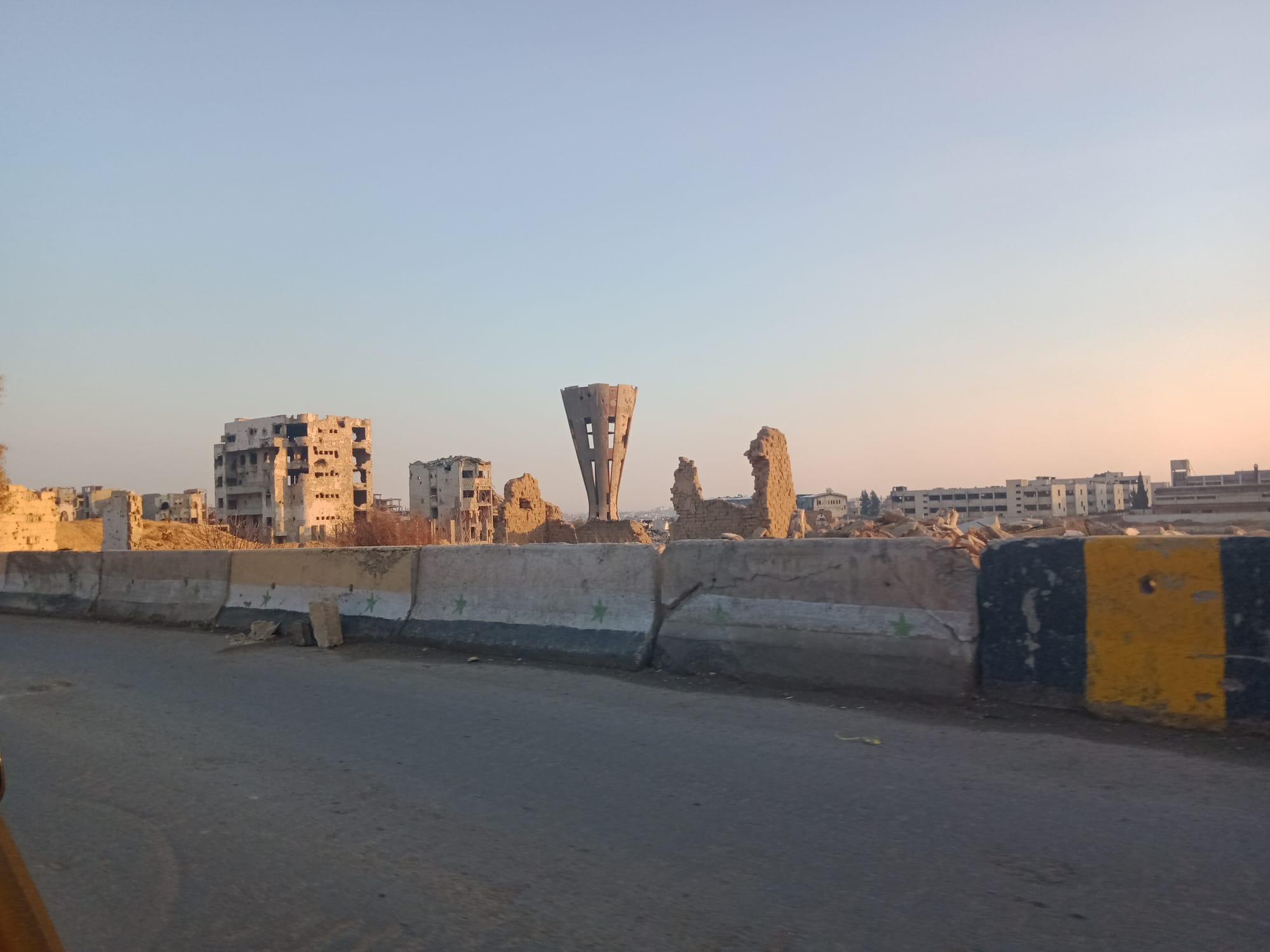
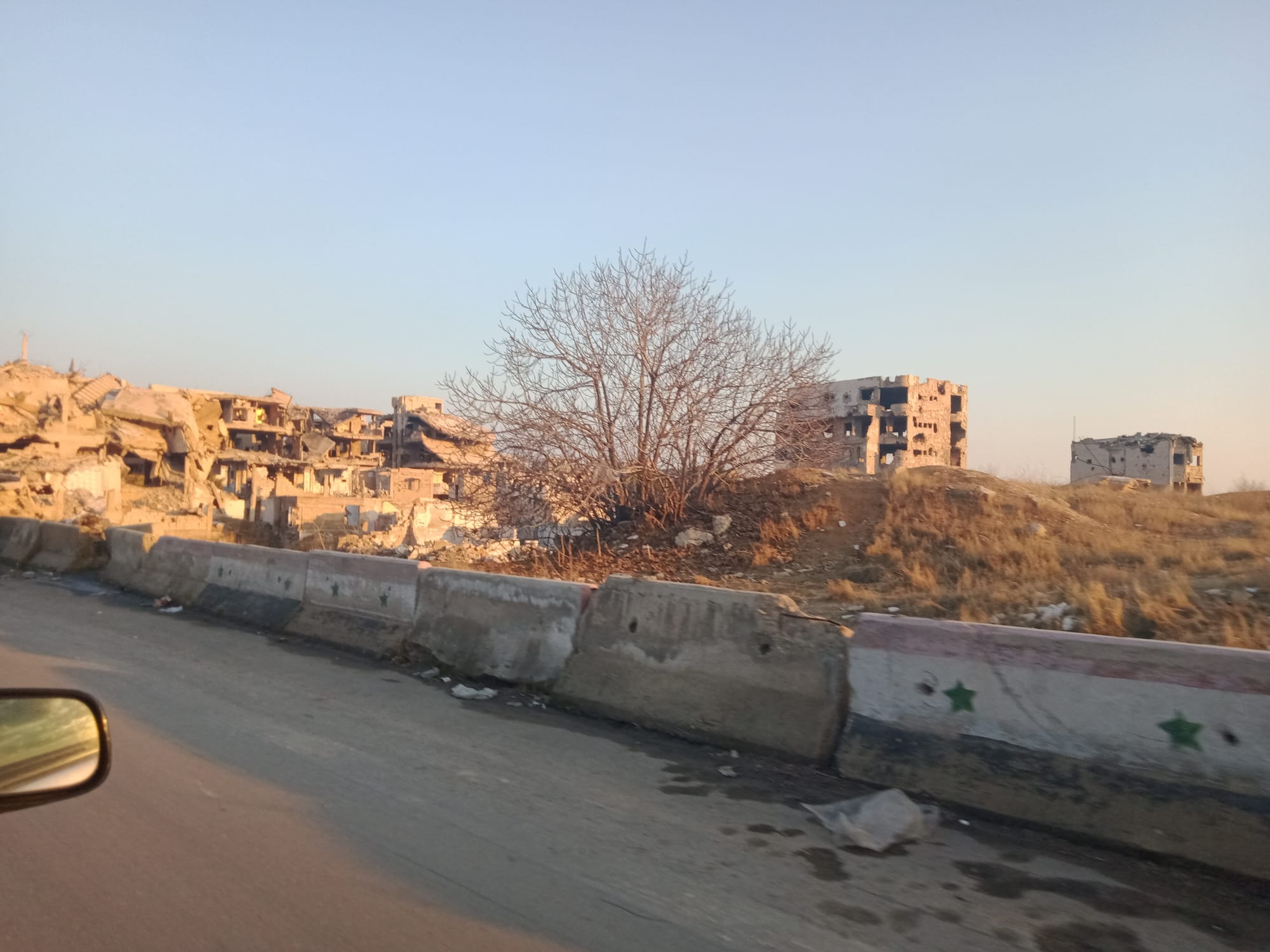
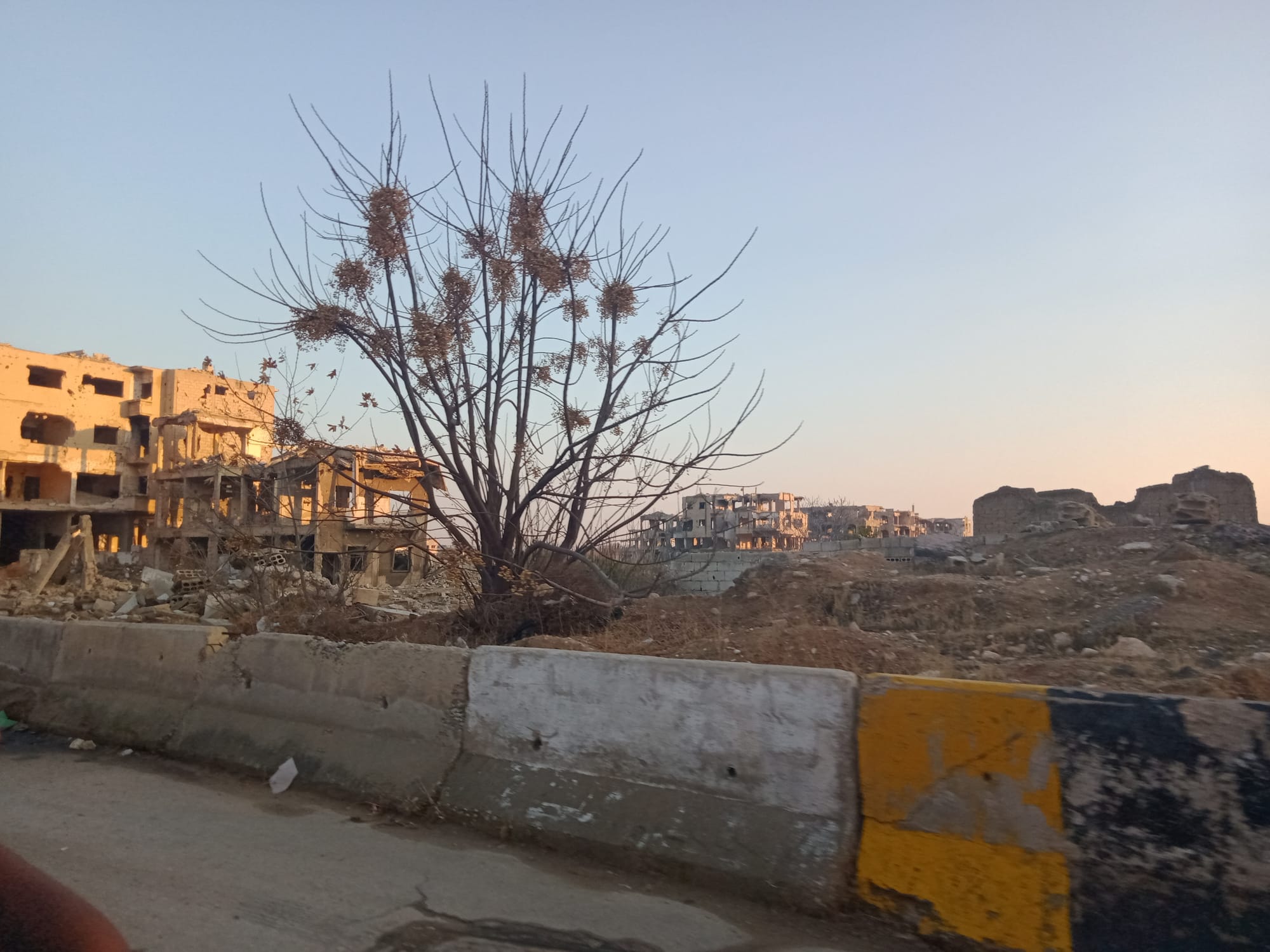
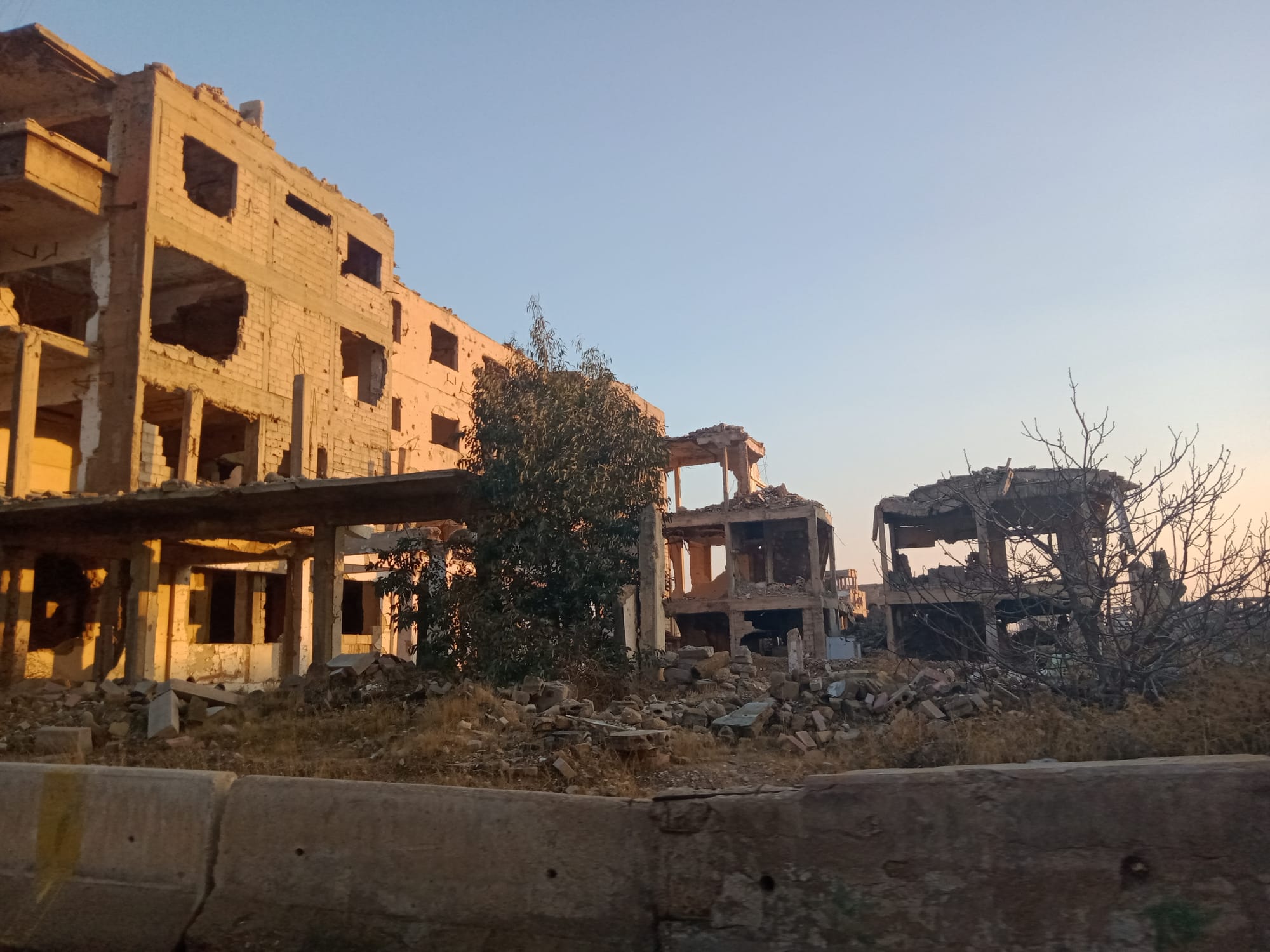
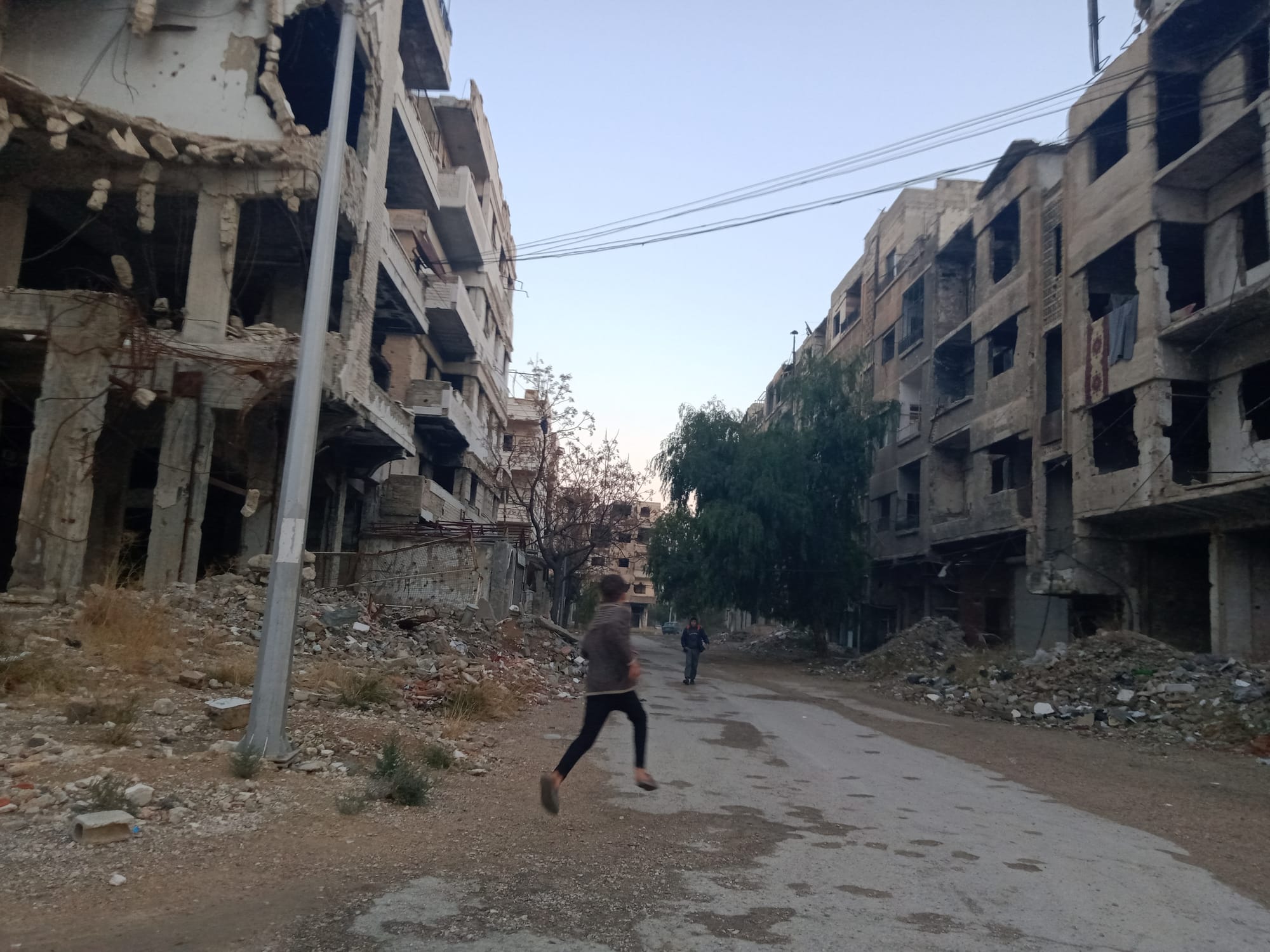
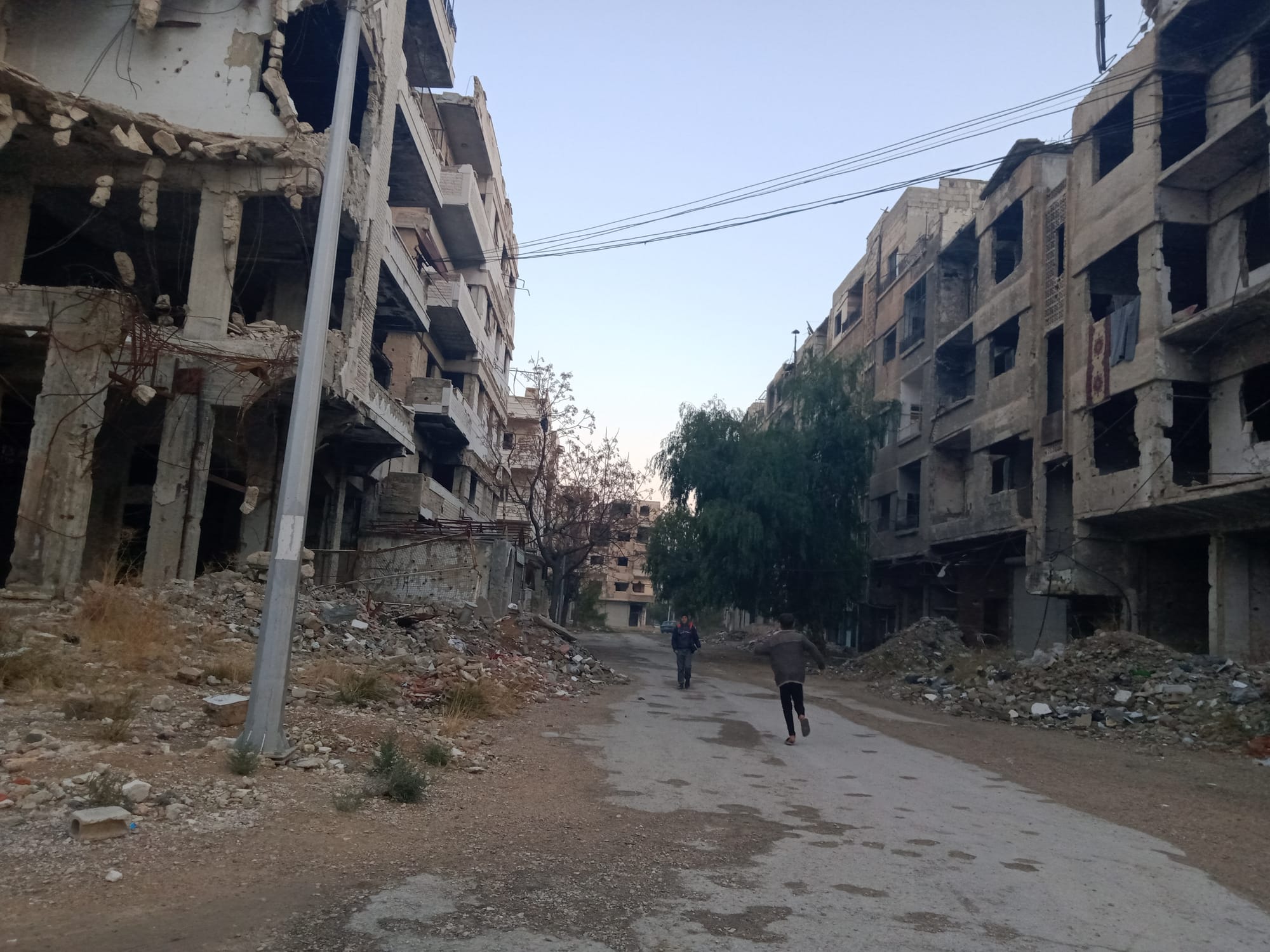
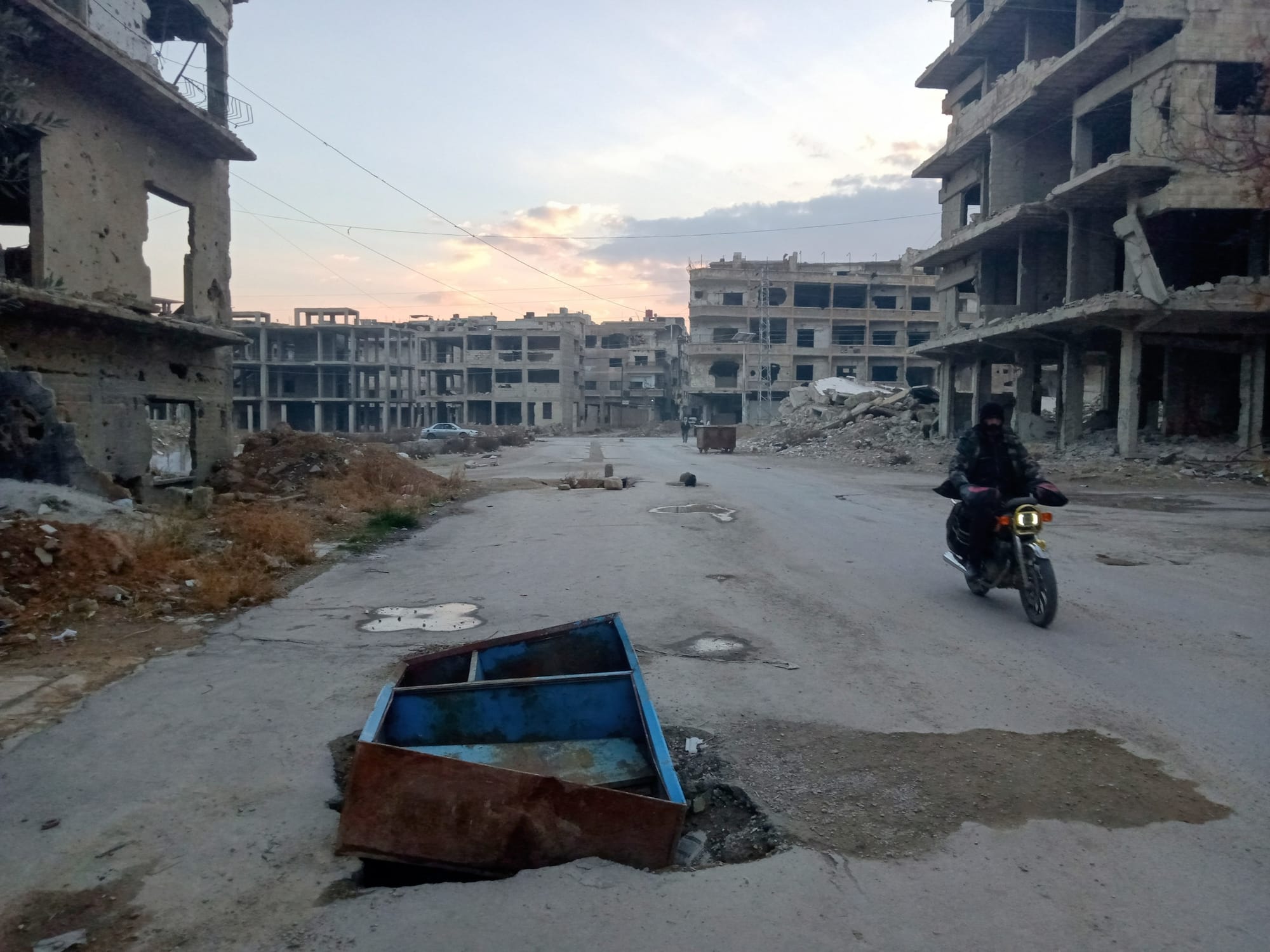
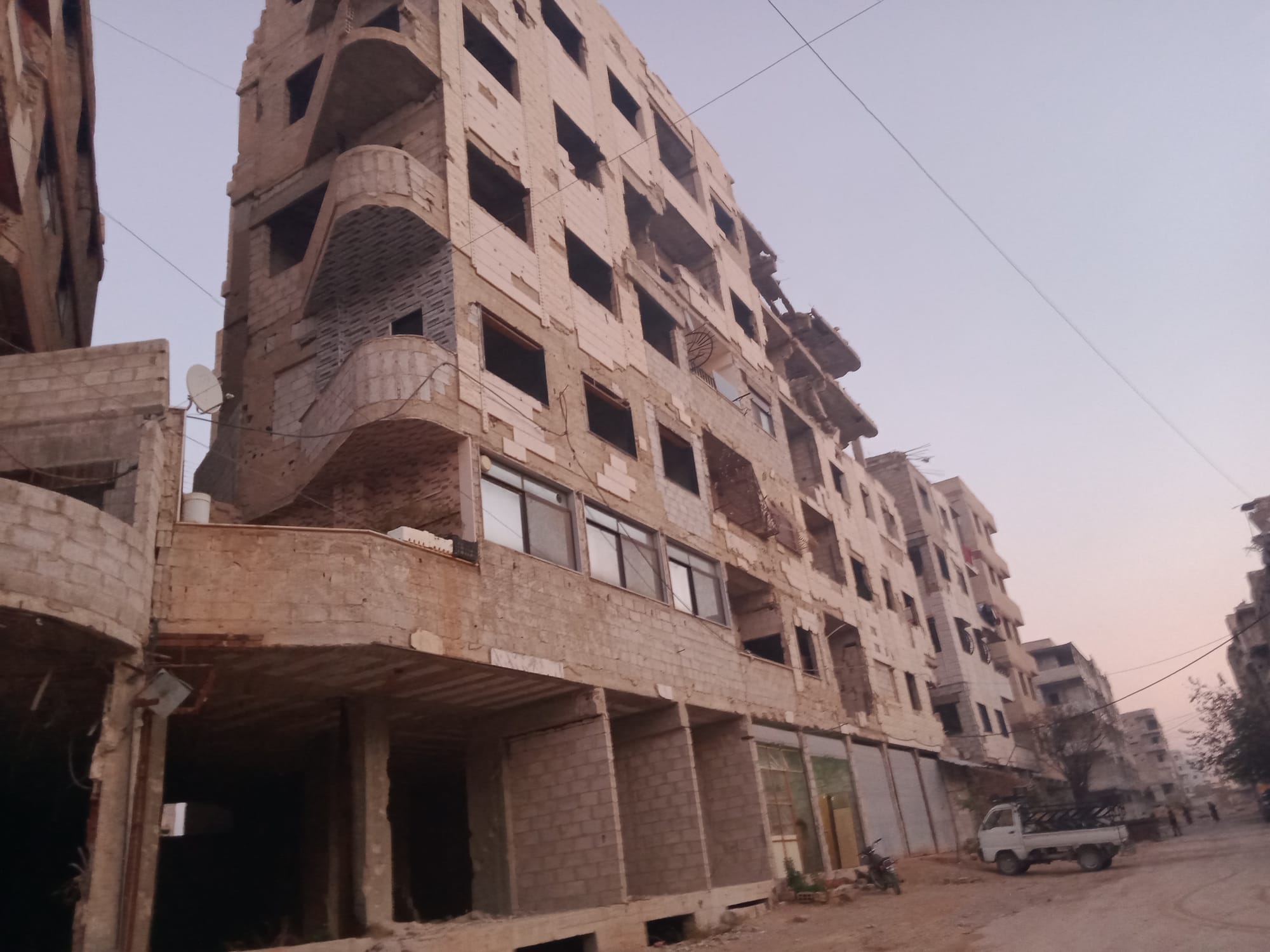
More of the devastation in Harasta, north-eastern Damascus CREDIT: Omar Hassan
It took the government roughly seven years to finally wrest this land from the people who loved and defended it. Some areas were fought over multiple times, with the regime capturing them, only to be driven back again, and so on. Eventually, the government enforced a harsh siege that lasted for almost five years.
By 2016, around 400,000 people were trapped in the area, starved of food and water by Assad’s armies. When that failed, they decided to use chemical weapons, killing 70 people including many children, and sending hundreds more to hospital.
Eventually, a deal was reached in 2018, and well over 100,000 people were shuttled up to Idlib in the buses normally used for public transport. (To this day, some Damascenes boycott these buses in solidarity.) It was a terrible defeat, symbolising a moment that marked the nadir of the heroic struggle to free Syria.
There was no upside to being reincorporated into government-held territory. Reconstruction efforts were banned in the area, a reminder of what happens when you do not accept your position as a slave. Food remained scarce, the infrastructure non-existent.
In one strip, there are huge holes in the road, large enough to fit a car. A local man, who does not wish to identify himself for fear of retribution, explains that the government wanted to redirect the water supply. When they didn’t find what they were looking for, they just moved on and left these cavernous holes in the street. But there are no lights or electricity here, so cars and bikes kept falling in. They found an old bookshelf and used it to cover the hole. “They didn’t care about us”, he says. “They only cared about themselves. So we had to fix the problems.”
He’s hopeful about the future, but cautious. “The new guys seem to be different, treating people with respect”, he says. “Inshallah.”
It’s now dark and freezing cold, so we decide to head back to Damascus. While others chat among themselves, I’m genuinely unable to participate, moved to silence by the sheer barbarity of the capitalist system and those who defend it.
Campfires dot the highway, families huddling close together, trying in vain to keep warm on a terrible winter’s night.
AN ENCOUNTER WITH THE LEFT IN DAMASCUS
SATURDAY 4 JANUARY 2025 | “This revolution is just getting started”, says Fadi, a man in his late 50s, standing on the steps of the Syrian Ministry of Education. “We have to keep pushing forward. It’s not over until everyone has their rights cemented”. I’m with about 50 Syrians, who are protesting against a move by the new government, led by Hay’at Tahrir al-Sham (HTS), to shift the school curriculum towards a sectarian and conservative Islamist worldview.
Everyone agrees that the pro-Assad propaganda that saturates the textbooks needs to be removed. But the proposed reforms go further: eliminating lessons on evolution and the Big Bang theory, abolishing all negative references to the Ottoman Empire, and removing all mention of the various polytheistic communities in Syria’s history. The changes would also teach students in primary school that Christians and Jews are “those who have lost their way” from Islam.
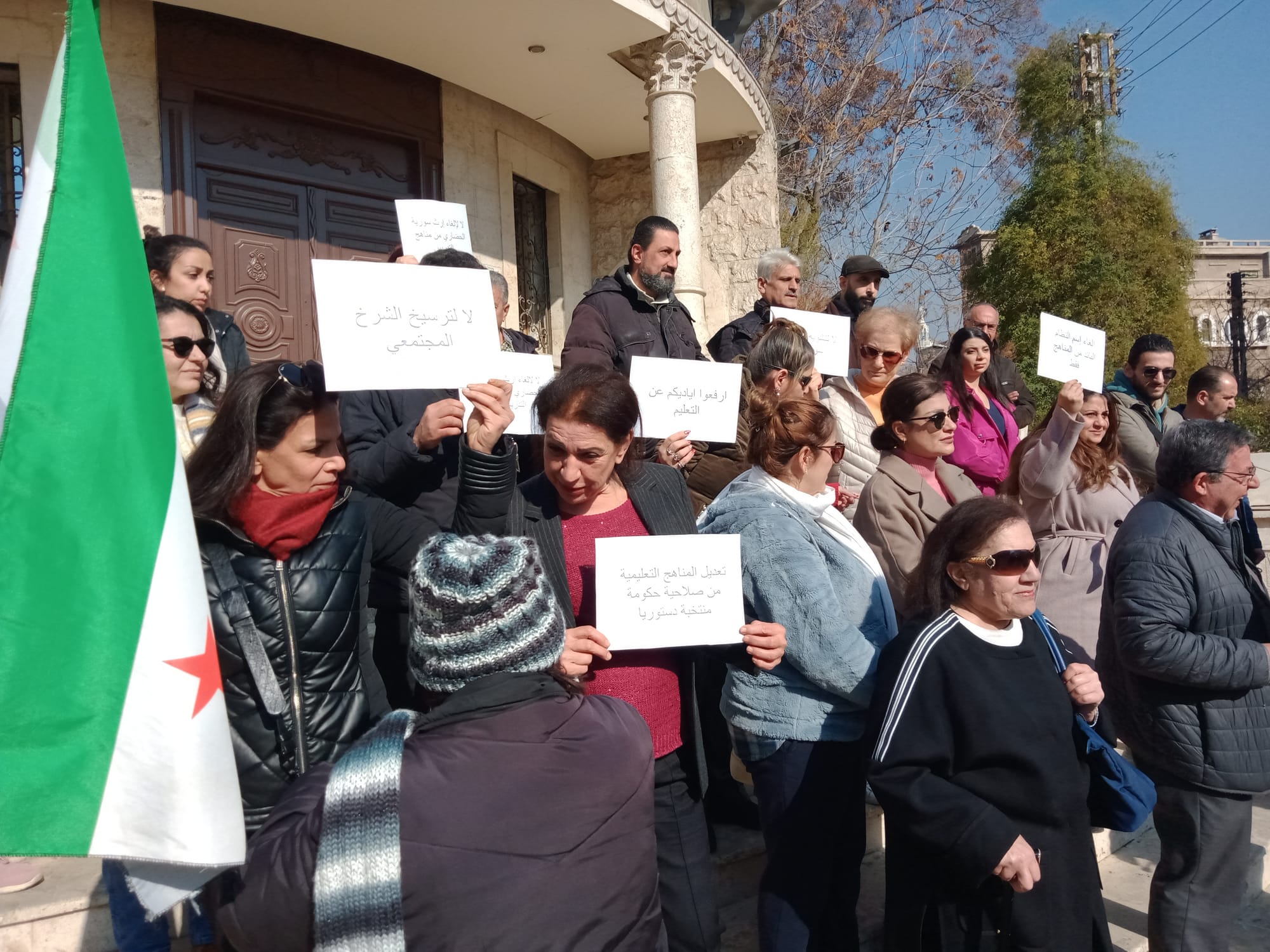
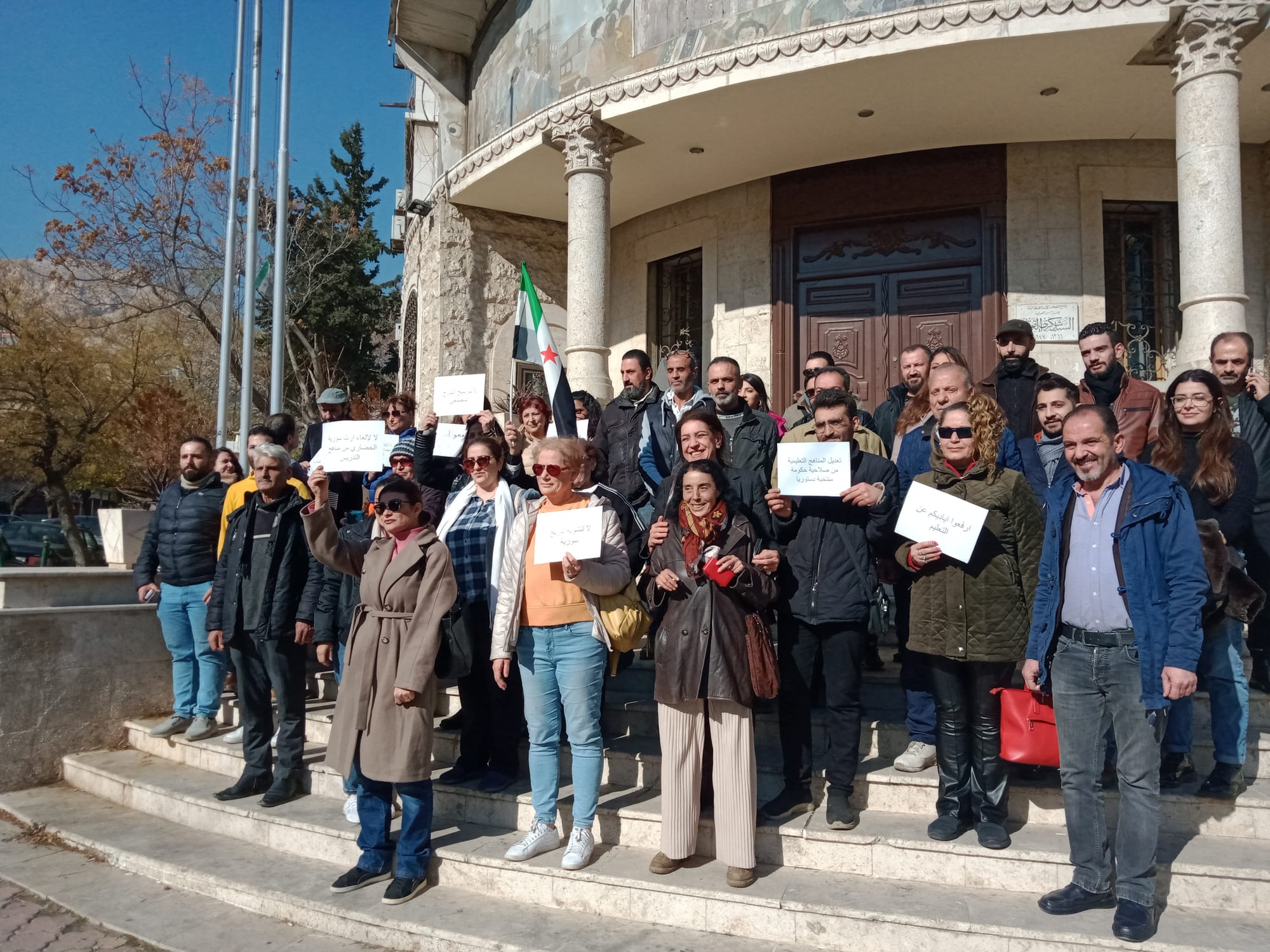
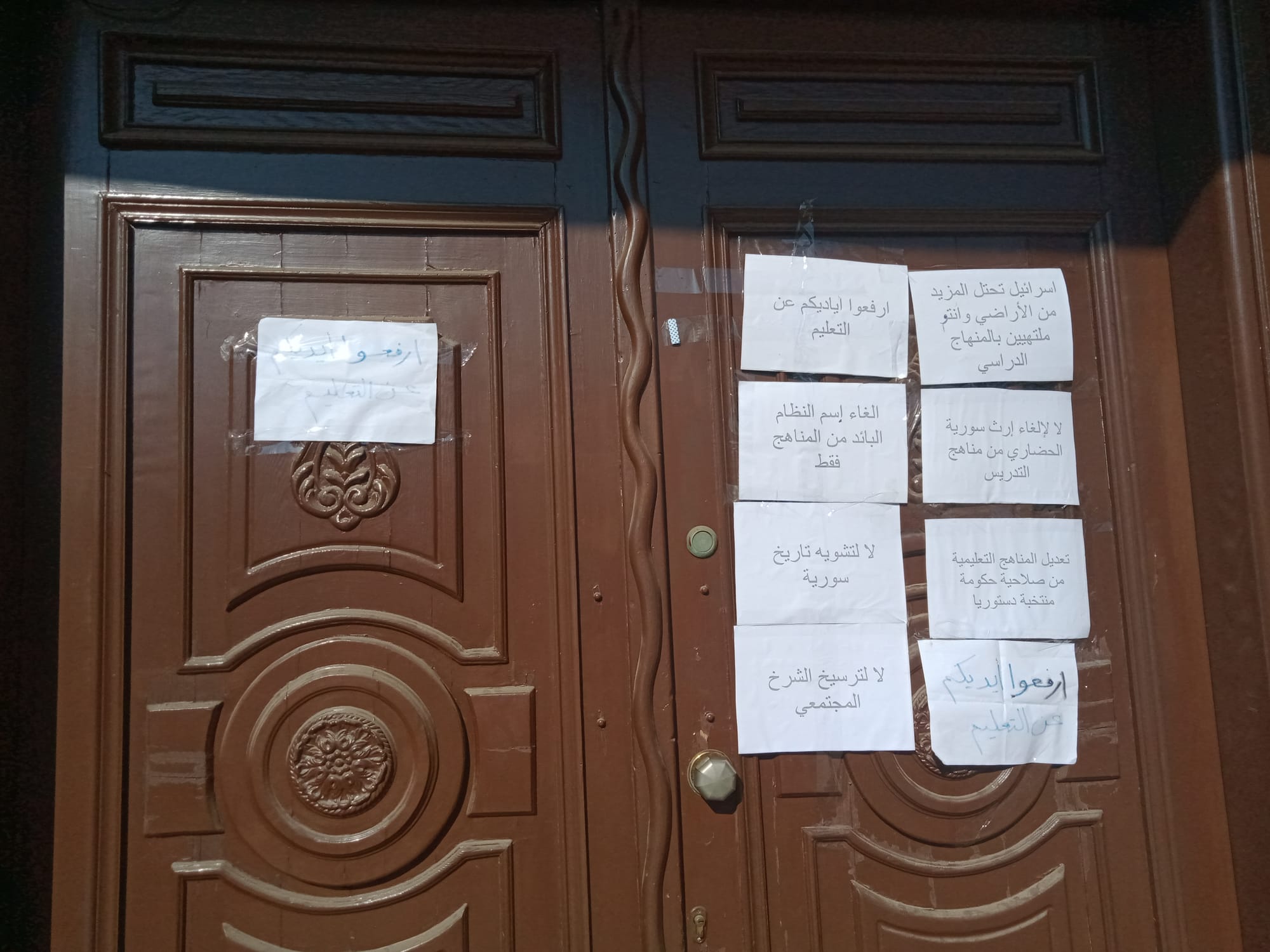
Leftists protest against education changes proposed by the new government led by Hay’at Tahrir al-Sham, Damascus CREDIT: Omar Hassan
The decree was immediately rejected loudly by many, many Syrians. So much so that the government was forced to walk back the changes even before the demonstration today, which meant it was fairly small. But it was an important gathering nonetheless. For one thing, there were lots of media present, giving left-wing activists a rare opportunity to make their voices heard to the Syrian people about their vision of an inclusive and just society for all.
More important, however, was the chance for progressive activists to meet each other and share ideas and plans for the future. There were two types of people present. Many were veterans of the underground, aged 60 or more, some having served lengthy jail sentences for their brave efforts.
“I was an oppositionist against the dad [Hafez al-Assad], I was an oppositionist against the son [Bashar], and I’m an oppositionist today”, says a charismatic older man, who eventually outs himself as a member of the Communist Labor Party. I’m introduced to Haseeba Abdulrahman, an independent socialist and feminist writer, who concurs: “We haven’t won anything yet, we need a stronger left, serious political parties to cement our gains and push for more”.
There was a good number of younger radicals who had been active in the early days of the revolution in 2011, and had been waiting desperately for a chance to take to the streets once again. “We were there from the start, and even in the last years there’s been some organising happening underground”, says Dima, a speech pathologist in Damascus.
I ask them what they think of those who say to be patient, to give the new government time. Tarek, a computer engineer, interjects forcefully: “How can we give them more time? They sat down for two hours this week and produced this terrible reform of the education system. If we leave them alone, what damage will they do tomorrow?! The first responsibility of a citizen is to hold their government to account”.
Dima jumps back in: “We’re not seeing different methods of operating from the last regime; they change the policy and we’re just expected to just accept it. Where’s the participation, where’s the democratic Syria we’ve been promised?”
These guys are impressive, but they’re in their 30s and early 40s. When I ask about the lack of representation from students and youth, it was put to me that their generation were too young to have experienced the revolutionary era, and so are less politically engaged. Presumably, the winter holidays don’t help either.
In any case, it’s been less than a month since Assad fell, and people are still finding their feet. Still, there’s been an explosion of political meetings and actions. At the same time as the education protest, a group of former prisoners was rallying to demand justice for those who tortured them in prison. Every day, there are meetings and actions organised by socialists, feminists, liberal NGOs, artists, the families of those who were disappeared in Assad’s prison system, and more.
It’s not all fun and games. At times, the efforts of this emerging left have been widely criticised and condemned. Partly, this can be due to sincere misunderstandings about their goals because many associate the concepts of secularism and socialism with the old regime. But there’s something more cynical at play too—a serious effort by HTS supporters to discredit any opposition as feloul (“remnants” of the old regime). Dima laughs when I point that out: “No way, it’s the exact opposite. People I know who were total sucks for Assad are now some of the biggest supporters of HTS”.
Halla, a member of Syria’s Revolutionary Left Current (RLC), made a related point when we met for coffee yesterday. “They call us the feloul, but actually, HTS has incorporated a number of figures from the old regime.” This is particularly the case when it comes to economic policy: the new governor of the central bank was the deputy under Assad.
Other leading figures from Assad’s economic team, known for privatising everything and cutting as many subsidies as possible, are being tapped to play important roles. HTS is doing this to signal its commitment to playing by the rules of the capitalist system. Halla also explains how, across the country, a number of former regime figures and bureaucrats have flipped their loyalties to HTS, including the top leadership of many trade and student unions.
It’s early days, but some have already begun organising against the new power. Firefighters in Damascus struck after being sacked and replaced with people from Idlib, winning a promise to be re-employed later. The lawyers’ union has come under attack after Damascene lawyers were indefinitely barred from working, and there’s now talk of establishing an independent union. The reopening of schools and universities in a few weeks could also create new possibilities for resistance.
At the end of the education rally, someone makes an announcement about an organising meeting scheduled for later that day, the second meeting of a new group called the Syrian Democratic Movement. It takes place in a cavernous cafe that I’m told is an historic haunt of the left. We walk past a classic scene of wizened old men playing cards and backgammon, and take our places in the room beyond. One man, who I subsequently learned has spent sixteen years in one of Assad’s dungeons, set the scene beautifully: “Comrades, we are living through a historic moment and we have a golden opportunity to shape our country’s future. Let’s work seriously”.
What follows is both familiar and extraordinary, as 55 people thrash out a program on which to build a progressive front to intervene in Syrian politics. There’s inevitably a bit of debate about secondary and semantic issues. But everyone is dead serious about trying to make this work and establishing the group on solid political foundations. There is broad consensus about emphasising women’s rights, opposing Israel’s occupation of Syrian land and working towards involving more youth in the movement.
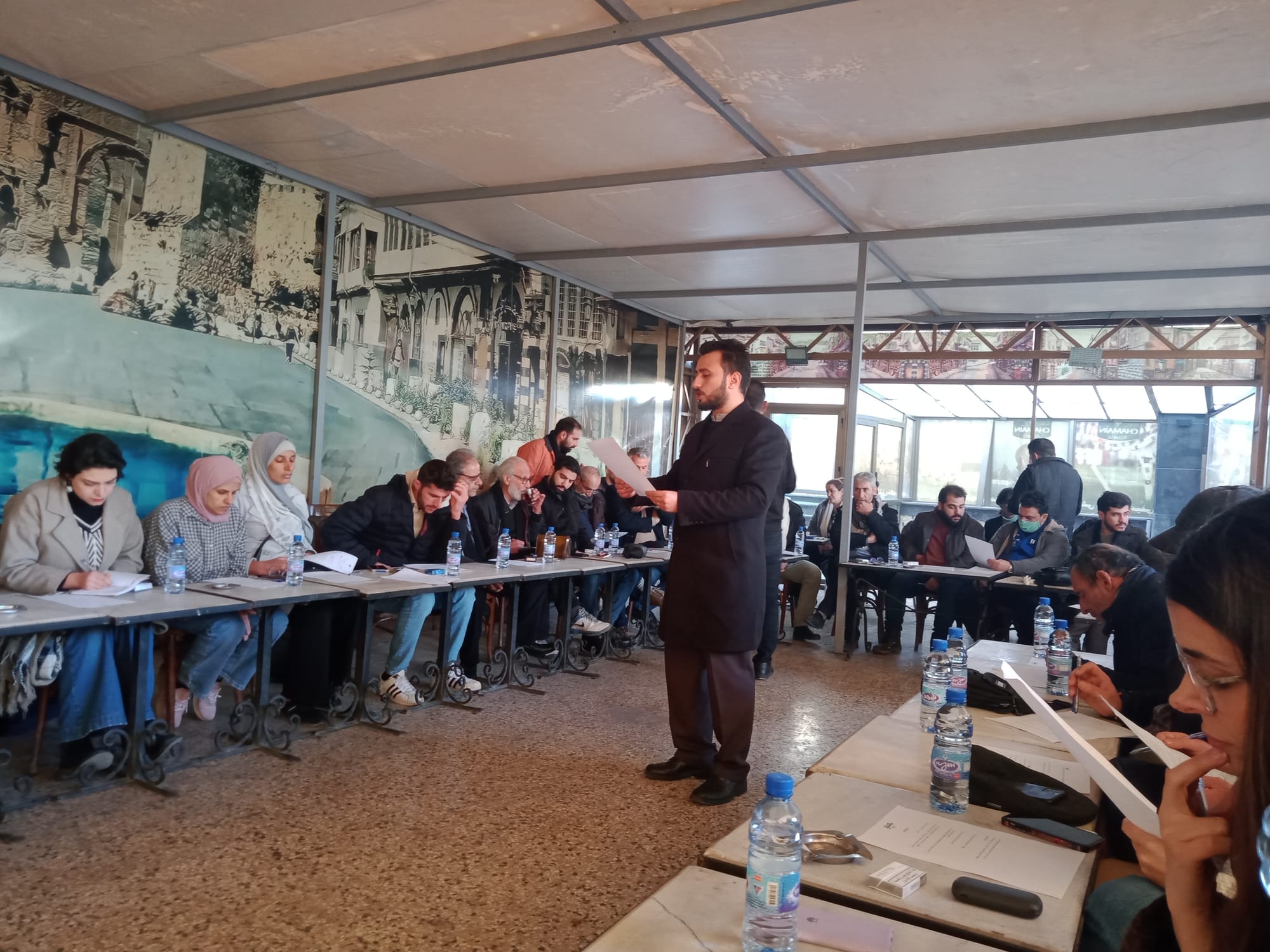
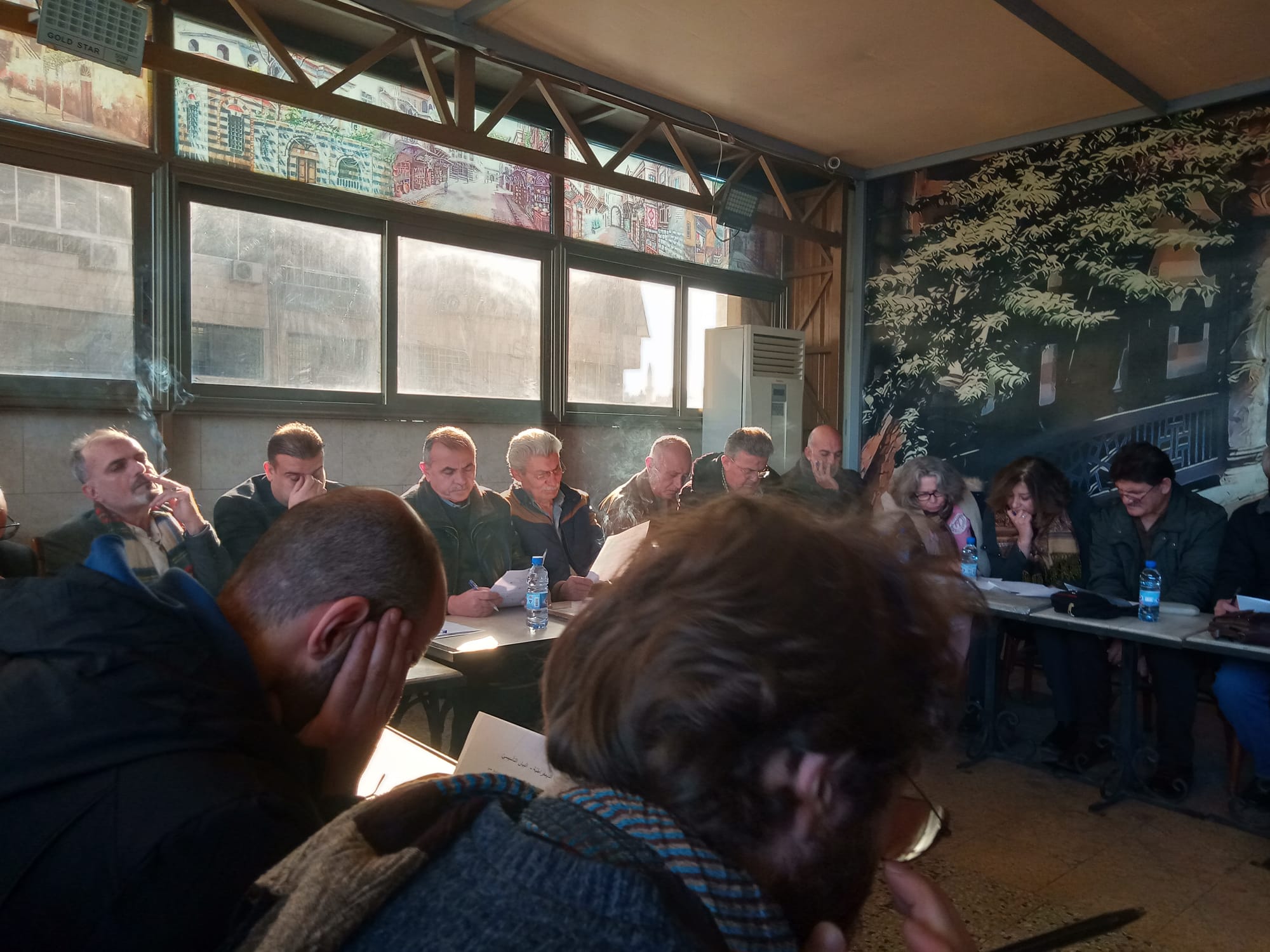
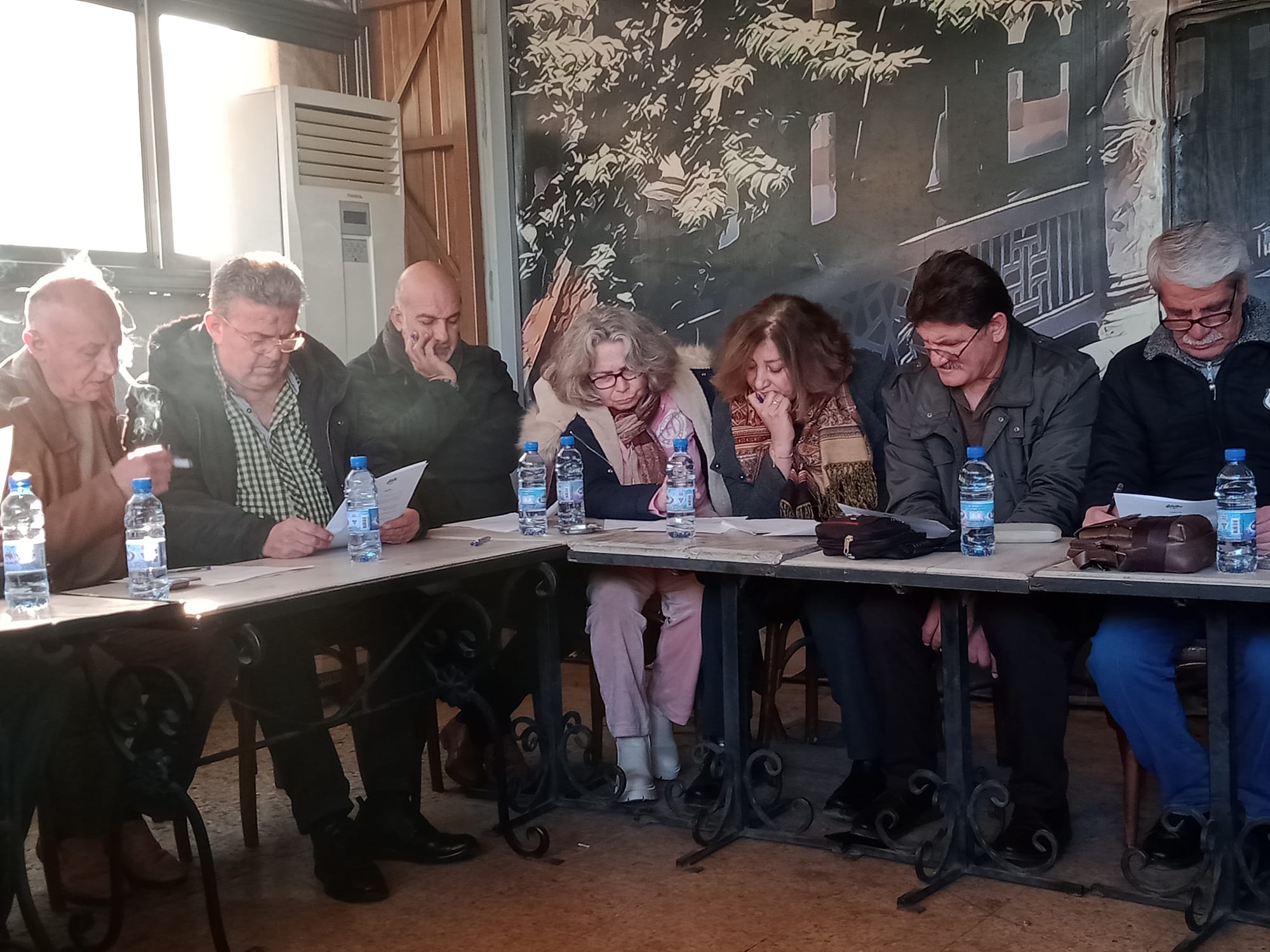
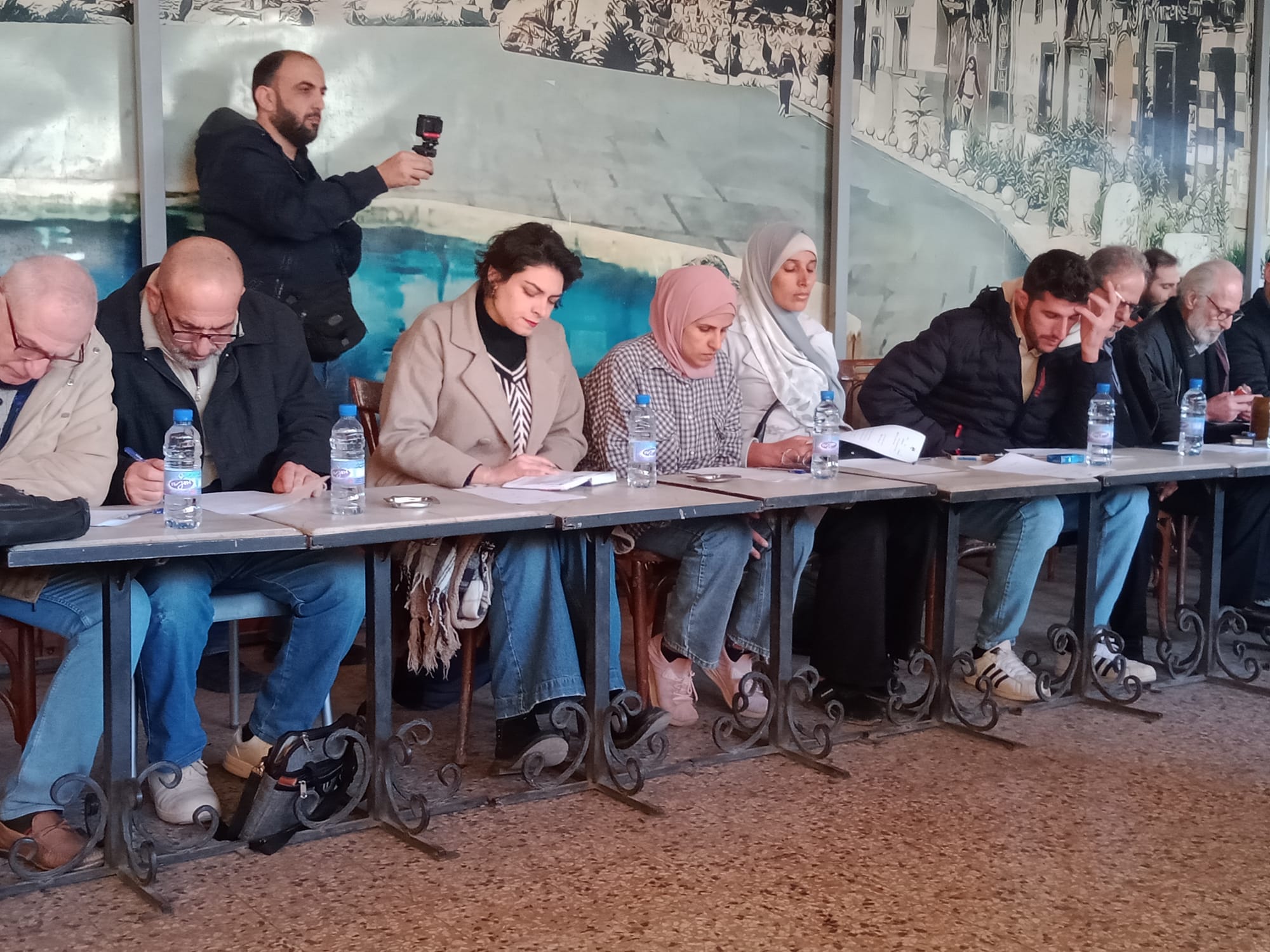
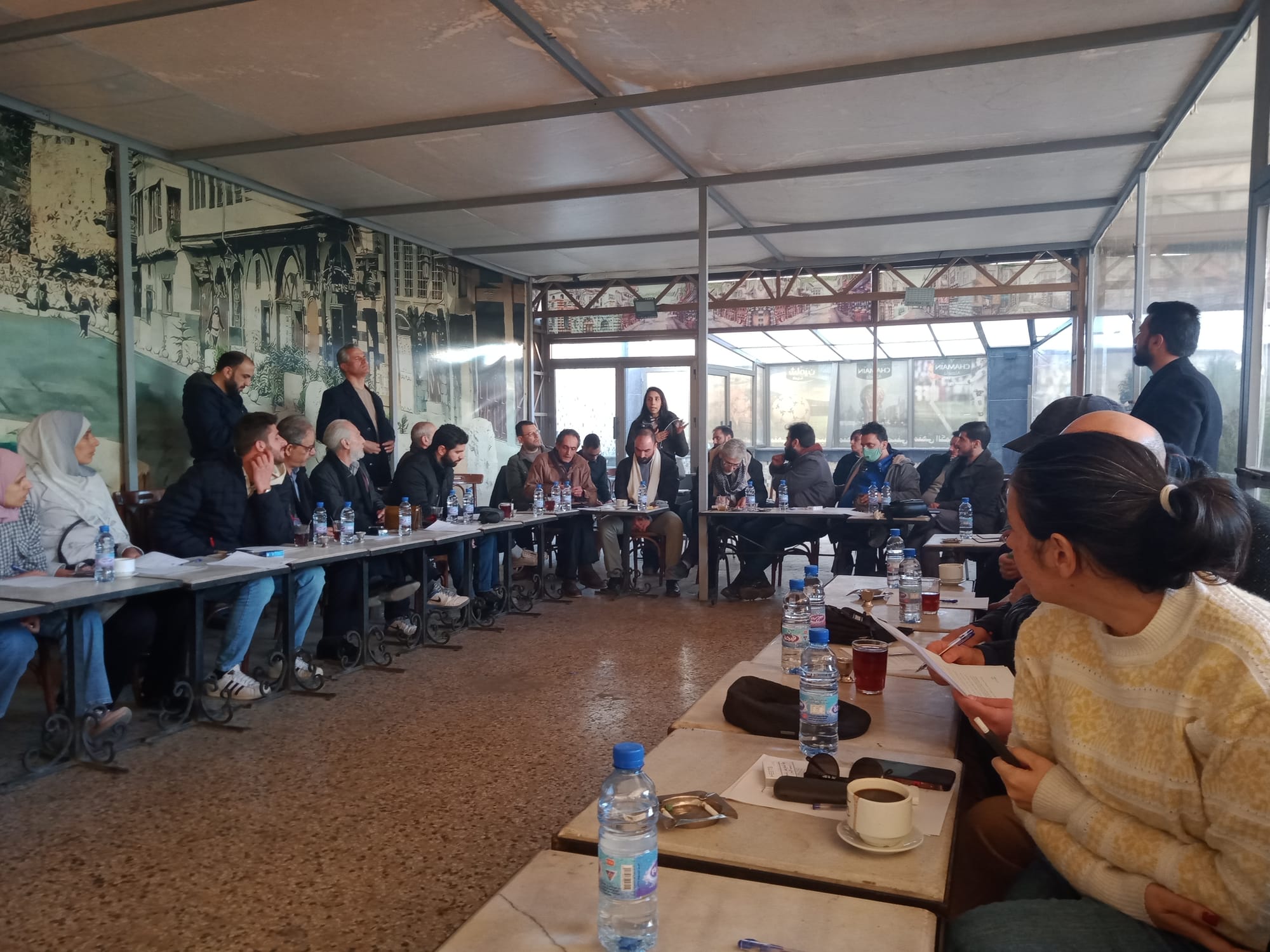
The second meeting of the newly-formed Syrian Democratic Movement CREDIT: Omar Hassan
Abdullah, an older man who translated Germaine Greer’s The Female Eunuch into Arabic, pipes up about the need to add a section about Kurdish rights, given the ongoing attacks against them by Turkish-aligned militias. He gets some support, especially from the RLC, but it doesn’t seem unanimous. There’s a long history of chauvinism towards Kurds in Syria, and evidently there’s still work to be done on that front.
If there was something missing from the conversation, it was a focus on economic grievances. Halla had warned me previously of the danger of the left being pigeonholed merely as spokespeople for minorities. “Of course we have to defend their rights, but we also need to speak in universal terms, to push economic demands that can appeal to workers from all religious groups”. Given that Human Rights Watch reported that over 90 percent of Syrians lived below the poverty line as of late 2023, I can’t help but agree.
Still, it is a wonderful experience to sit in a room with people experimenting with open democratic organising for the first time. There is something a bit magical about the golden light coming through the windows, the haze produced by the widespread chain-smoking, and the passion of comrades speaking their minds, constructing an important collective platform, out in the open, after 54 years of dictatorship.
Tomorrow’s schedule of events includes a public meeting by the RLC arguing that removing the head of a regime is by no means enough to guarantee permanent, progressive change. In a totally different part of town, there’s a lecture being held on Syria’s economic future featuring well-known oppositionist intellectuals, and a documentary screening about the life and activism of Syrian dissident Yassin al Haj Saleh. And that’s just what I’ve gotten wind of. Presumably, there’s much more.
There will definitely be huge challenges and many debates ahead, but the left has well and truly entered the battle for Syria’s future.
LEFTISTS CONTINUE TO ORGANISE
MONDAY 6 JANUARY 2025 | “Field executions and random killings [have become] a daily occurrence. Among the most affected areas, the provinces of Hama and Homs were at the forefront of these crimes ... followed by the Syrian coast, particularly in Latakia and Tartous.” These chilling lines are taken from a bulletin by the Syrian Observatory for Human Rights released on 3 January.
It’s a stark reminder that the situation in Damascus, where stability reigns and the right to protest and gather peacefully is fairly unchallenged, is not the experience of all Syrians at this time.
Footage and reports from a four-day siege of the town of Khirbet Al-Ma’azzah went viral in the days before Christmas. Hay’at Tahrir al-Sham (HTS) had subjected its people to daily searches, harassment and interrogations. It was eventually lifted, but only after an entirely apolitical employee of the state electricity company was found shot dead in his house.
Meanwhile, in Homs, residents have been subjected to door-to-door searches by armed HTS militants. The most terrifying rumours about what was going on quickly spread, some of which were confirmed in a definitive statement released by the Homs Civil Peace group. In careful and nuanced language, they accepted the principle of the operation, which is to arrest and punish senior figures from the Assad regime, but condemned its heavy-handed approach.
They described incidents of arbitrary destruction of property, physical and verbal assaults of civilians, forcing people to bark like dogs, harassment of some women found not wearing the hijab, arrests conducted without explanation or chance for appeal, and the deployment of tanks in civilian areas.
Stories of these outrages spread throughout Syria primarily via Facebook, which I’ve noticed is not hobbled by the same censorship that has driven English-speaking activists to other platforms. Posts written in Arabic routinely receive hundreds if not thousands of reactions, followed by furious debate in the comment section.
At times, these debates can fall into sectarian patterns and discourses. Syria has vast regional variations in economic conditions, ethnic and religious compositions, languages and accents. The old regime expertly pitted groups against each other to expand its profits and power.
For instance, it is widely understood, both externally and within Syria itself, that the Assad dynasty was a sectarian Alawi operation. There is an element of truth to that, as many key posts in the state and public institutions were given to fellow members of the Assad family and those from its community. This then tended to cascade down in the form of nepotistic hiring practices and so on, which in turn led to hostility from other communities towards the Alawi.
While the top leaders of the transitional government have been careful to avoid saying anything explicitly bigoted, their cadres and supporters have been less restrained. Calls to “cleanse” Syria of supporters of the former regime can sometimes be code for wider attacks on the Alawi community.
But Nour, a young comrade from the Syrian Revolutionary Left Current (RLC), has a different perspective: “People talk as if the Assad regime was defined by its sectarianism, but that’s wrong; its only religious commitment was to wealth”. This is an important point. Assad’s most consistent supporters were the largely Sunni bourgeoisie of Damascus. There are huge economic, social and political divisions within the Alawi community, as with all others. A number of courageous efforts were made to organise resistance to the regime by Alawis themselves, and the left is filled with figures from that community who rejected the regime for the same reasons as everyone else.
She made these comments at a public meeting of RLC, in the relatively clean-cut Damascus suburb of Sahnaya. It was a young and dynamic crowd, with women a slight majority of the 35 people present. Nour kicked off proceedings, explaining that it was the first public meeting the group had held since the fall of the regime. The meeting was held in the back room of a house that had been used for illegal meetings through the years of dictatorship. British socialist and Middle East expert Anne Alexander addressed the audience on lessons from the Arab Spring, her face projected onto a cardboard screen.
Later, I attended a meeting organised by the Nissan Women’s Group in the Jaramana Social Forum, previously the local HQ of the ruling Syrian Ba’ath Party. I’m told that Jaramana itself is an interesting part of Damascus, with a strong alternative subculture and a more liberal attitude to relationships and women’s rights. On this night, about 100 people, much older and with more men than the earlier meeting, showed up for what turned out to be fairly technical talks on macroeconomic policy in Syria.
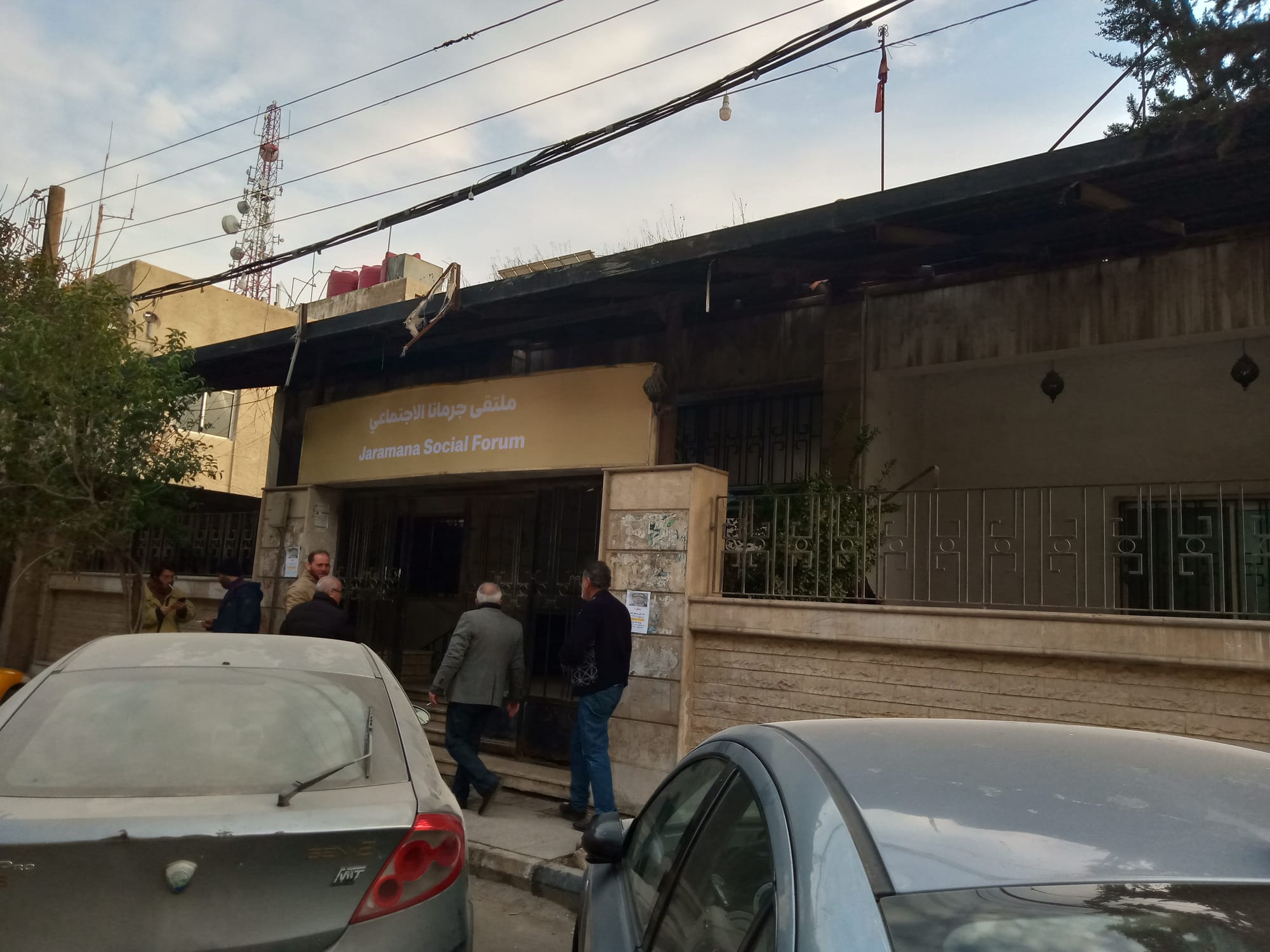
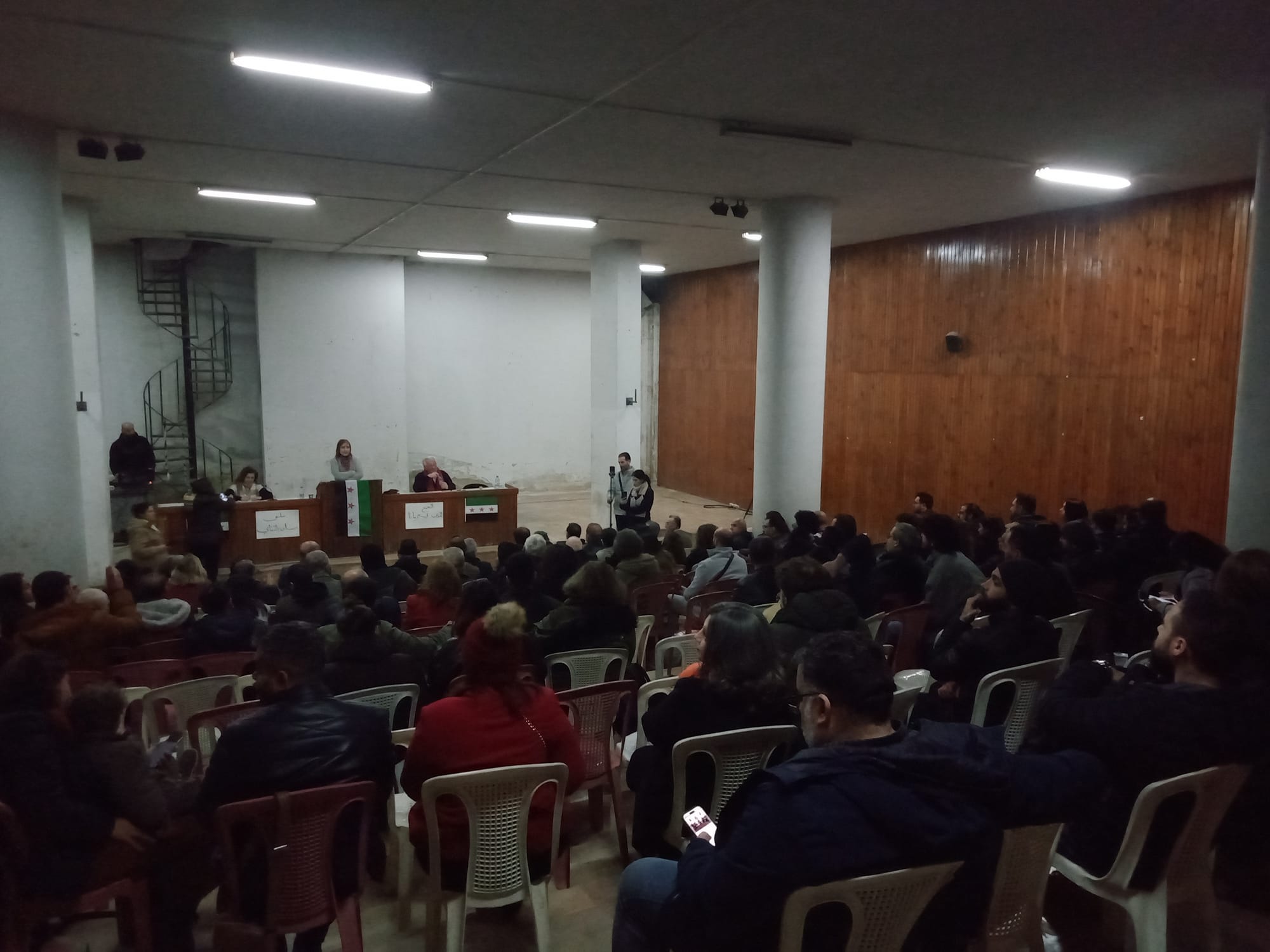
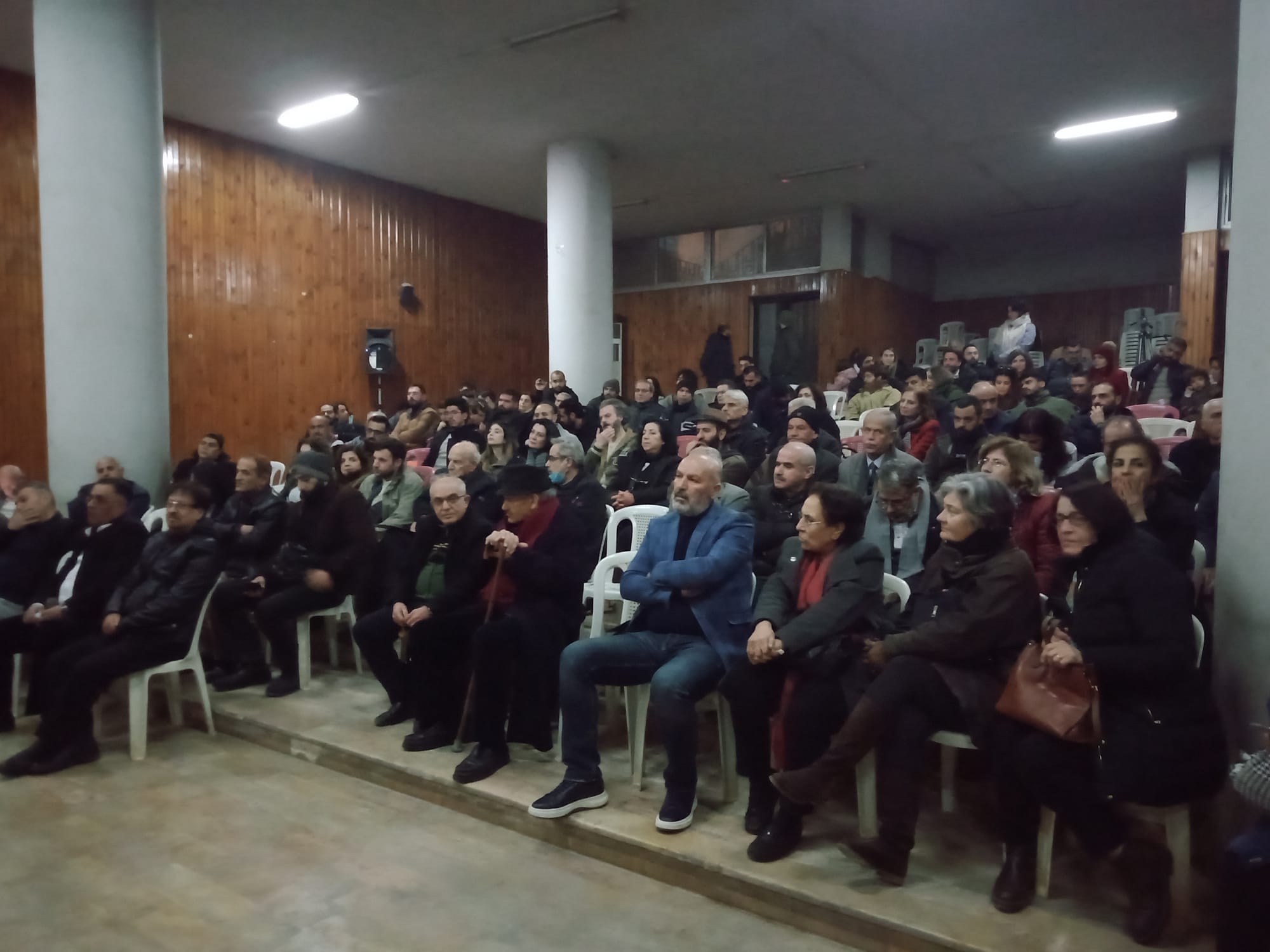
A meeting of the Nissan Women’s Group in the Jaramana Social Forum, Damascus CREDIT: Omar Hassan
It was clear, however, that the attendees at both events were far more interested in discussing concrete perspectives and proposals than historical and theoretical issues. Where the talks had a somewhat abstract flavour, especially in Jaramana, audience members wanted to know how to take forward the fight for social and economic justice in Syria today.
Both meetings saw repeated complaints that there had been no shift in the approach to decision-making from the old regime. “We can sit here and talk about what we would like, but they’re not listening to us”, one man complained in Jaramana. “How do we turn that around?” One young radical responded by arguing forcefully, if optimistically, for a general strike: “It’s the only way to force them to listen”.
In Sahnaya, attendees expressed similar concerns: “Do [HTS] really need 3-4 years to write a constitution, or is that just a tactic to stall until they have all the power?”, someone asked. Another pointed to the elephant in the room: “How do we mobilise to defend our rights without provoking another civil war?” No easy answers.
Alexander stressed the need to build and strengthen independent unions that can use their power at the point of production to discipline bourgeois forces like HTS. Such a project is well beyond the capacities of this small group of young revolutionaries at this stage but it helped point the way forward.
Lines are quickly being drawn between supporters and opponents of the new government. For now, its critics are mostly on the back foot, responding to specific incidents and policies rather than setting the agenda. They’re racing to establish institutions and spaces that can allow them to think, organise and resist collectively.
On the other side, HTS are taking full advantage of their status as the only nationally organised force in Syria. Governing in Idlib gave them time and space to consolidate their political and military machine, assisted by extensive foreign donations. Their leaders are intelligent and battle-tested and are learning to enjoy being at the helm of the Syrian state while being wooed by global capital.
To justify their unilateral assumption of power, HTS use the slogan, “Those that did the liberating get to do the decision-making”. It would be a lie to say this argument, as anti-democratic as it is, has no purchase among the broader Syrian public. But HTS’s reactionary program—and the brutal, anti-revolutionary actions of many of its leaders during the civil war and its reign in Idlib—mean that many remain wary.
For now, the majority of Syrians are watching and waiting to see what comes next, willing to give the new government a chance. But that could change at any moment, triggered by an overreach or some other crisis. The transition from a 54-year dictatorship will take months, if not years, to unfold, and there will be many shifts in momentum and the balance of forces.
As we leave the meeting in Jaramana, my companion, an experienced journalist who has thrown herself into democratic organising, seems a bit down. She asks me what I think will happen to Syria. I tell her I have no idea, but that’s a positive in and of itself. Under Assad, it was guaranteed misery from here to eternity.
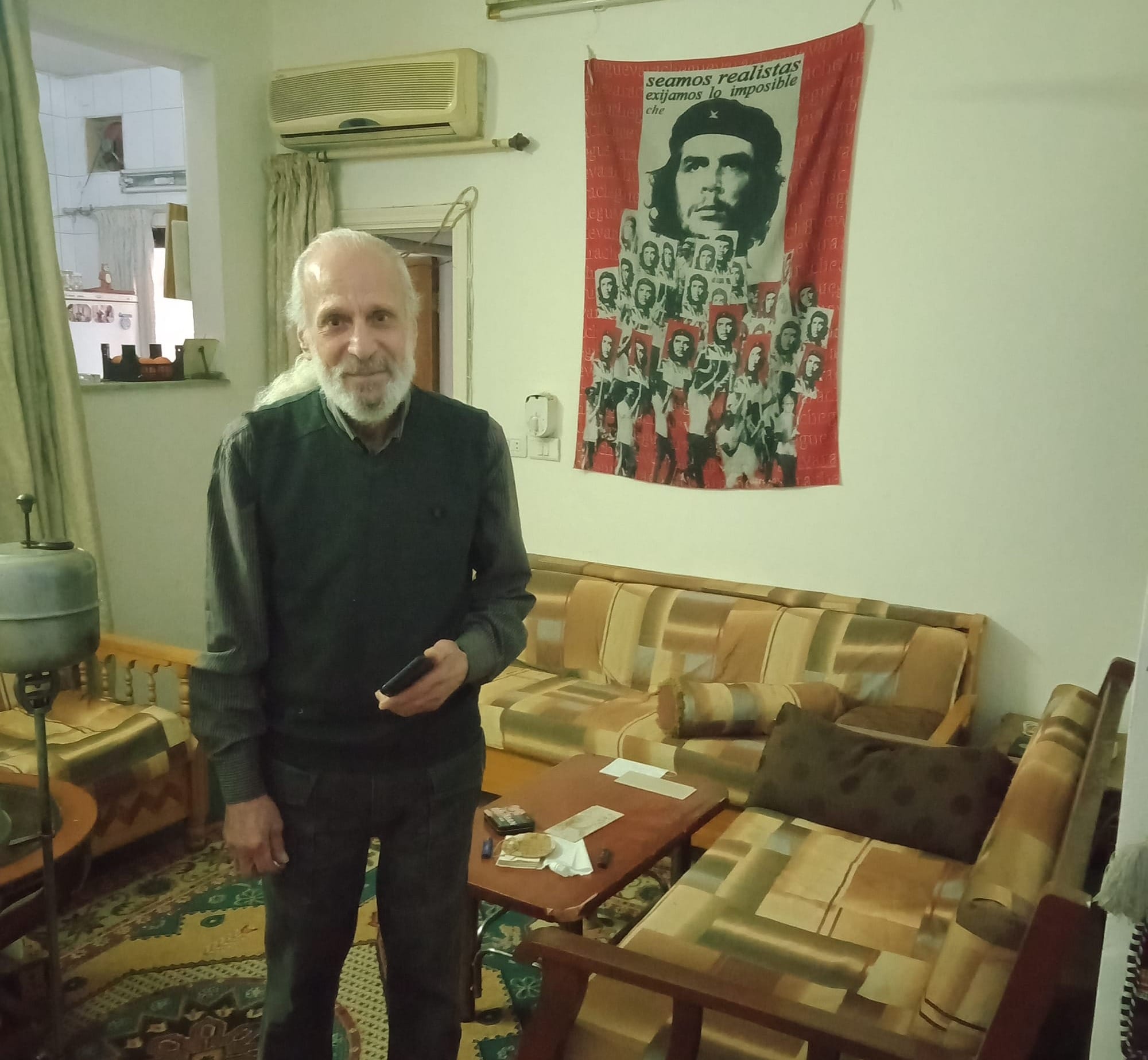
THE OBLITERATION OF A PALESTINIAN REFUGEE CAMP
TUESDAY 7 JANUARY 2025 | As I climb out of the microbus and take my first steps in Yarmouk refugee camp, in the south of Damascus, I spot two young boys slowly digging through a pile of garbage and rubble. I ask if I can take their photo, part of documenting what Assad did to this area and its people. They look at me suspiciously, layers of filth clinging to their faces and clothes. “No, go photograph someone else”, one of them says. They look tired, defeated, possibly embarrassed. I sense their eyes on me as I walk away, wondering what my deal is. Eventually, they return to their scavenging. They’re no more than 10 years old.
According to UN records, Yarmouk was home to around 160,000 people before 2011, overwhelmingly Palestinians. My driver, Ahmad, boasts that it was once one of the most economically vibrant parts of Damascus, with shopping districts, industrial sectors and more. He takes me to visit Abu Saeed Aidi, an old man born in 1945 in the now obliterated Palestinian village of Lubya. He’s lived in the camp for decades and tells a similar story of Yarmouk once being a thriving centre of Palestinian life. His eyes shine with pride when he describes how the camp was designed by a Palestinian engineer from Jerusalem using the most modern ideas available at the time, how it had a democratic structure different from the rest of Damascus, and how generous donations from abroad meant it had the best infrastructure of any suburb.
There’s nothing left of that now.
Ahmad drives for over half an hour, winding through the narrow, desolate streets. I try to film, but it’s hopeless. The reality of such devastation can’t be captured with images alone. Row after row, block after block after block of destroyed homes. An old United Nations school bombed to smithereens. The shell of not one but two enormous mosques, meeting places and cultural centres for a once thriving community. A small garden, its healthy crop of string beans merely highlights the devastation surrounding it. An old playground, a rusty swing, a fading children’s painting of a happy family, one of the kids waving the regime flag.
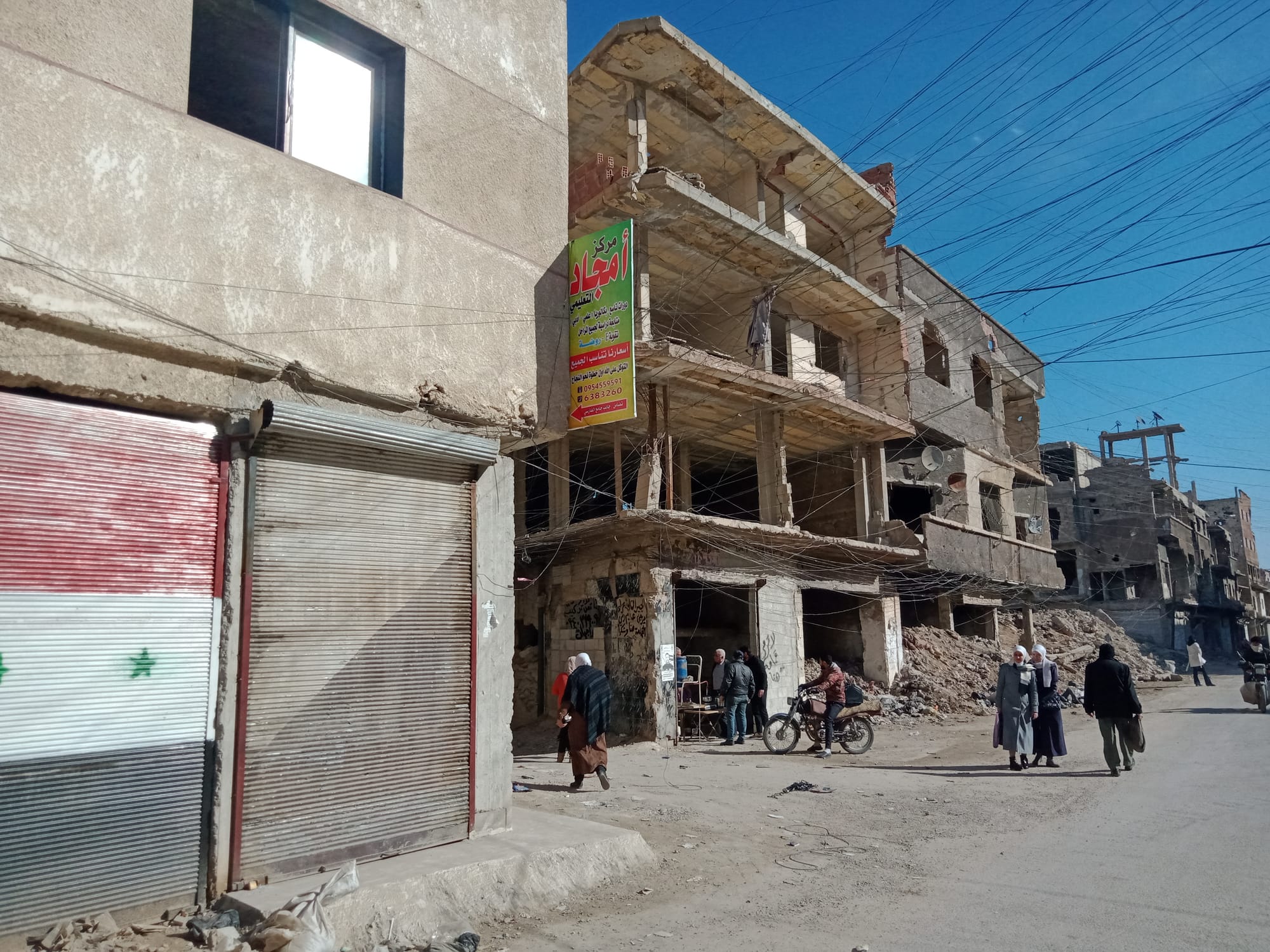
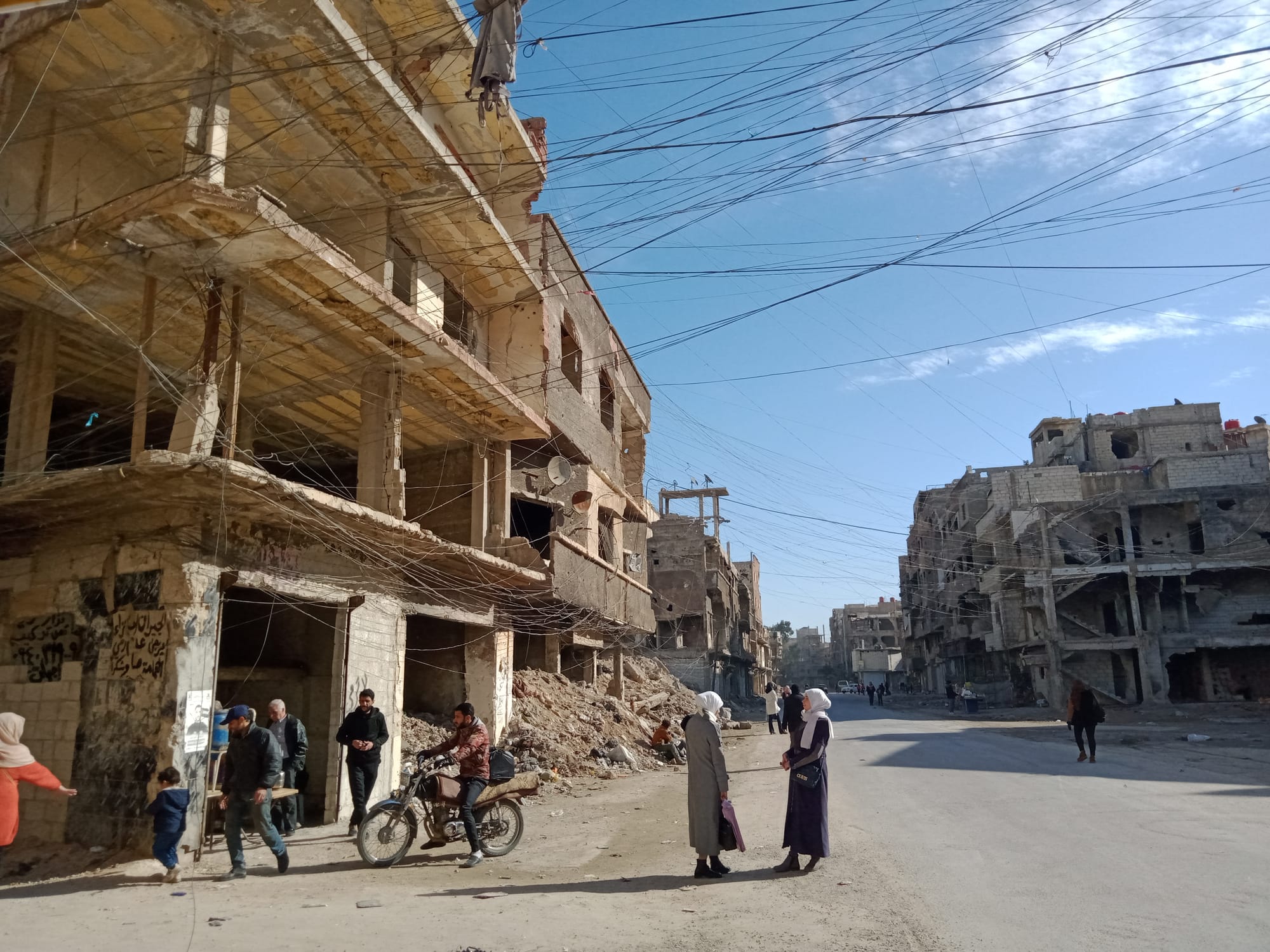
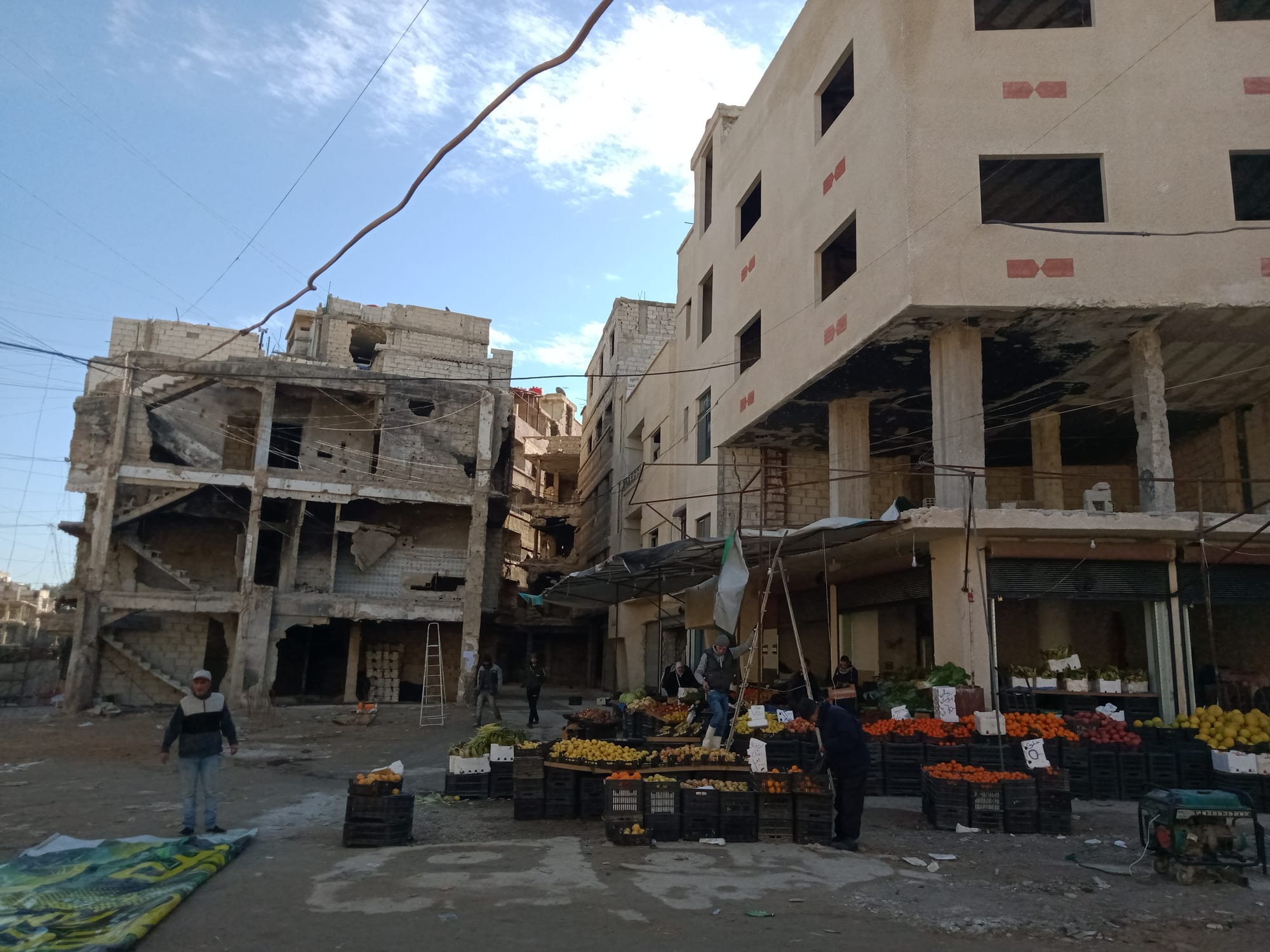
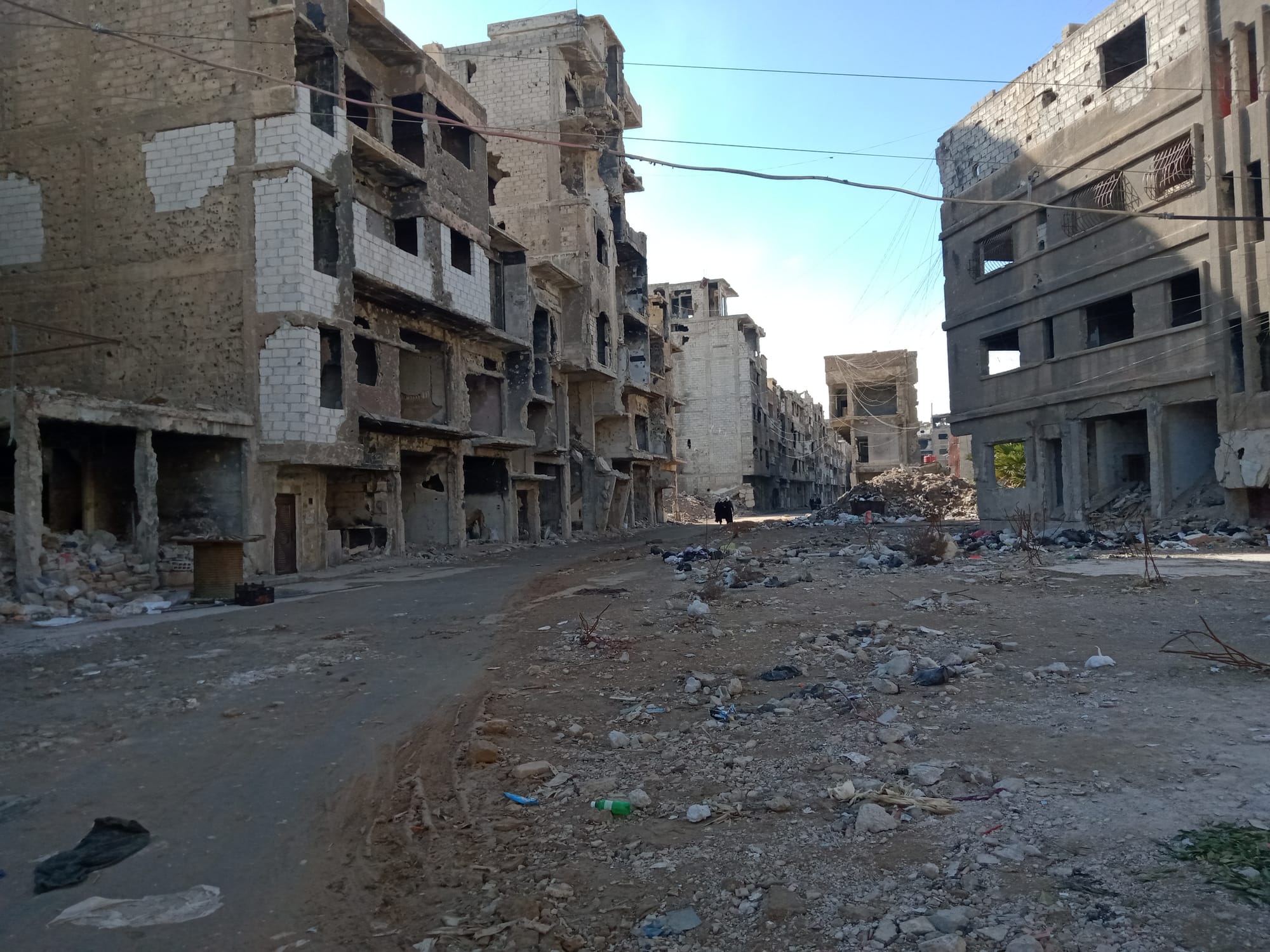
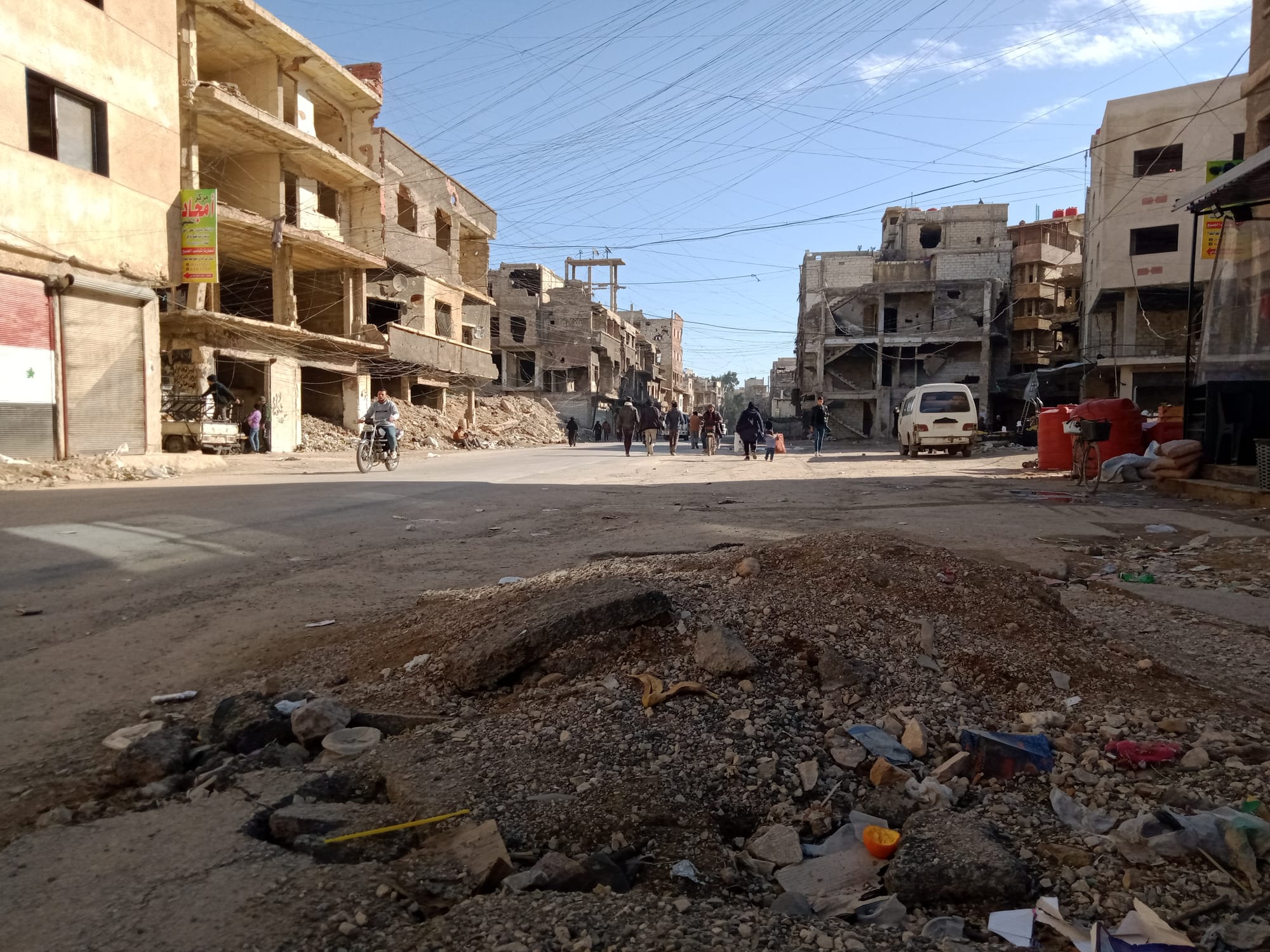
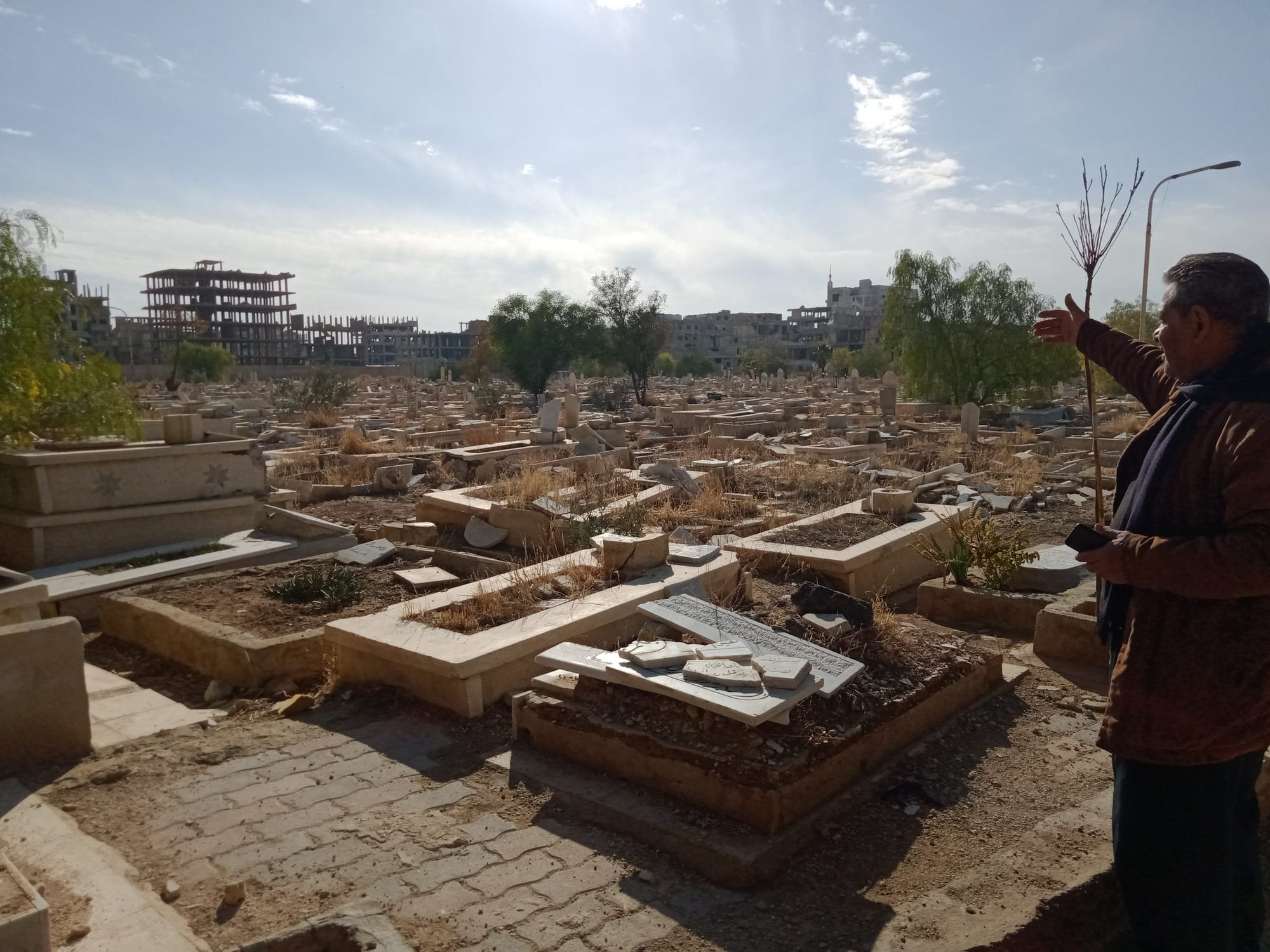
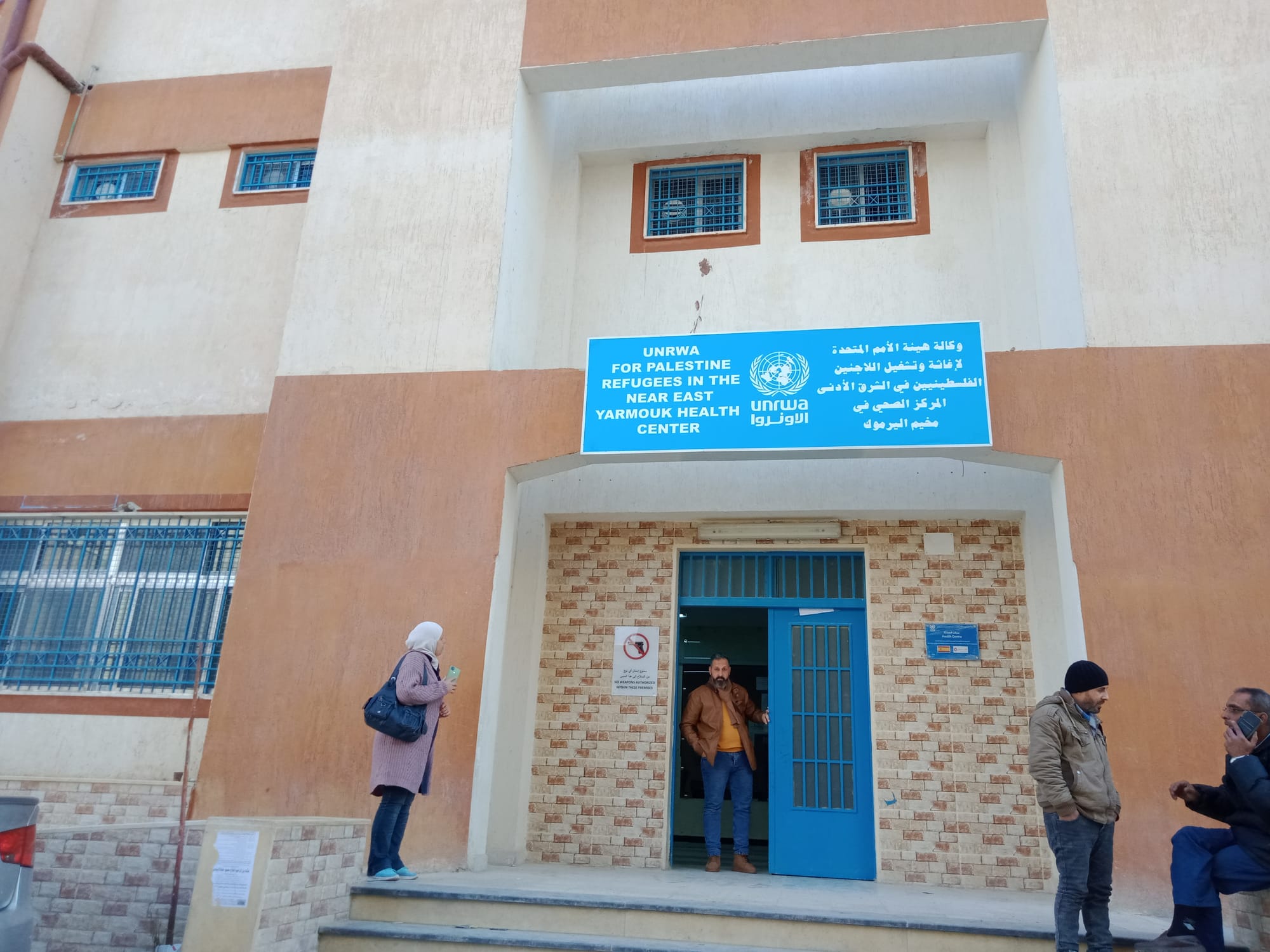
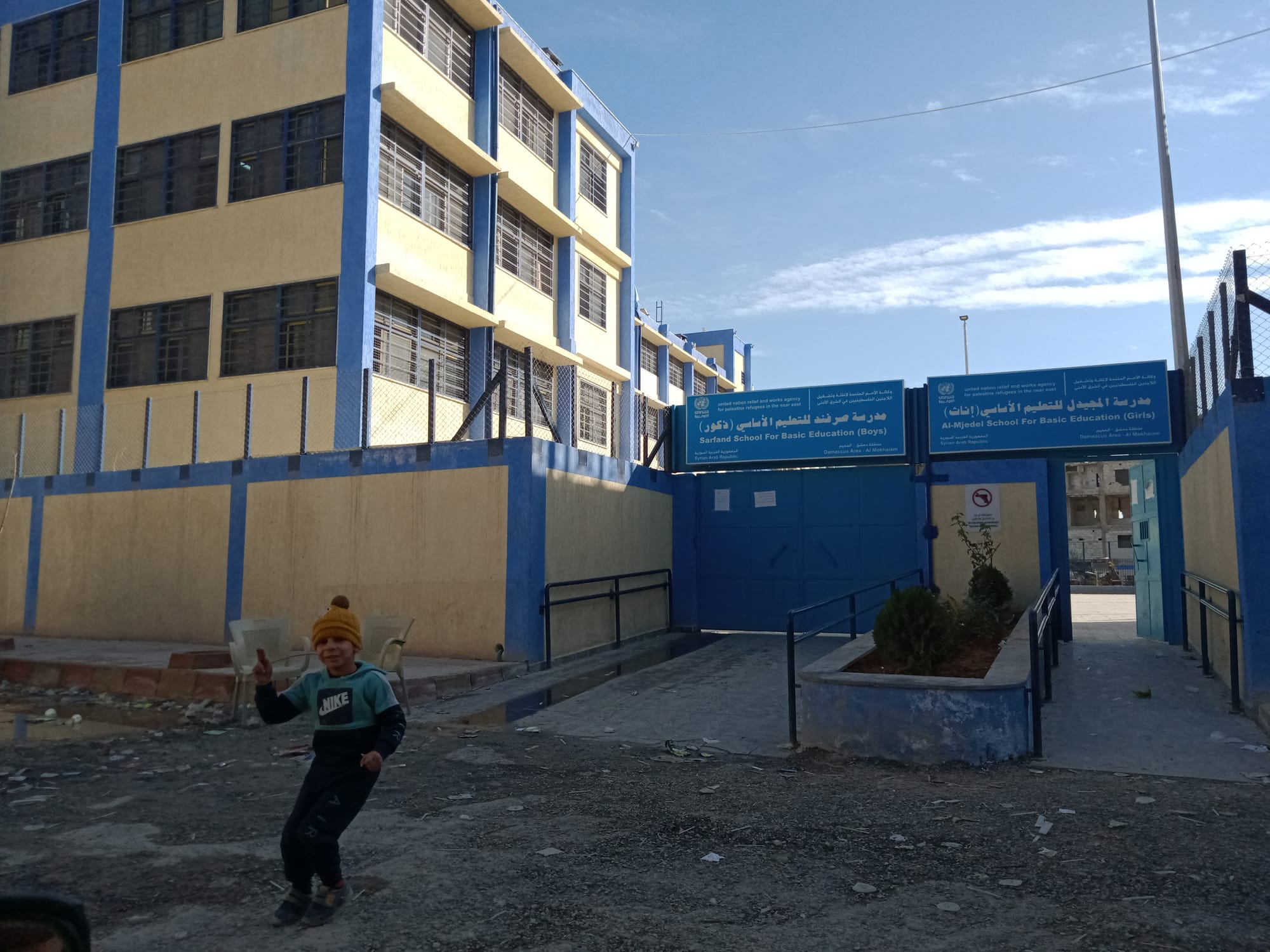
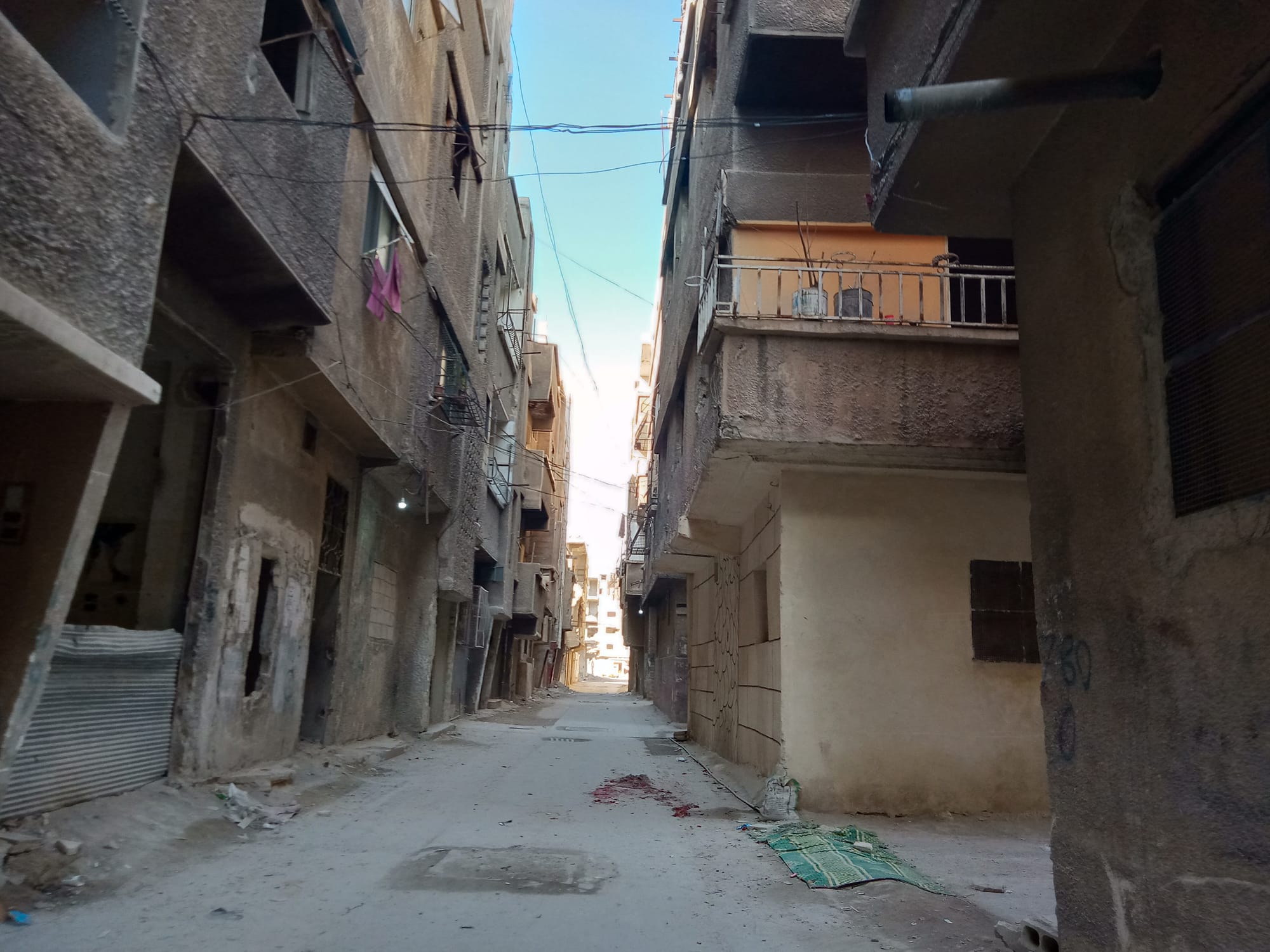
Yarmouk refugee camp, in the south of Damascus CREDIT: Omar Hassan
Saeed al-Shneeni is keen to talk as soon as he gets in the car. “You need to record this”, he says confidently [note the footage at the beginning of this piece]. He’s a long-term camp resident, and he has stories to tell about every building we pass. “That’s the checkpoint where they used to randomly kidnap people”, he says as we pass a small concrete pillbox on a narrow street. “That’s the line of demarcation, where every building was demolished to give the government a clearer shot into the camp. Then, they stole the steel from the rubble to sell on the black market. Criminals in every way, these people.”
He tells a tale of the five-year siege of Yarmouk, which the regime imposed between 2013 and 2018. Its effects were so brutal, so total, that an Amnesty International report published in 2014 found that 128 people starved to death that year alone. This was collective punishment for the crime of supporting the Syrian revolution.
Saeed says that a wealthy Palestinian exile eventually bribed the regime to allow an aid delivery. Authorities took the cash but opened fire on those who lined up for food. It became known as the Rijeh square massacre. “It was just like what the Israelis did in Gaza last year”, he says. Seven more people died in that incident, killed while lining up for bread to feed their loved ones.
Yarmouk had also been home to a vibrant Palestinian civil society. “There were more than fourteen [political] factions”, says Ahmad’s nephew, Mohammed, who joins us for lunch. “Each faction had their own organising committees and armed wings ... but that’s all finished now.”
The regime kept them on a very short leash. In fact, they had a special office within the internal security department tasked with abducting, torturing and killing Palestinian organisers who stepped out of line. Referred to as the “Palestine branch”, it attracted some of the most brutal and sadistic people within the Syrian state. They were responsible for responding to the revolutionary uprising that found a strong echo in Yarmouk and the surrounding neighbourhoods.
By the time Assad’s forces retook Yarmouk in 2018, the camp was a wreck, and only a few hundred people remained. The combination of famine and endless bombardment had made the area unliveable, forcing over 100,000 Palestinians into yet another exile. To make matters worse, ISIS and Nusra had overrun the camp a few years earlier. These reactionaries drove out the remaining rebels and spent the next three years terrorising any citizens that remained.
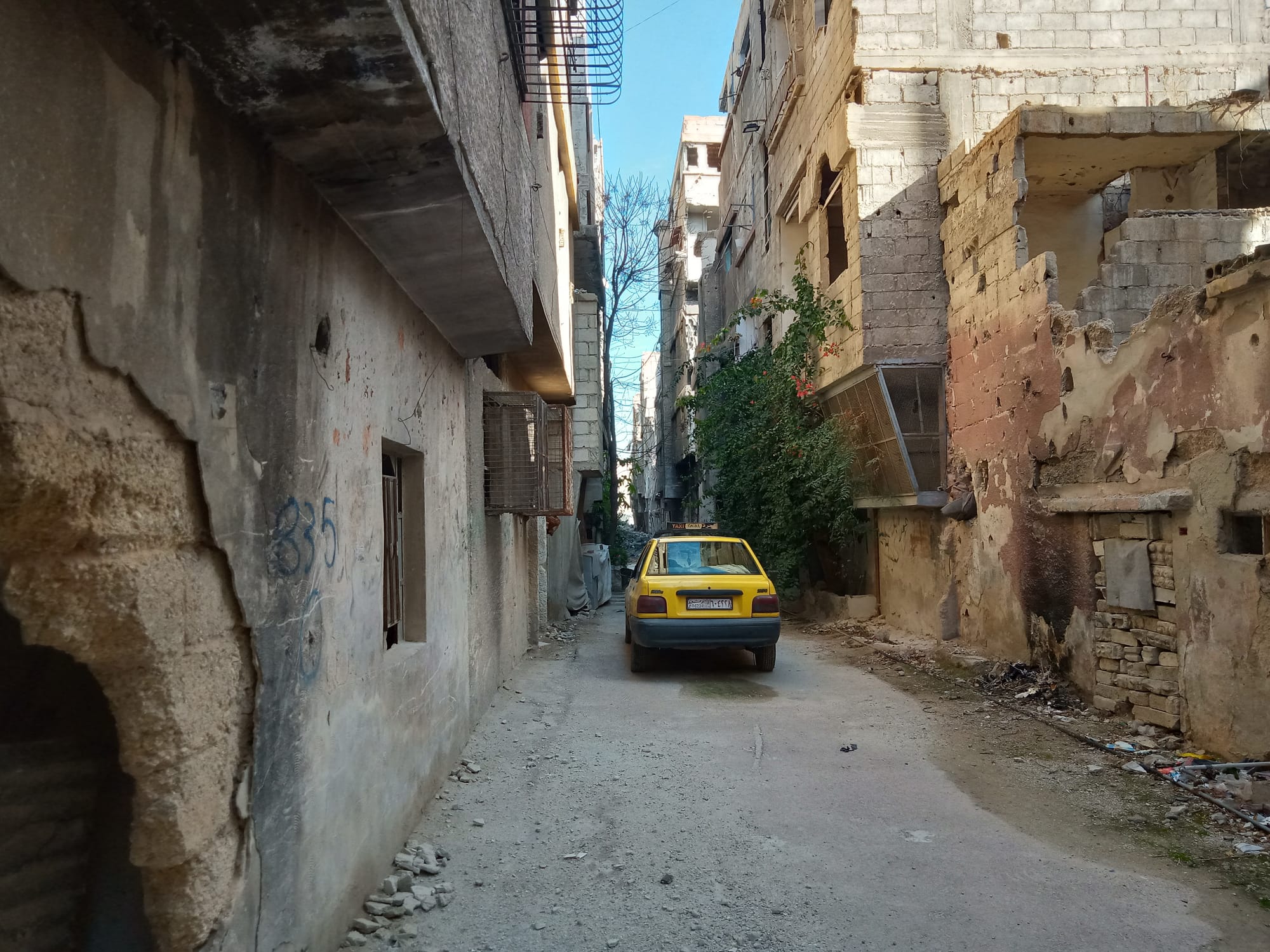
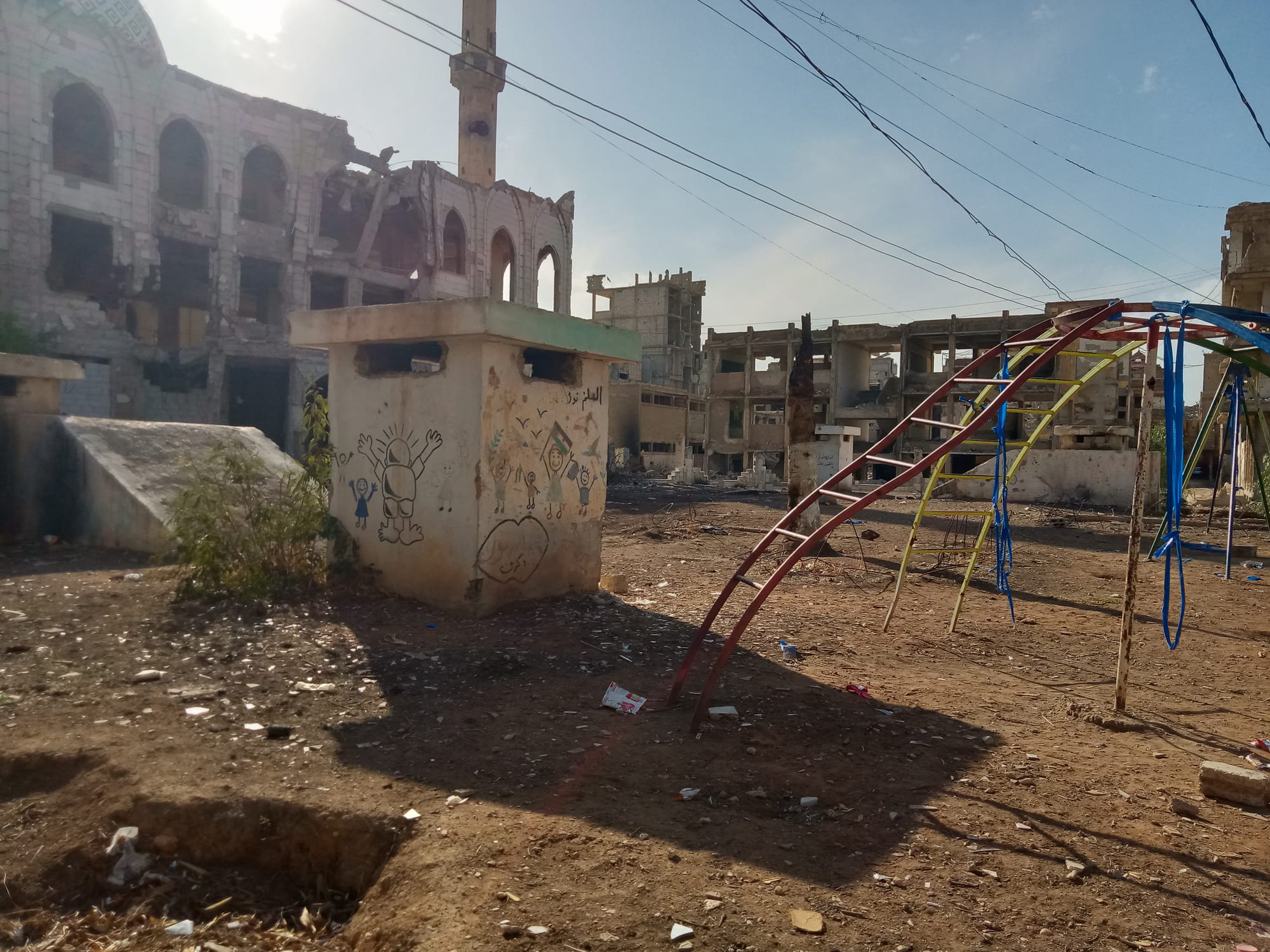
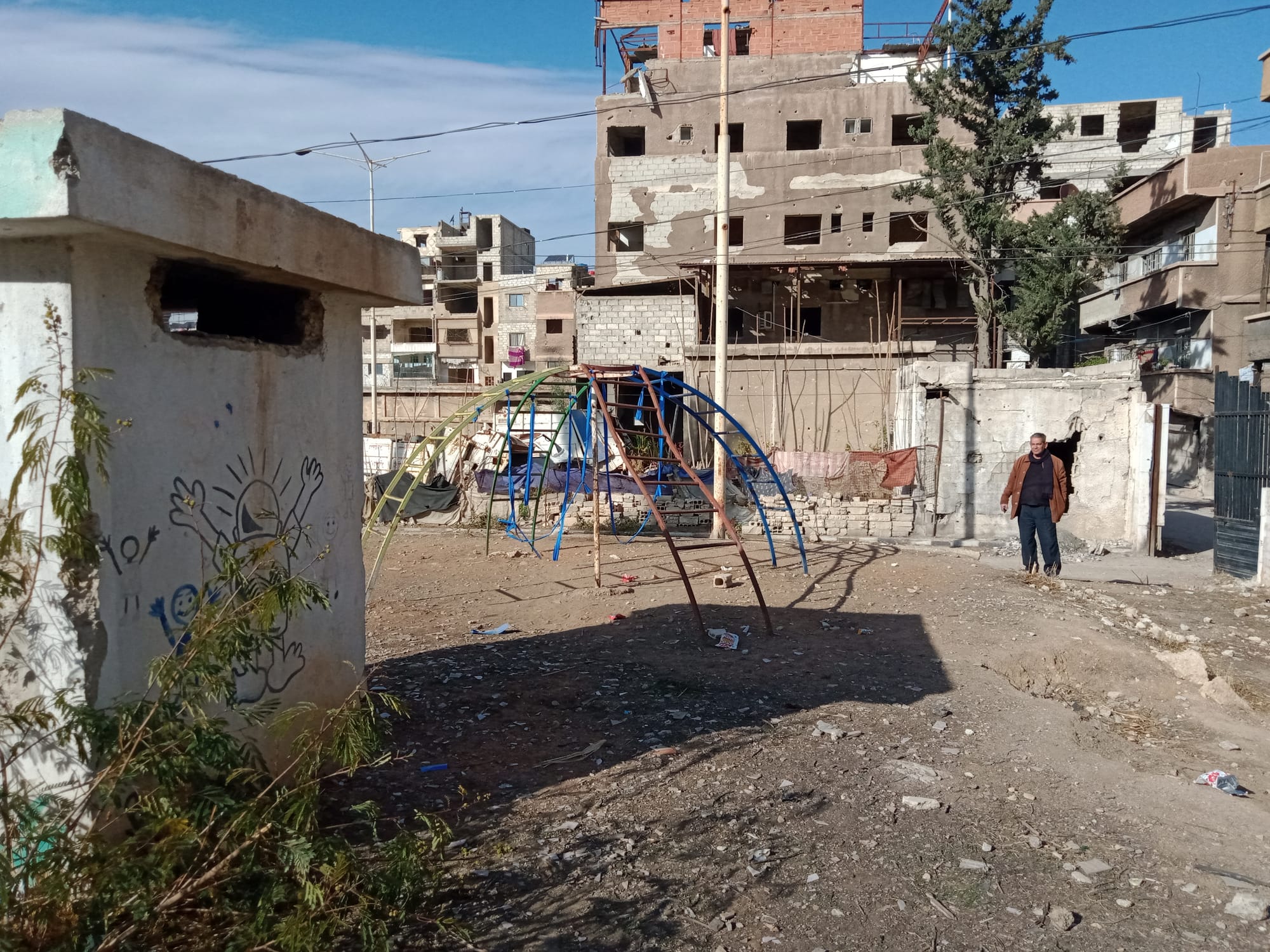
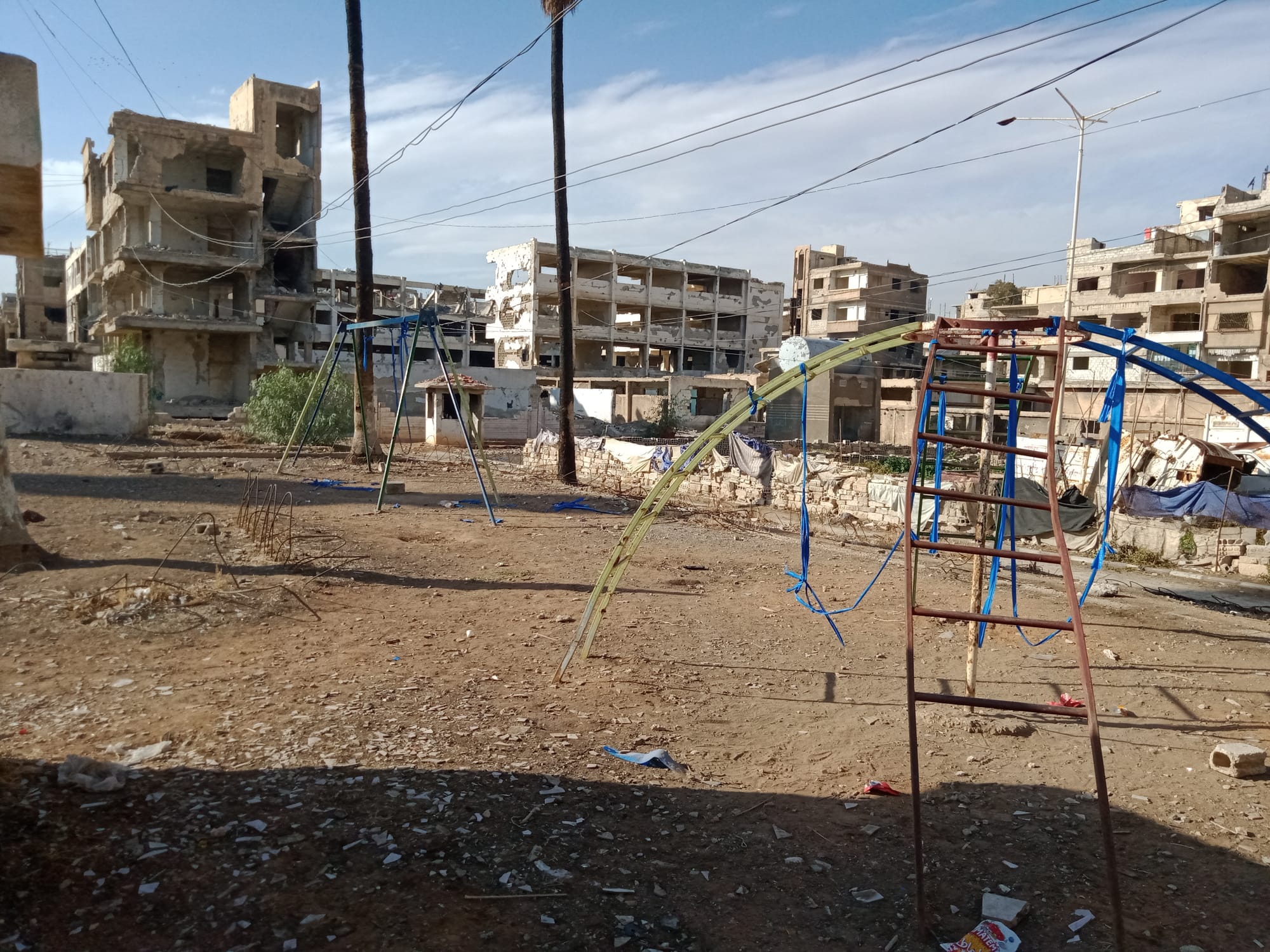
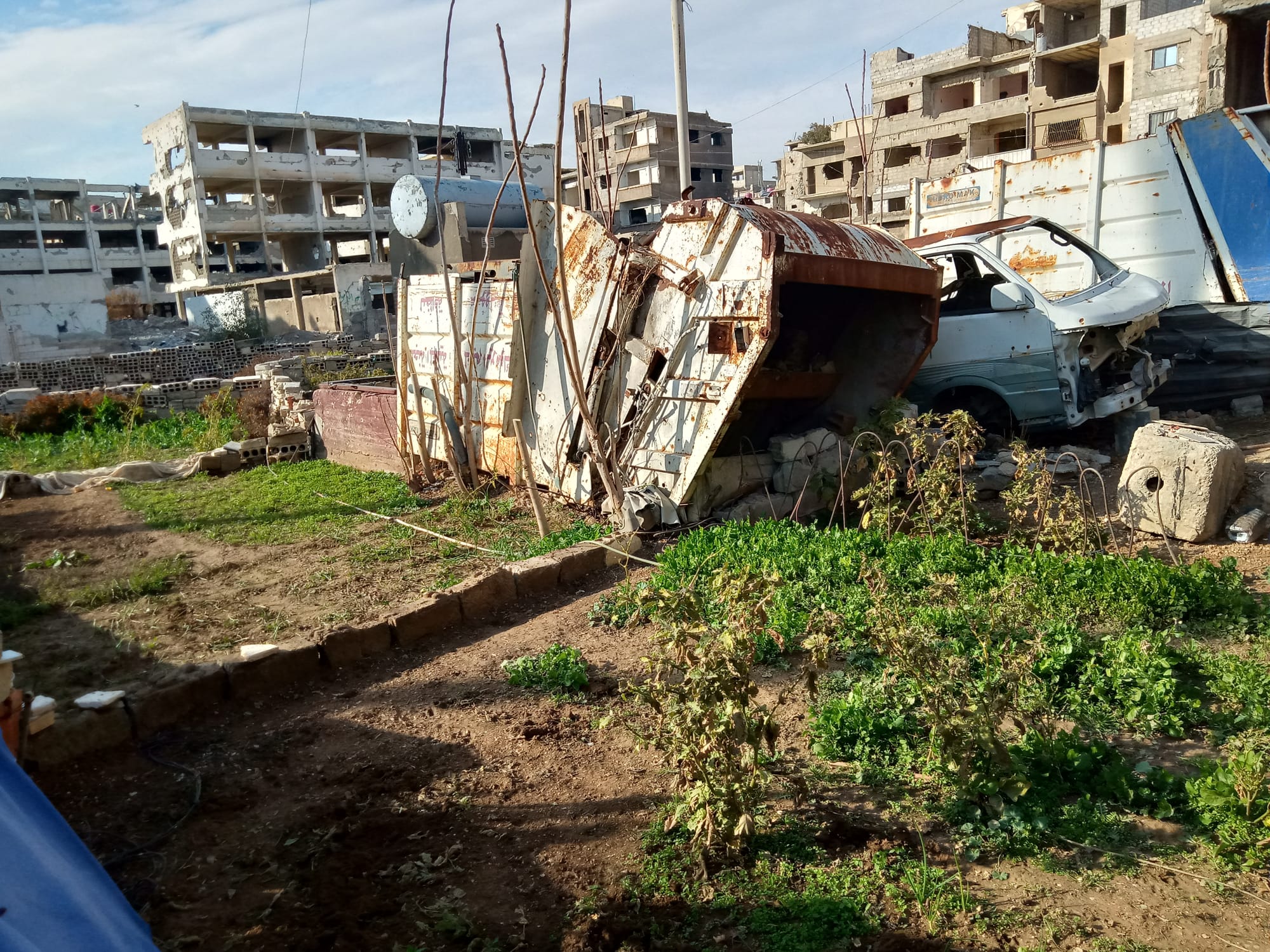
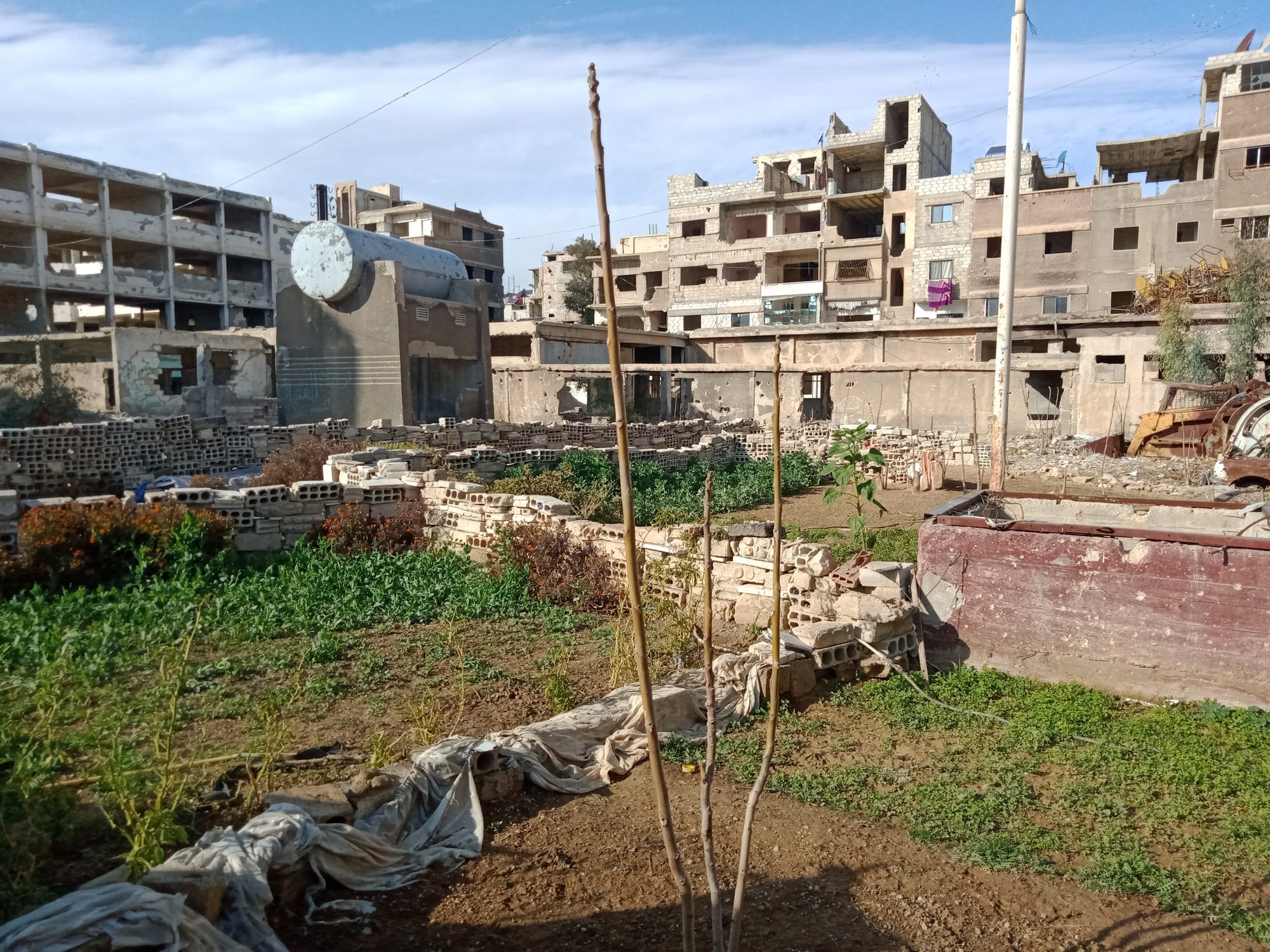
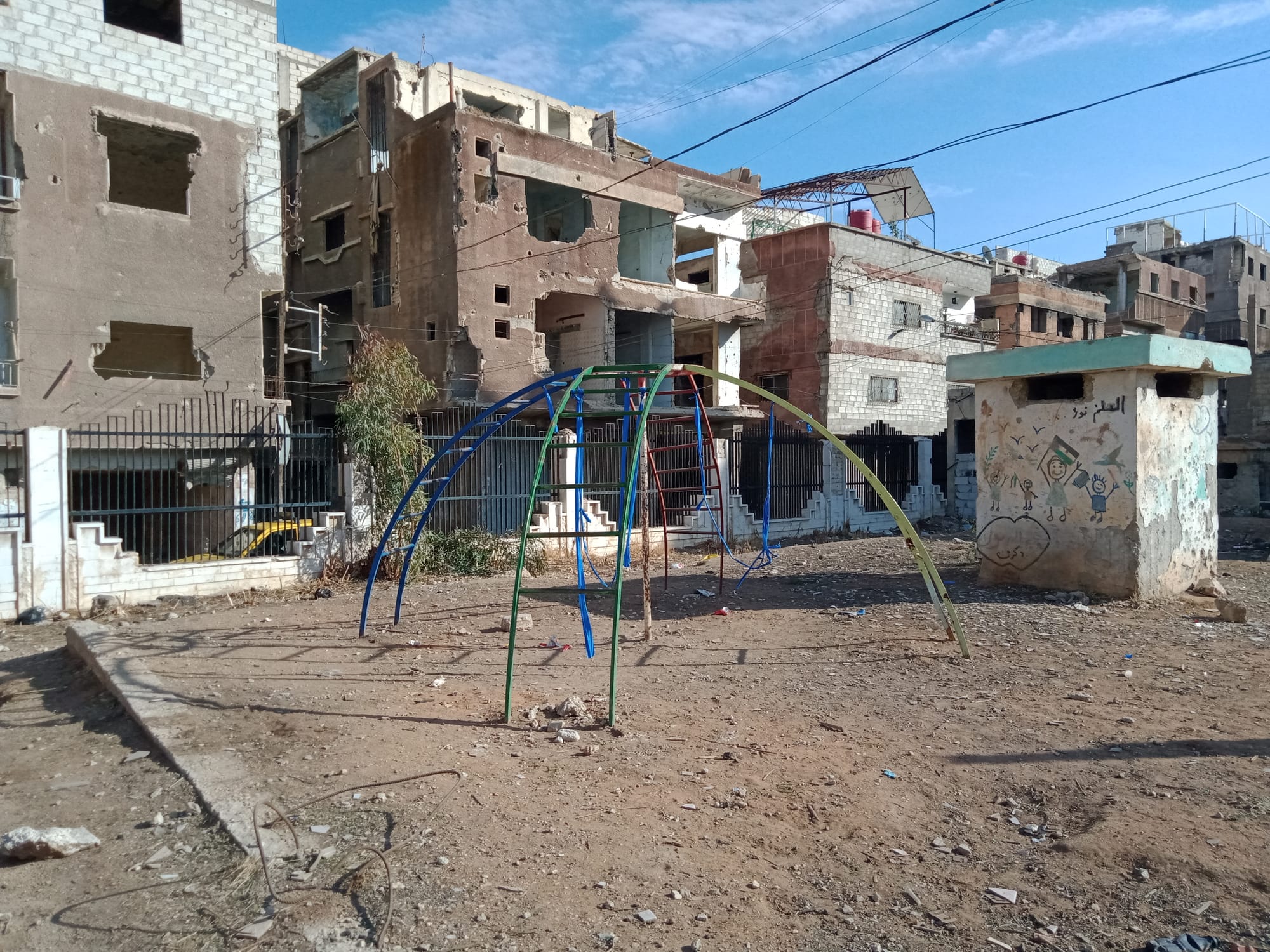
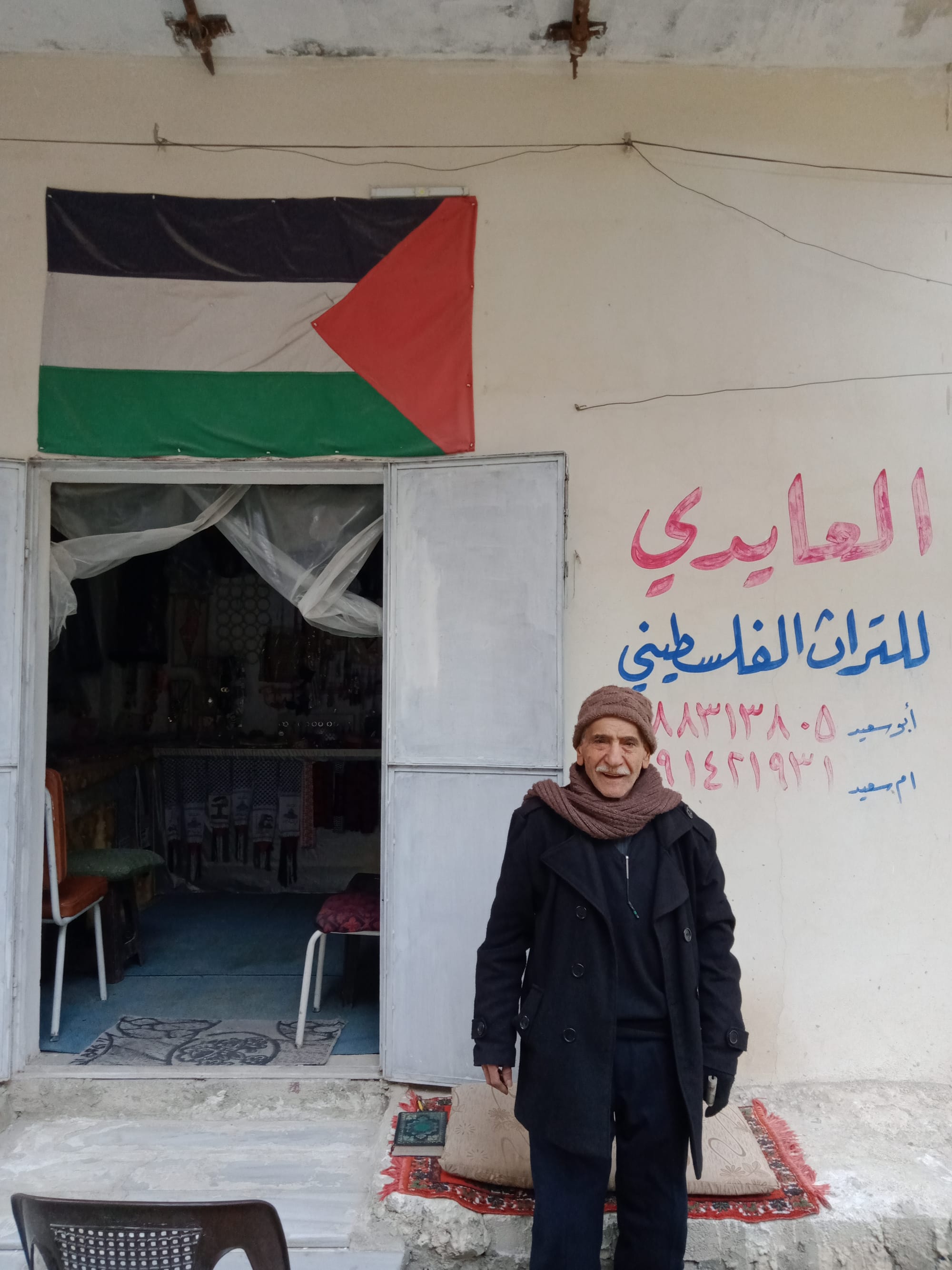
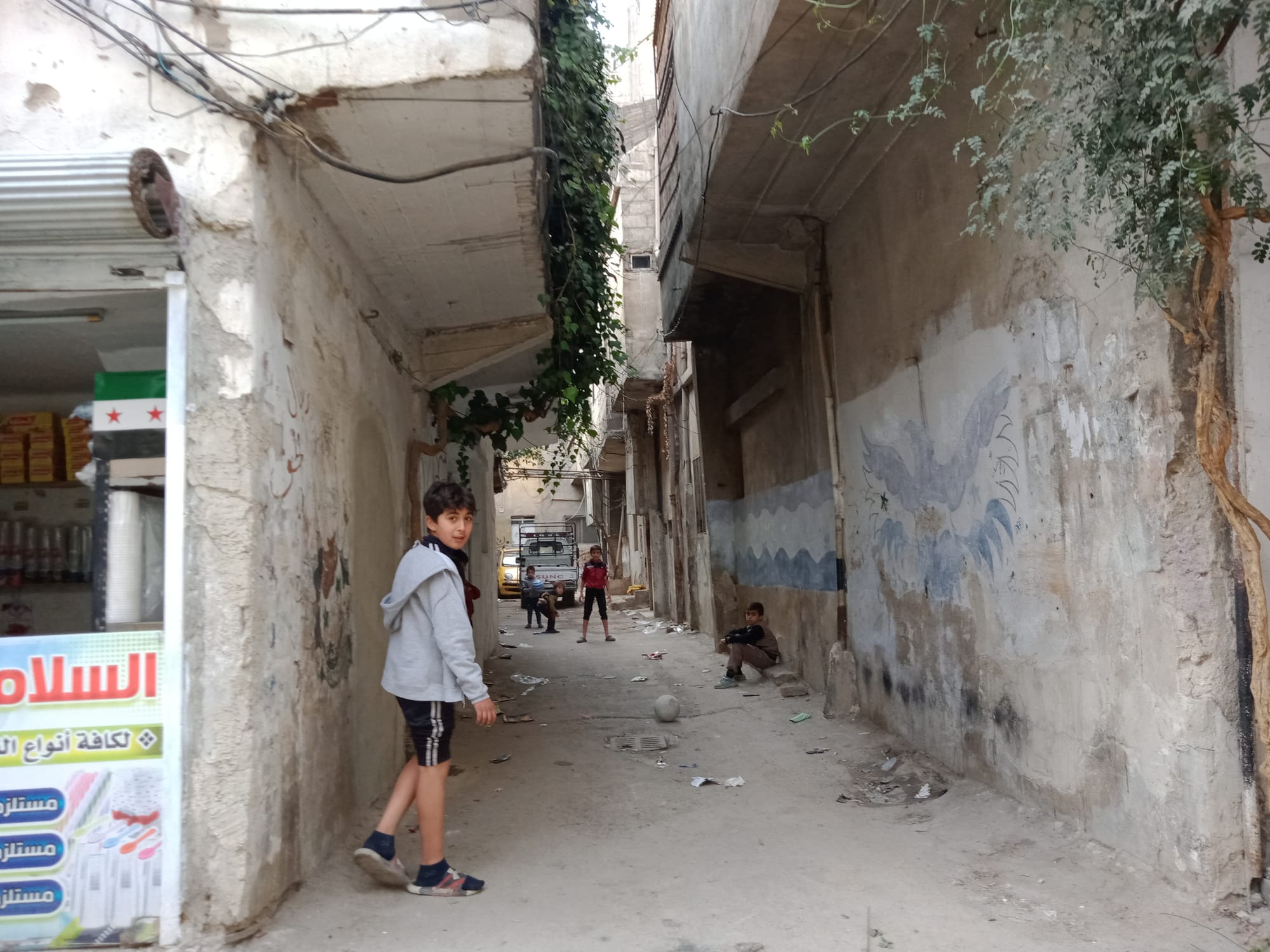
Yarmouk refugee camp, in the south of Damascus CREDIT: Omar Hassan
Undeterred by the scarcity of living beings to harass, the soldiers were ordered to abuse the dead instead. Ahmad takes me to Yarmouk cemetery, where the gravestones have been smashed. “They gave us no peace, even in death”, he says. It’s not until we’ve sat down for lunch in Ahmad’s home that Saeed talks about how the arbitrary violence of the Syrian state forever changed his own life.
“At the time, we were still living in our flat on the fourth storey of a building near here”, he says. “But the bombing was so constant that my wife and I had decided to sleep in separate rooms, so that if one of us died, the other could keep looking after the kids.”
They were eventually forced to move to their parents’ house after a bomb landed on their next-door neighbour’s apartment. A few weeks later, their 16-year-old son, Mahmoud, went missing. “It was strange at the time—nobody was staying outside after dark due to all the fighting. I was up all night worried, and when he didn’t return, I spent the next week looking for him. I looked everywhere, asking anyone if they had seen him.”
After trying everything else, Saeed went to the morgue. “The worker there showed me body after body ... At one point, I thought I had found him, but it turned out to be someone else’s child. I was relieved, but still very stressed.” The mortician told him to try the internal security office, where a database was kept of dead bodies “found” locally.
Saeed’s eyes glaze over; retelling the story has sent him back in time. “When I got to the relevant room in the security building, [there was] a man sitting behind a computer, with an officer on either side. They were showing him pictures of dead faces, sixteen to a page.” Saeed stood behind them and watched them scrolling through endless pictures. He describes feeling torn between wanting to find his son and yet wanting to cling to the hope that he was alive. Soon, his face showed up. “I yelled, ‘That’s my son!’ They hadn’t even noticed I was there until then.” Saeed was then shown eight pictures of Mahmoud’s body. He’d been shot in the head at close range. That’s all Saeed ever learned about the loss of his precious child.
But this story isn’t finished.
In 2014, two years after Mahmoud’s execution, Saeed’s son Ousama was a month away from graduating high school, having specialised in administration and law. Saeed’s family had moved to yet another apartment—“more space for the kids”, he explains. One day, a government employee came to their house and asked them to go to the mayor’s office to register their new addresses with the local administration. On arrival, both Saeed and Ousama were arrested and thrown into a van. After a few minutes, Saeed was let out and dropped off on the street without charge or explanation. He was never to see his son again.
For years later, members of the internal security came to his house, promising to get information about his son in exchange for money. “I must have paid out over $5,000”, he says. This was a common practice, Ahmad interjects—a way of extorting cash from desperate people. “I knew they were manipulating me, but I would have done anything to hear something about my boy”, Saeed says. He never got anything in return for these transactions but doesn’t regret trying.
Two weeks ago, he received a message from his daughter. Her friends had sent her a photo of an official document from 2015. It was a photo of a list of names of dead bodies found in the region surrounding Yarmouk. It included his son, described only as “Palestinian” and listed as number sixteen.
Because Ousama was never officially declared dead, Saeed’s last surviving son Abdullah was almost forced to serve in the same Syrian army that had killed his brothers. The prospect nearly drove Saeed insane. It took another round of bribery—worth another couple of thousand that he didn’t have—to convince the local bureaucracy to sign off on his status as an only child. Today, he’s in Germany, building a new life for himself.
In tears, I find myself apologising to Saeed for his suffering, on behalf of an indifferent world. He shrugs, tells me not to worry. He leaves shortly after with the look of a man who has completed a difficult but necessary task. It seems that sharing this traumatic incident with the world, even just some nobody from Australia, is for Saeed an act of resistance and love. Ahmad subsequently tells me that Saeed suffered enormously during the intervening years, the stress and sadness leading to a range of health issues. “The regime took his sons, but they also took the best years of his life.”
By the end, the Assad regime’s sole claim to legitimacy was its supposed support for the resistance to Israel. Of course, those with the most basic knowledge of Syria’s history know about the regime’s treason during Black September, its defence of the far-right, pro-Israeli forces in Lebanon’s civil war, its role in driving Yasser Arafat and the PLO out of Lebanon not once but twice, and how it defended Israel’s borders better than any other Arab state in the region.
But regardless of this history, what the regime did to the Yarmouk refugee camp, to people like Saeed, should stand on its own as an unforgivable crime. Indeed, Assad’s thugs killed more Palestinians in Yarmouk than Israel did in any one of its wars prior to 7 October.
As we’re digesting our dinner, Ahmad gets a call from his son in Germany. He announces that it looks like the government might be about to revoke the asylum status of many of the nearly 1 million Syrian refugees in the country.
Mohammed grimaces. Just minutes earlier, he had explained that he planned to seek asylum in Germany alongside his wife and 10-month-old baby. This news must have broken his heart, but he hides it behind a bitter smile: “The Arab world doesn’t want us, and the West doesn’t want us. They should just send me to Gaza so I can die fighting for my country”, he says.
ACTIVISTS IN THIS CITY PLAN TO SHAPE THE FUTURE
SATURDAY 11 JANUARY 2025 | “We grew up with [socialist musicians] Marcel Khalifi, Julia Butros, Shaikh Imam ... many of us were communists when we were younger, back before they joined the regime”, Safaa says. We’re in an apartment in the southern city of Suwayda, where three women—Safaa, Oussayma and Omayma—explain the history of the area’s revolutionary resistance to former dictator Bashar al-Assad.
“The hirak, the movement for freedom and change, started in August of 2023. It started because prices were going up so high; inflation was just making everything unbearably expensive”, Oussayma explains. At the same time, the government decided to cut state subsidies on essential goods like petrol and bread. She continues:
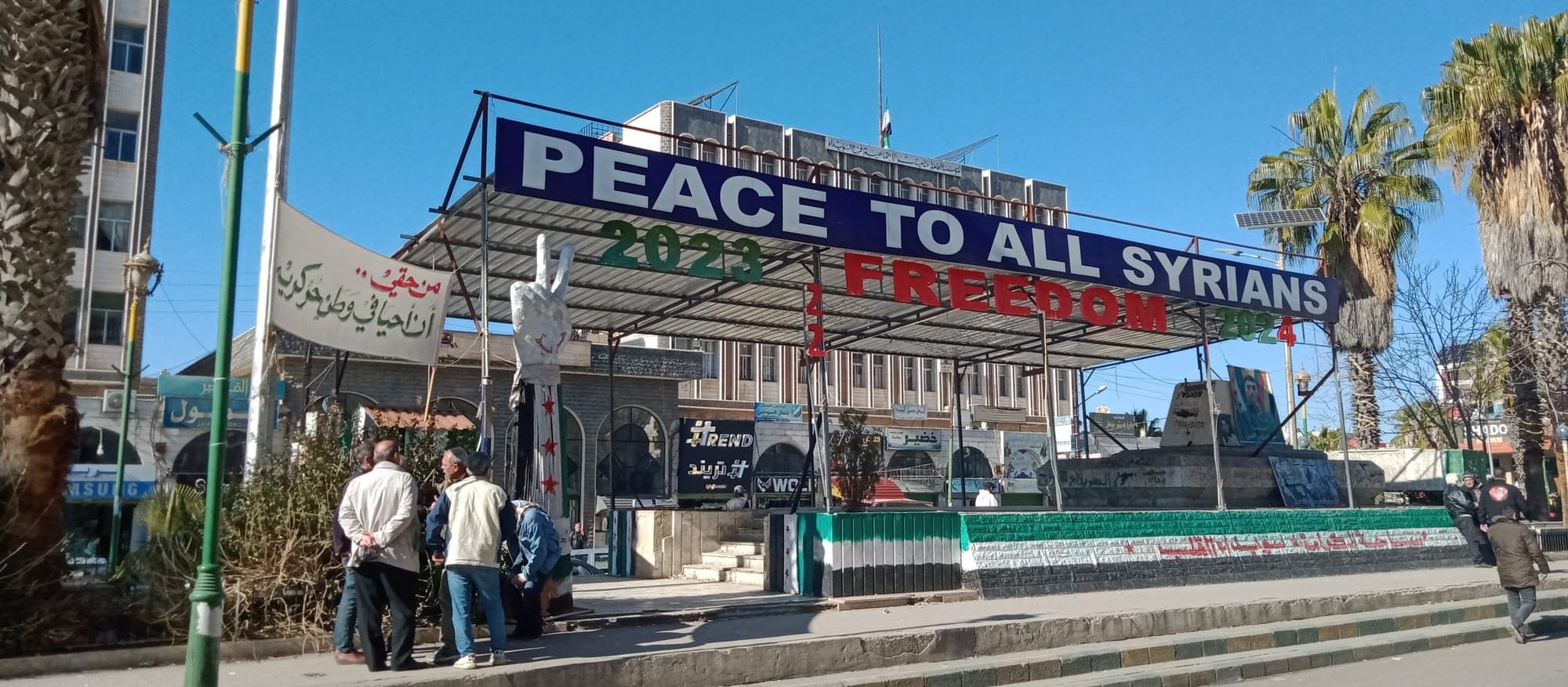
“These were the issues that mobilised people: we wanted to eat, have water and electricity, to live a decent life. At one point, the state-subsidised bread amounted to less than a full loaf. That’s why it was initially called the bread revolution. A group of youth, very small to begin with, went down to Karama Square to protest in August 2023. They came back every single day after that for one year and four months. Of course, not everyone could be there every day, so Fridays became the focus for large actions. Once the fear was gone, people just went for it.”
They’ve been doing it ever since—a year and four months of daily and weekly actions. The protests grew quickly, peaking at around 8,000 people. Most of the initiators were veterans of the 2011 revolution and had been active in the repeated waves of protests in Suwayda in the intervening years. To begin with, the movement focused on renewing the subsidies and lowering the cost of goods, that is, for reforms. But quickly, their ambitions grew, and they started demanding the fall of the regime.
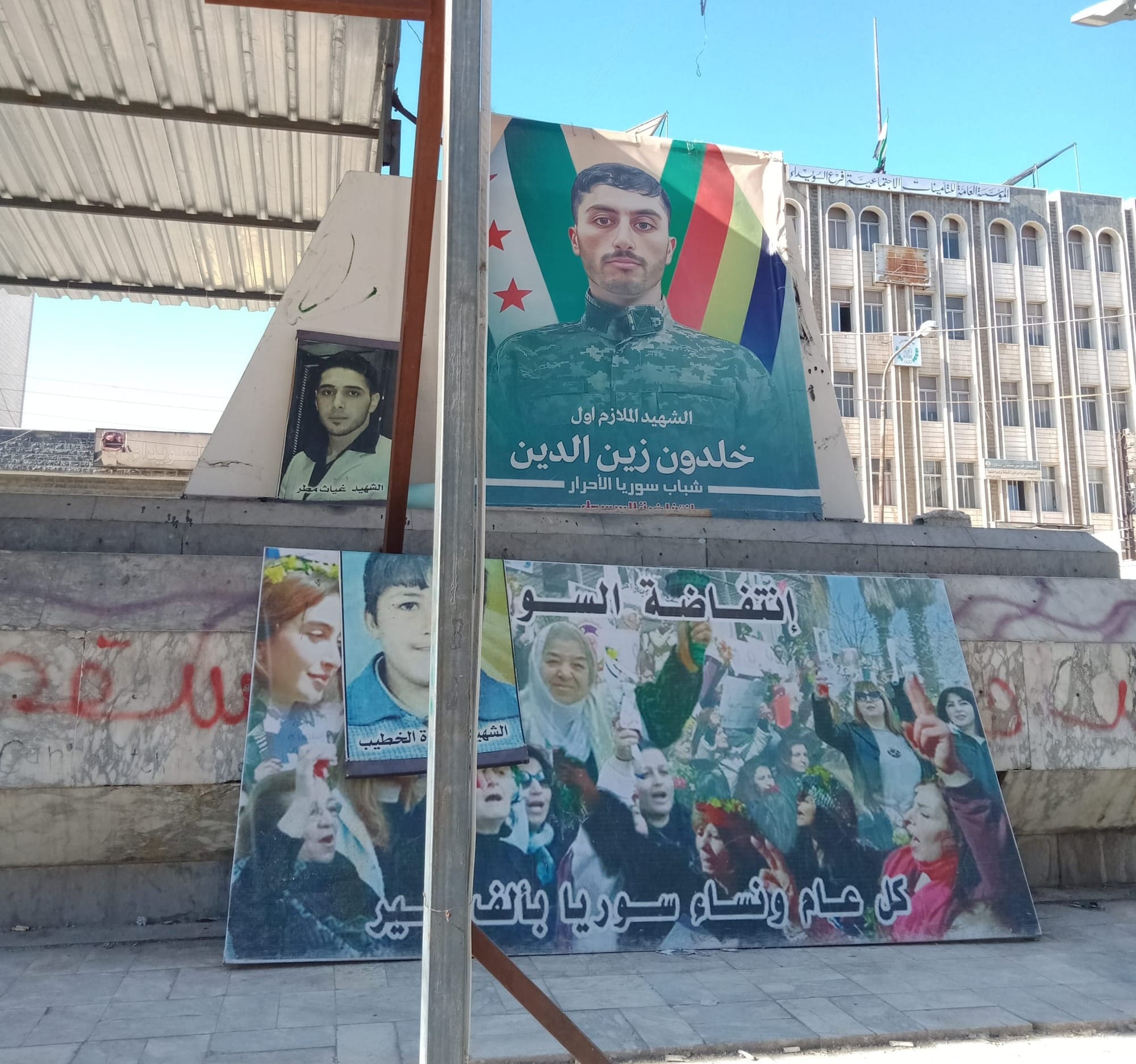
“People endured the biting cold, the snow, the heat of summer—it didn’t matter, we were there”, Omayma says. Through their placards and chants, protesters sought to highlight grievances and issues from across Syria, but also international events such as Israel’s genocide in Palestine. Inevitably, there were debates. Safaa explains:
“A section of people stopped coming when we raised the slogan of bringing down the regime. They said, ‘We were here about the price of bread’. What they were really worried about was that the regime would do to Suwayda what it did to the rest of the country.”
This situation was worsened by undercover officers who were sent in to cause trouble and division wherever possible. Oussayma again:
“They used to start fights over everything, things as simple as what songs we would play during the protests. As numbers got smaller, they kept saying that we were defeated, that we should stop. At times, when the actions were smaller, they would just try to snatch people off the street. Also, you have to understand that women were the big majority of the movement here. The reason was that there had been a collective decision made in 2016 that no man from Suwayda would agree to serve in the Syrian army, to kill their brothers, their people, fellow Syrians. If the army was fighting Israel, we would happily have served.”
Many men left the country to avoid this fate, often by paying Hezbollah a bribe to take them over the mountains to Lebanon, from which they could go elsewhere. The women find humour in a situation where the party responsible for propping up Assad through murderous repression would simultaneously profit from his victims. Those who couldn’t afford to get out were often trapped in their local towns and villages, unable to travel for fear of being snatched at government checkpoints.
Women were therefore vital to maintaining the street mobilisations organised by the umbrella group, Movement for Freedom and Change. The regime’s supporters and security services began a terrible campaign of slander and harassment of activists online, particularly targeting women. They hoped that by posting unflattering photos and suggesting that they were behaving inappropriately, their partners or family members would discipline them into silence.
Safaa, Oussayma and Omayma are furiously speaking over one another at this stage, conveying their disgust. But they admit that it did have an impact. “Even if your family was supportive, people knew what was happening in Sednaya and other prisons, so once you became a focus for the security… well, it was seriously scary”, Omayma says.
Were there any difficulties regarding women’s involvement from within the movement itself? “No way, our community here isn’t like some other places. We’ve been involved from the start”, Safaa says. “Actually, the guys were encouraging us to come out, they were quite open-minded.”
Having said that, it was mostly a small group of men from the 2011 era calling the shots to begin with. But the movement gradually became more collective and inclusive. Oussayma relates:
“We didn’t have separate women’s meetings; we were encouraged to take part as equals in decision-making, as spokespeople, in everything. Some meetings were called off entirely if there weren’t enough women present. But of course, it wasn’t all easy—there were sometimes big debates. Democracy can be hard in this country. But I used to say that even if we didn’t overthrow the government, the movement taught us a lot about politics and how the world really is.”
How is it that they weren’t just slaughtered by the regime, like so many others around the country? The activists say that they had taken full advantage of a contradiction within the regime’s propaganda, which claimed to defend minorities against violent extremism (that is, against the Sunni majority). This made it harder for the army to drown Suwayda in blood. This constraint gave the people here precious space to organise, but it was far from easy. Activists were still being killed and kidnapped—the kaleidoscopic range of security forces in Syria continued to operate underground. But through their courageous defiance, activists in Suwayda eventually won a degree of political freedom unheard of in other regime-controlled areas.
“We have not been under the direct control of the regime for something like ten years”, Safaa confirms. “That’s why, when the movement began, [the regime] counted to one million before dealing with us militarily.” The government had made an effort to reestablish itself in 2018, after ISIS occupied some eastern villages and towns and committed massacres across the region. “Actually, the regime brought ISIS here”, Safaa says. “But the people here rose up and we crushed them, drove them out ourselves on the very first day.”
This significance of the city’s independent military capacity is emphasised more by others in Suwayda, especially Alaa, a leading figure in one of the town’s largest militias, Liwaa al Jabal, or the Mountain Brigades. Joining us in the flat, he explains Suwayda’s relative autonomy as being a product of their fighting strength:
“My militia alone had 4-5,000 people under arms, and there were many others. Most of the time, we didn’t directly clash with the regime. But if they tried anything, for instance, if they snatched one of our people in Damascus or from a protest, we fought back. We would kidnap their soldiers and exchange them or threaten their commanding officer in the region. Things were mostly resolved that way.”
Walking and driving around Suwayda, it is obvious that the city and surrounding districts have not suffered the same devastating destruction seen in other parts of Syria. There are no buildings destroyed by missiles or bombs, no bullet-ridden homes. There are also fancier buildings and shops, more large construction projects underway, and fewer visible signs of poverty.
“Almost every family in Suwayda has some people outside the country, sending money back”, Ra’fat, my driver, later explains. “As well, there’s a higher proportion of people who’ve studied at university, in higher paying jobs.” Alaa makes a similar point, saying that most of the militia was made up of educated people. It’s impossible to confirm many details as there is little data on Syria’s population (though the transitional authorities are planning a census soon). But this relatively clean and functioning city of 500,000 is a taste of what Syria could have been had the Assad family not clung to power with such maniacal tenacity.
Alaa is quietly confident about the future. This week, his militia announced its intent to merge with the other main local militia, the Men of Dignity (Dignity Square is the site of many protests in Suwayda’s capital city). In a joint press conference, both declared their willingness to join a future Syrian army. “We will negotiate with [Hay’at Tahrir al-Sham (HTS)] as equals”, Alaa insists. Their unified command now controls 10-12,000 fighters.
Their statement was endorsed by the most prominent sheikh in the area, who has long positioned himself as an advocate of the movement. (“Though he has always had his own ambitions that don’t exactly match ours”, warns one of the women). Importantly, he emphasised that Suwayda must have a role in the shaping of the new Syria, not simply be told of the outcome.
People here remain fiercely committed to their independence, which they see as the only guarantee of their freedom and rights under the new regime. Alaa explains that HTS sent 35 cars filled with soldiers on New Year’s Eve, hoping to occupy the area by catching the local fighters by surprise. “We turned them around on the highway and told them that if they entered, they would be slaughtered. And that was that.” As a result, along with Kurdish-controlled areas in the north-east, Suwayda is the only governorate in Syria without an armed HTS presence. There is, however, an HTS envoy, Mustafa al-Bakkour, who is in practice functioning as the area’s governor, which nobody seems to mind.
There is a trend, represented in the Liwaa Party (unaffiliated with the militia), that advocate the secession of Suwayda from Syria. They have an informal alliance with the right wing of the Syrian Democratic Forces, the Kurdish forces controlling north-eastern Syria, and are similarly open to collaboration with the West and Israel to achieve this goal. But I’m told that most people in Suwayda reject this approach, and that the movement voted not to allow their slogans in the square. “We are Syrians; we do not want to be separate”, Safaa says. The others agree.
There is some disagreement about how to proceed with the transition. Alaa expresses some lingering bitterness about those who served in the old regime: “Honestly, I feel we can’t just move on—we need them to know that we know who they are, to feel the shame”. Safaa disagrees: “We need justice, but it needs to be restorative justice. We need to rebuild a sense of community, to forgive each other for the crimes of the past”. Ra’fat concurs: “We should hold senior figures accountable, but most of them have left the country. The average soldier had no choice: they were conscripted, there was a gun to their head. We need to start with a blank page”.
The women speak about HTS with a familiar mix of hope and trepidation. “Things have been pretty reasonable so far—Jolani is acting carefully. His ministers have said and done wrong things, but when there’s been a popular uproar then Jolani walks it back”, Oussayma says. (Abu Mohammad al-Jolani is the nom de guerre of HTS leader Ahmed al-Sharaa, who has become the country’s de facto leader.)
Safaa offers a slightly different perspective. “We lived many years under this terrible regime, with so much fear and anxiety. It hasn’t just all gone away overnight”, she says. “We don’t even really know what freedom will look like. Also, in this area, most of us are Druze ... We are very worried that the new government will adopt a strict interpretation of Islam; their ideas are very conservative.”
Alaa is even more sceptical: “The man was al-Qaeda, and politically, he’s still al-Qaeda. His ideas don’t fit with the people here; we want a progressive, secular state”. These fears are far from baseless. Where HTS and its predecessors governed the northern city of Idlib, Christian and Druze villagers were subjected to serious sectarian violence and had their lands and homes stolen. Women were forced to wear the hijab, and conservative social norms were policed strictly. While Jolani has recently made an effort to undo some of the worst excesses, if only to soothe domestic and international opinion, issues remain, and these crimes have not been forgotten.
Yet, once again, all insist on differentiating between HTS, with its strict interpretation of Sharia law, and the Muslim community as a whole. “Suwayda has received so many refugees from parts of the country that the regime was attacking. We were happy to welcome them; we don’t have any problems with anyone living here”, Safaa says. “But [HTS] have been trapped in Idlib for so long, they don’t know what Syria is like, what Damascus, Suwayda, Tartous are like.”
Oussayma cuts in: “There’s no way that [HTS] is going to be able to run the whole of Syria like Idlib. If they try, we’ll rise up again. We defeated the old regime, we have our own militias, we can do anything now”.
HEROES OF THE REVOLUTION PLAN AMID THE RUINS
MONDAY 13 JANUARY 2025 | “Each and every family has paid a price for our freedom”, explains a middle-aged man, his dark eyes betraying suppressed despair. “Some lost their homes, some lost years of their lives, and others lost their children, whether as exiles or martyrs.” Preferring to remain nameless out of fear of retribution, he spent seven years in jail for the crime of living in the Syrian town of Daraa, whose revolutionary spirit was a perpetual thorn in the side of the regime. He returned to his home, a shack in a refugee camp for Syrians displaced during the Israeli occupation of the Golan Heights, to find his neighbourhood destroyed. Yet another Syrian town turned to rubble.
Daraa was one of the birthplaces of the popular revolution against Assad, when a group of around twenty teenagers were arrested and tortured for anti-government graffiti. The local backlash to their abuse was the spark that inspired a heroic rebellion that lasted more than a decade. “We didn’t understand the full significance of what we were doing at the time”, explains Mouawiya, one of the teenagers involved in the action. “We were still just kids.”
But his experience of being tortured in Assad’s prisons taught him all he needed to know about the dictatorship’s brutality. It instilled in him a lifelong commitment to struggle for justice. “They tortured us so badly, using electric shocks, pulling off our fingernails ... it was hard.” Another local explains that he was hung for two weeks by his wrists and allowed only one ten-minute break each day for a sip of water. The jailors hoped to turn the activists into informers, and to find out “who was funding us”, Mouawiya explains. “But none of it had any impact. When they released me, I spent the next five or six months in peaceful protests that kept getting attacked, first with batons and then with bullets and bombs.”
This was the fate of the revolutionary movement across Syria at the time. In Egypt and Tunisia, the regimes abandoned their figureheads in order to preserve the core of the ruling edifice, whose military, economic and political power lay untouched. They calculated that such a move would best preserve their power in the long run. The brutal suppression of protesters in Bahrain and Syria proved to be an alternative option. In both cases, the dictatorship was too narrowly based, and in the Syrian example, too tied to the personality and family of the leader, to attempt the Egyptian method. “So after a while, we formed the Free Syrian Army to fight back.”
Mouawiya explains that the Free Syrian Army was a fairly loose outfit, neighbours arming themselves to defend their communities against an unimaginably violent state. “To begin with, it was mostly small groups of young guys who knew each other, say 20-50 people”, he says. “They would have a leader that would work with other similar groups in the broader district. Eventually we developed a unified command.” That process of organisation took time, and according to Mouawiya, never went beyond the level of Daraa province. Despite its name, the FSA was never a national army, with coordinated battle plans and resources. Rather, it was, depending on the area, a mix of former soldiers that had defected to the revolution and local citizens that had armed themselves to defend their families.
Like in other parts of Syria, the revolution was especially strong in the poorer, working-class areas of Daraa, whose people had suffered the worst impacts of the crony capitalist dictatorship. It is not a touristy area, nor one blessed by natural beauty or resources. Rather, generation after generation has earned a living tilling the stony soil, the bottom strata of workers living in tents on the land where they work. The city’s main roads are dusty and dilapidated, even by Syrian standards. Its one hotel manifests the absolute disconnect of the regime from its people. Clearly designed for official visits, the ground floor is opulent in a classical Arabian style, built from marble, gold and glass. Never mind the slums outside.
With extraordinary difficulty and bravery, the FSA in Daraa liberated large swathes of the governorate for substantial periods of time, including many of the suburbs and small agricultural towns. By 2024, the only part they didn’t control was the heart of Daraa’s capital city, which remained under heavy military occupation.
Though the people of Daraa are rightfully proud of their heroic resistance, it has left their region scarred beyond recognition. Arriving from Suwayda was like entering another country. Every single home on the freeway is marked by the conflict, and entire suburbs lie in rubble. My driver takes an unscheduled detour to show me what the regime did. We pass through the suburb of Al Mansheyah, which lies on top of a little hill, and it’s like being back in Yarmouk or Harasta. Every other house has been liquidated; kids play soccer in the debris.
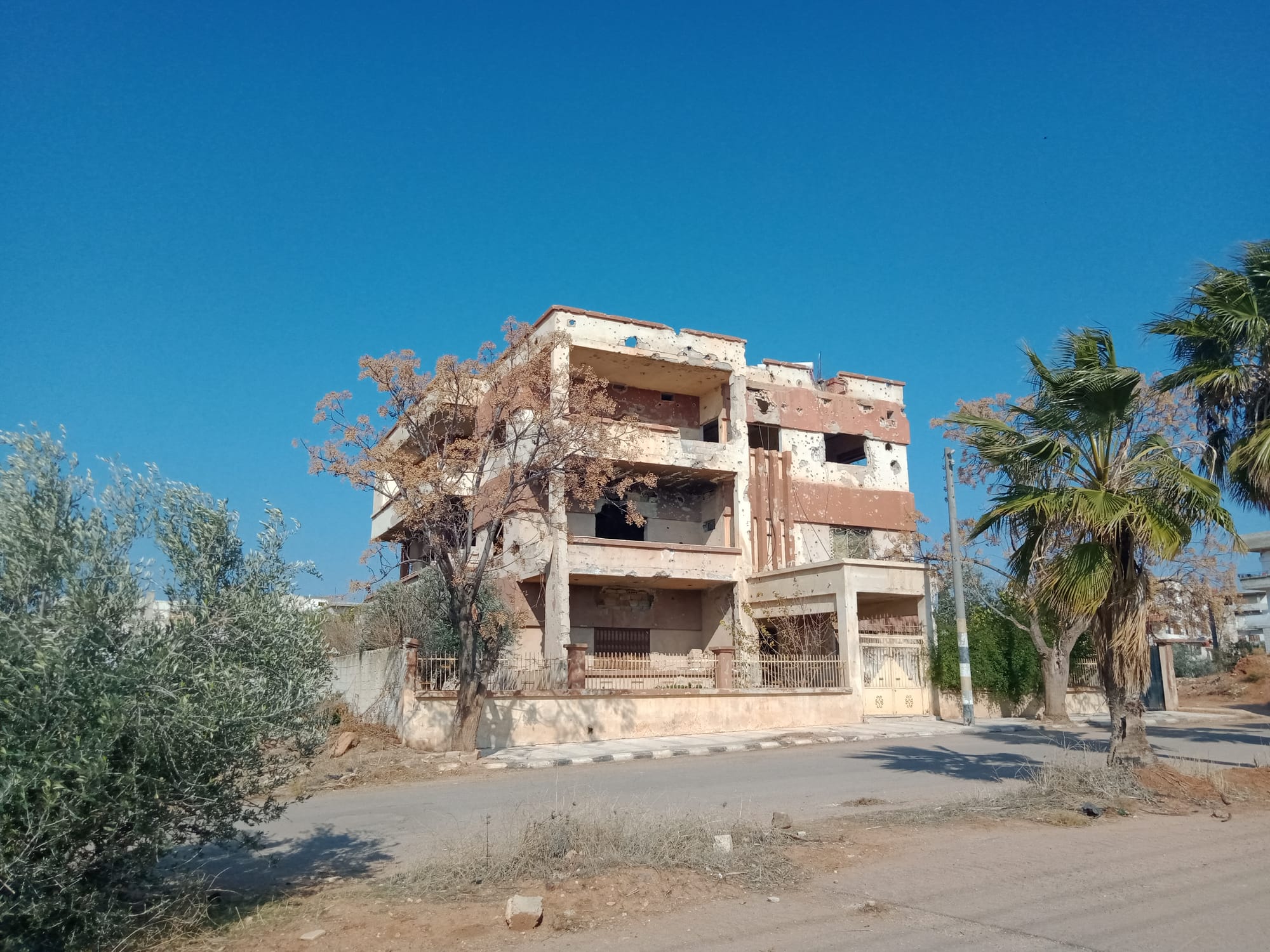
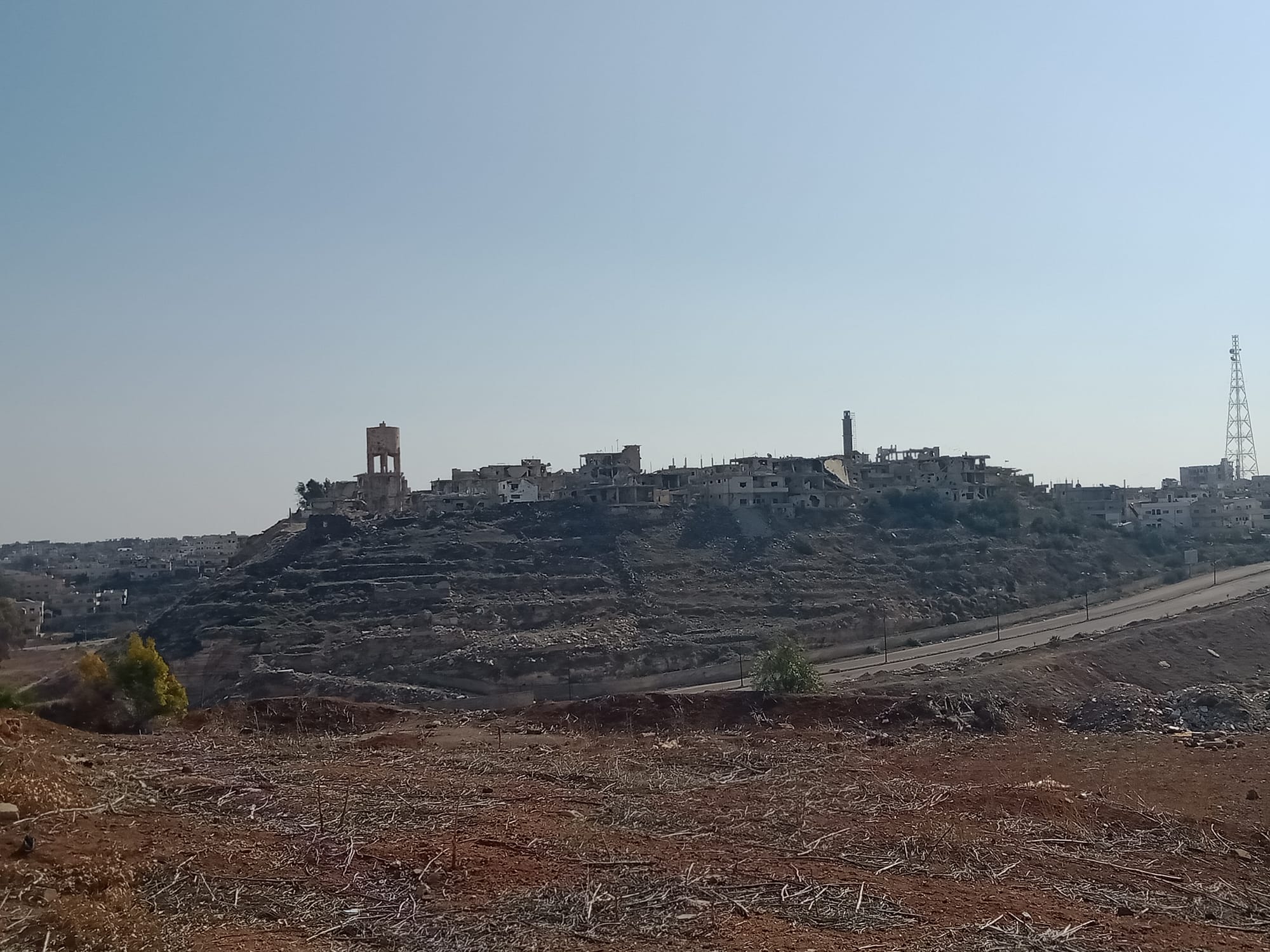
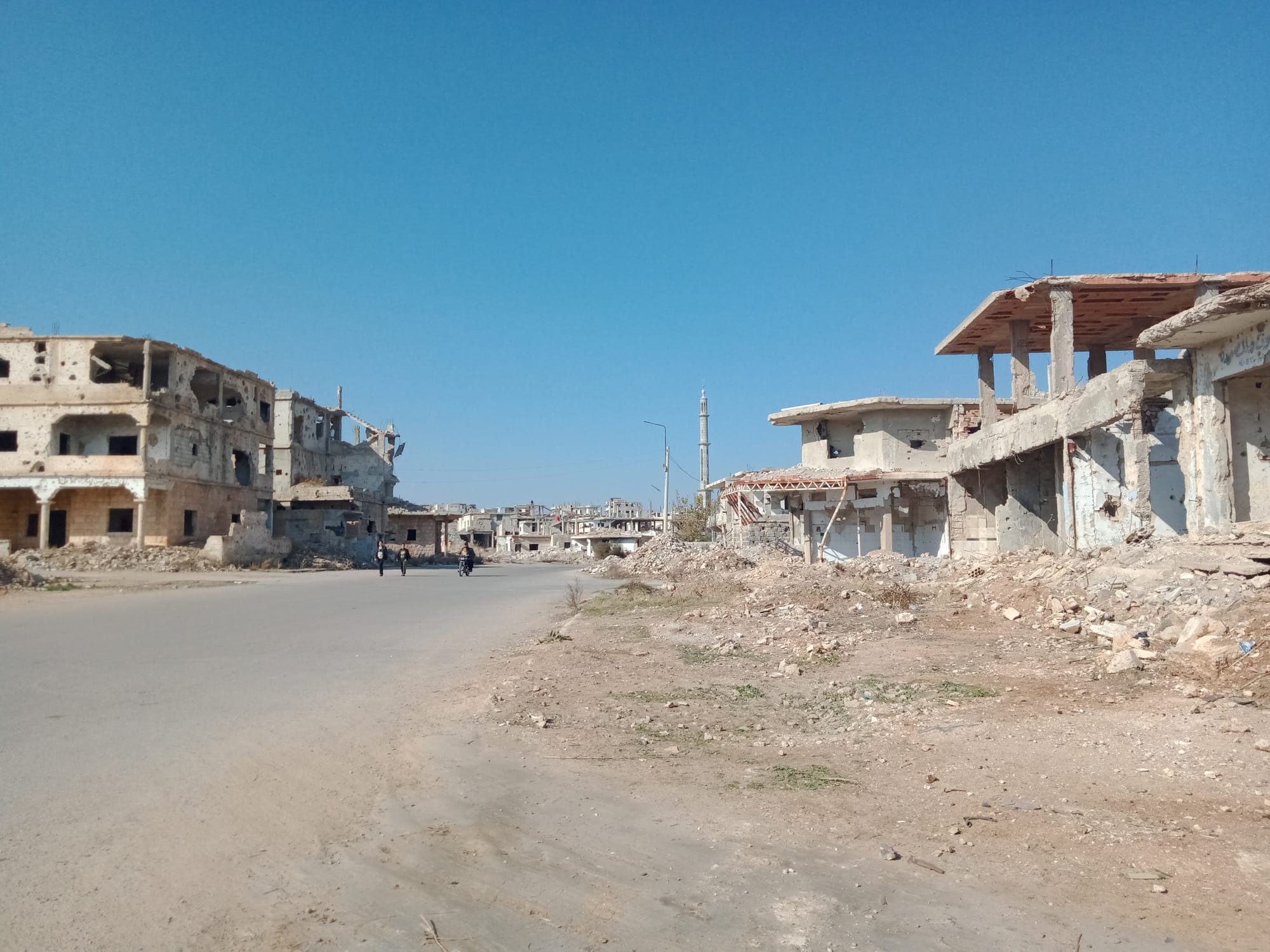
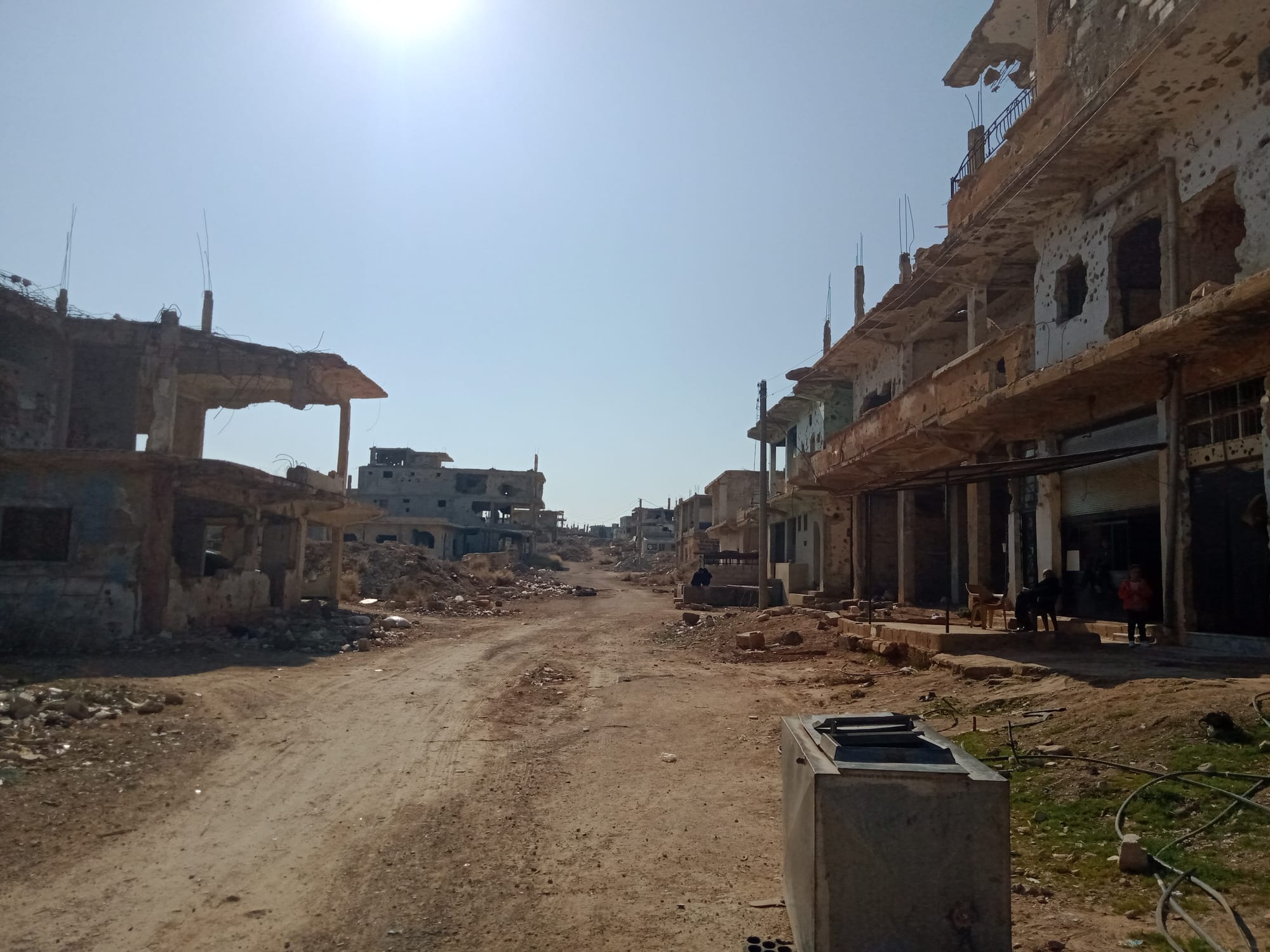
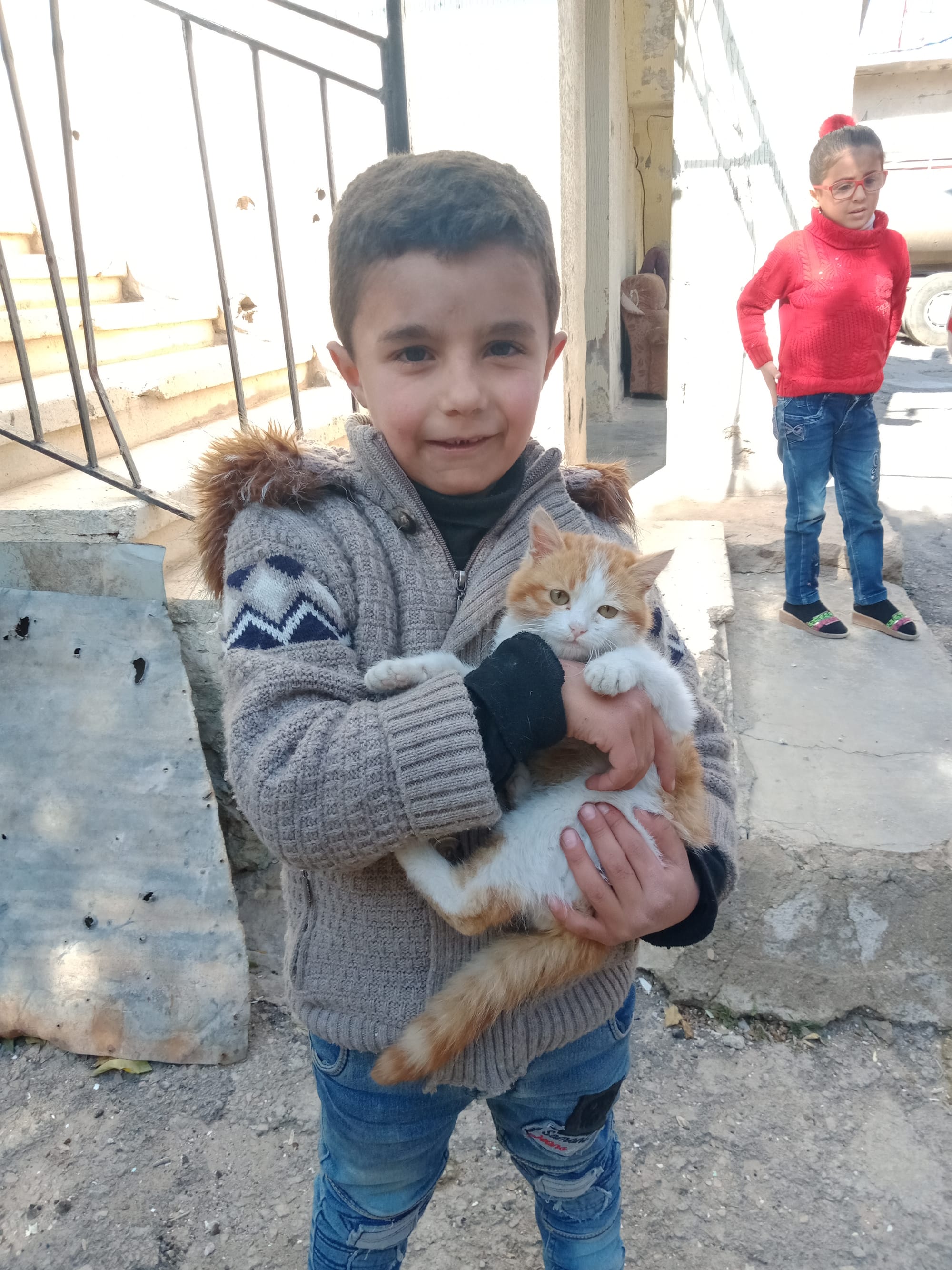
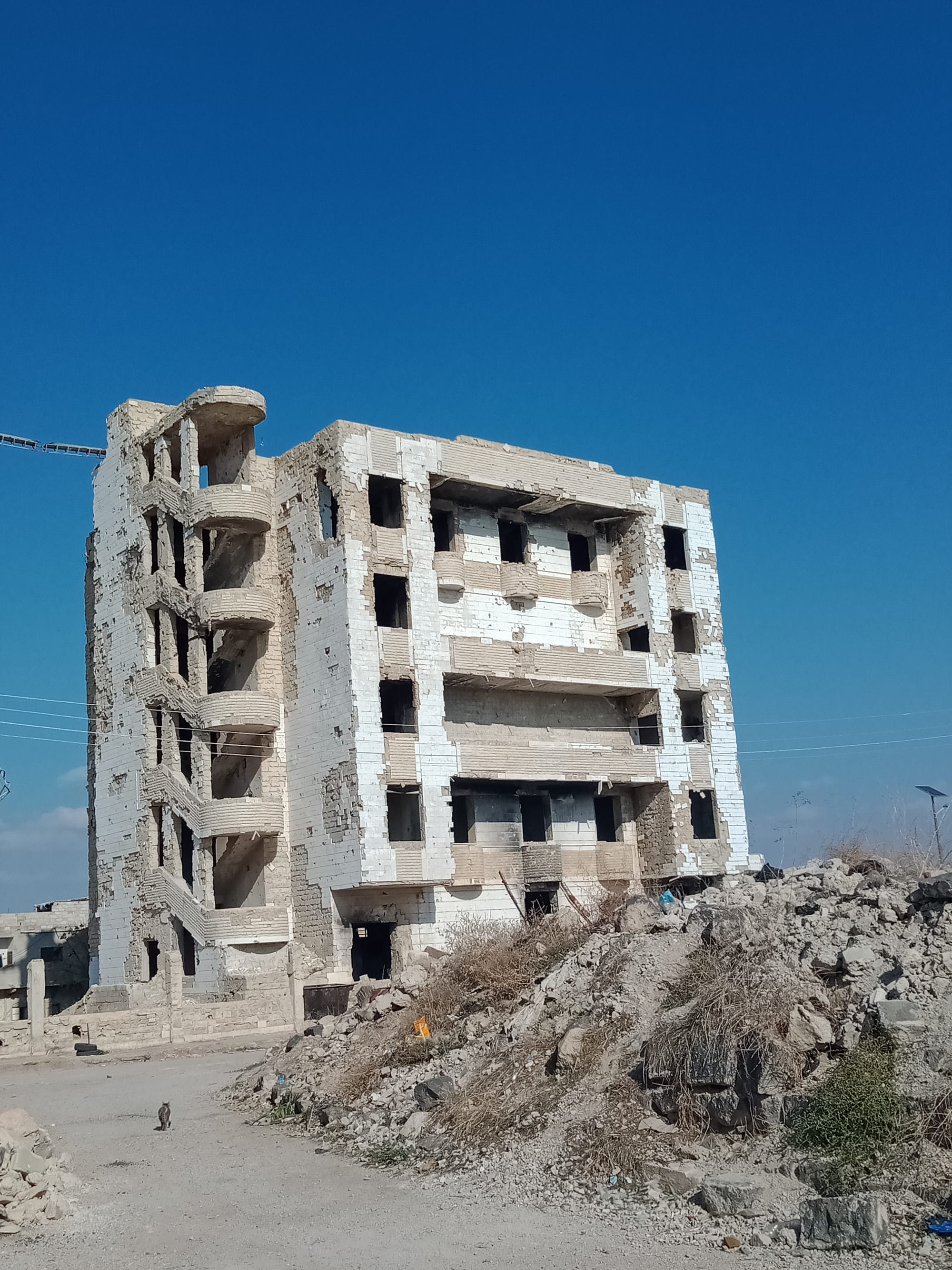
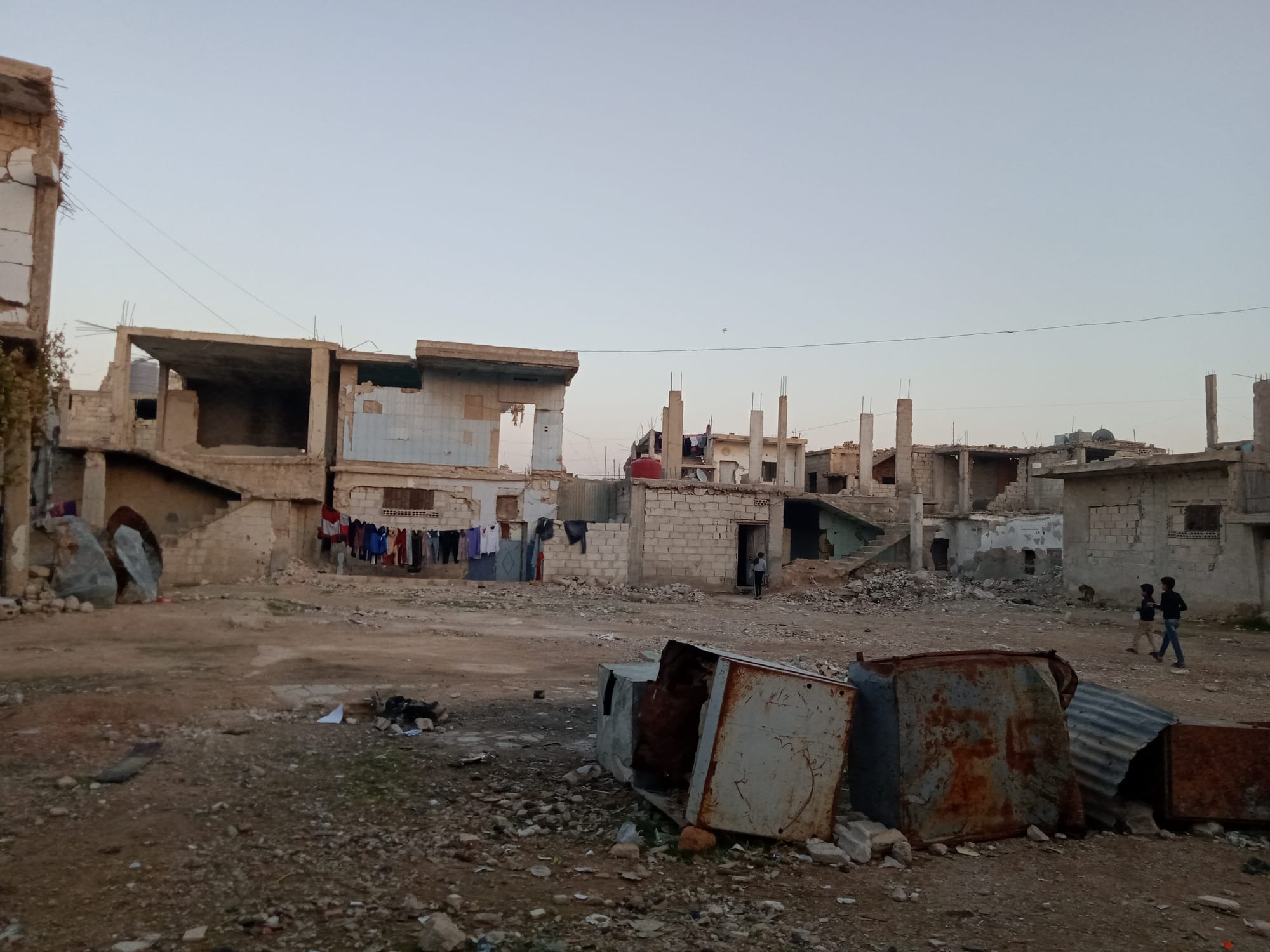
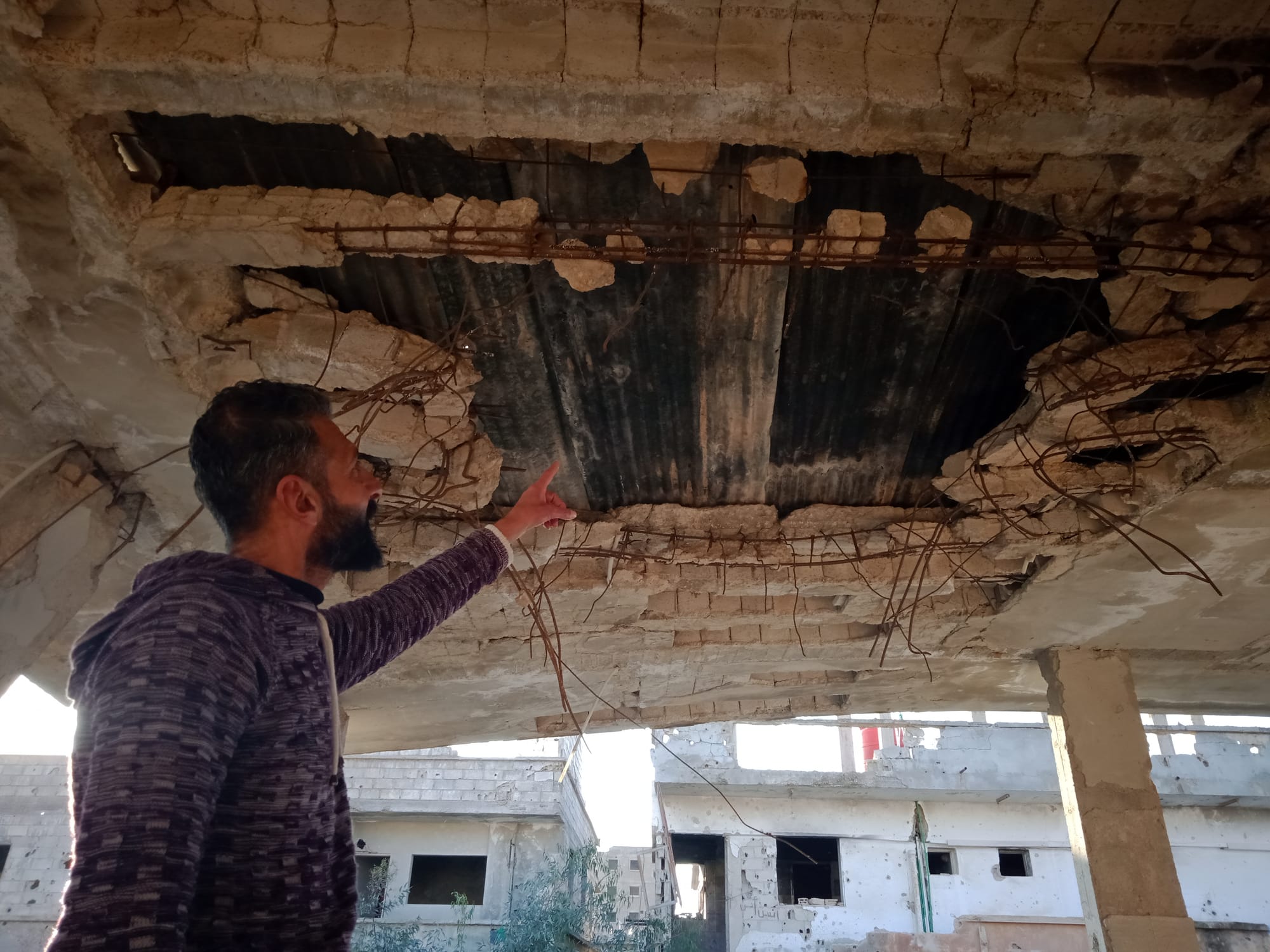
The town of Daraa CREDIT: Omar Hassan
All this devastation is the product of thirteen years of assault from the land and sky. Some parts of Daraa were fought over multiple times. Others were mostly free but subjected to endless bombing from above. Mouawiya’s brother Mohammad shows me the three-metre hole in his roof where a barrel bomb hit, destroying an entire level of his apartment building as well as a bedroom below. Sealing off the damaged areas is the best they can do for now. They can’t even afford to eat properly each day, let alone rebuild.
The Russian air force also bears much responsibility for the damage, launching wave after wave of bombing raids from its Hmeimim airbase. One boy, around 11 years old, tells me that they used to get warning calls from friends in Damascus, giving them a few precious minutes to seek shelter before the bombs began falling. Many people fled the area, seeking refuge in Jordan or Lebanon, while some fighters were sent to Idlib in the north as part of various truces. But many others had no option but to stay. One man says that he spent months living in the nearby telephone interchange without sanitation, water or electricity.
Faysal, a teacher and member of a grassroots committee for the provision of social services, explains that the district had 40 schools to begin with, but by 2018, only four were still standing. The rebels have built another sixteen since then, he says proudly. Families here clearly value education highly, their children’s futures a big concern even amidst the horror of war: “We didn’t want the kids to miss one day of school, and they didn’t”, beams Hanaan, another local teacher. But she admits that the war badly affected the younger generation. “They’re mentally unwell, they recoil from loud noises”, she says, ruffling the hair of a nearby boy.
There are other initiatives to try to improve amenities in the area. Nagham, a local activist I met in Damascus two weeks ago, is leading a campaign to replant trees that had been chopped down for heating fuel during the war. “I see the re-greening of Daraa as serving two purposes”, she says. “First, it’s about bringing natural beauty back to Daraa. Second, I see it as a way of holding on to the souls and memories of the revolution’s martyrs.”
The area’s many mosques are also slowly being rebuilt after the regime destroyed almost all of them. In this fairly religious and largely Sunni town, such spaces are a vital centre of social life as much as they are a place for prayer. It is moving to see thousands of these impoverished people gathering for Friday prayers in the partial ruins of a mosque, having survived, both physically and spiritually, the systematic terror of the past 54 years.
Mouawiya does not romanticise the armed phase of the rebellion, saying that “things started getting messy when money and guns started coming in from the outside”. Some hustlers and crooks got involved, some of them making a lot of money reselling guns meant for the resistance. Mouawiya is visibly angry at this, insisting that it was possible to remain clean if one was fighting for the right reasons. It is inspiring to see this man hold on to principle in a situation of social and economic breakdown, when the regime has made all normal life impossible.
In recent times, some of the FSA brigades in Daraa have begun affiliating to HTS. They were attracted by its superior funding and organisation, but also by what they saw as its success in governing Idlib province. “Things are great there, almost like Europe”, claims an armed guard patrolling the streets. He moved to Idlib just a few months ago after his father was appointed to a leading position within HTS. They returned to Daraa triumphantly, part of HTS’s southward march through Hama, Homs and Damascus. “We’re in HTS, but all the fighters here are local guys”, he emphasises. His fellow militiaman never went to Idlib but has joined HTS for similar reasons. He was first politicised by being shot in the back at the age of nine for playing on his front porch during a government-imposed curfew.
There are plenty of fighters that have not joined HTS. Mouawiya insists that he remains independent and that, in any case, HTS won’t exist for much longer. “It’s finished. All the groups will all be united into the Syrian army. And then there will be elections. There has to be.”
Overall, the dominant impression from Daraa is a feeling of somewhat resigned relief, a great distance from the elation and bustle of central Damascus. People are hopeful, but the suffering of previous years is inescapable, bruising, inscribed both in their physical environment and their collective psyche.
This is partly due to the terrible economic conditions that plague Daraa, and much of Syria. Mouawiya and his family continue to live in grinding poverty, as do most people he knows. Work is hard to find and doesn’t pay much. Freedom hasn’t yet increased anyone’s capacity to buy food, or diesel for heating. Nor has it dealt with the extreme electricity shortages, which mean most people get no more than a couple of hours a day. Several people also rage about the lack of viable homes in the area. “You’re lucky to find a single enclosed room for your whole family”, one says.
If a viable and better Syria is to be built from the ashes of the Assad dynasty, it will need to meet these essential needs—in Daraa and across the rest of the country.
CAN THE SYRIAN PEOPLE RESIST A NEW CAPITALIST REGIME?
SUNDAY 19 JANUARY 2025 | “Our public servants are a national asset”, read one placard from a strike by government employees in Suwayda last week. “No to the unjust decree, No to the sacking of our workers”, read another.
Around 600 people had gathered to protest against the dismissal of hundreds of public servants by administrators appointed by the new government led by Hay’at Tahrir al-Sham (HTS). The crowd reflected the full spectrum of working-class life—from nurses, doctors and administrators from the public health system to telecommunications workers, agricultural workers and employees of state-run factories. Importantly, it included those who had been fired but also those still employed by the state. The latter haven’t been paid in nearly two months and so joined not only in solidarity but also to raise their own demands.
Last week, hundreds of workers occupied the Department of Public Health in Daraa. This was in response to the HTS-run department announcing plans to halve its employee numbers, from roughly 1800 to nearly 900. They were joined by workers in the local tourism, culture and treasury offices, who face similar cuts.
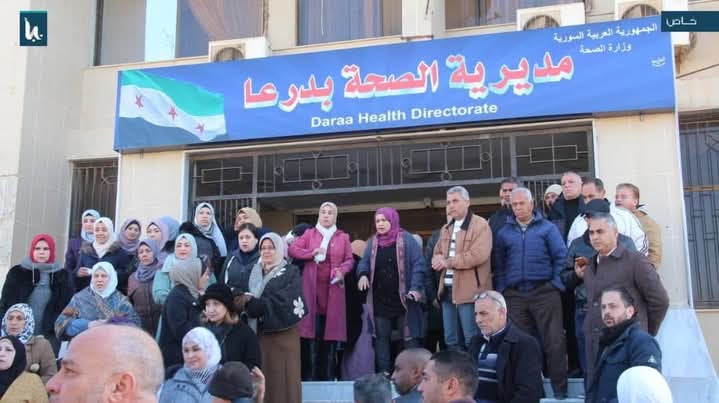
Accounts from the Daraa demonstration conveyed the workers’ fury and sense of betrayal: “We served in the most difficult times of war, and did not abandon our post during the pandemic ... We stuck to our jobs for years, despite salaries shrinking to no more than $20 a month”, one worker explained.
The cuts are coming as part of an effort by the interim government to resolve what it calls the “obesity” and inefficiency of the public sector. “[The government] does not have a magic wand to solve Syria’s economic problems”, said the caretaker finance minister, echoing managers of austerity drives from time immemorial.
What they do have is a very large axe, and their target is to slash 300,000 jobs from a total government workforce of around 900,000. If allowed to proceed, this plan will leave many families without any source of income, increasing the poverty rate in one of the poorest countries on Earth.
This reactionary measure is being dressed up in revolutionary, anti-Assadist rhetoric. The government claims that cuts are a necessary response to the corruption and mismanagement of the old regime. For instance, managers would create fake jobs for their friends and families regardless of their qualifications or even whether a job opening existed in the first place. The lucky few with deep connections (here, they are called wasta) could have as many as six salaries from such means.
Another argument that has appeared on social media and other unofficial channels is that anyone hired in the last ten years is, by definition, a supporter of the old regime. But this is a profoundly cynical perspective. As one working-class man said to me in Damascus: “[HTS] were living the good life in Idlib, earning good money sent to them via the Gulf [states] ... so it’s easy for them to blame every other Syrian who had to work for the disgusting regime to survive. But what were we supposed to do?”
The explanation for these moves is that HTS has a clear and reactionary economic vision for the country: “[Syria] will be a free-market system based on competition”, declared the head of the Damascus Chambers of Commerce after meeting with senior government figures, including the interim economy minister. As well as sacking hundreds of thousands of workers, they have made moves to open Syrian markets to foreign trade and have cut subsidies on bread. The government has faced criticism for these decisions, including that, as a transitional government, it should be making only emergency, as opposed to strategic, policy decisions.
For now, the HTS-led government is enjoying a grace period, still basking in the glow of its role in defeating the Assad regime. This is reinforced by the growing support Ahmed al-Sharaa and his team receive from international ruling class figures in the Middle East and the West.
It’s also reinforced by the important improvements in life for many Syrians. The first, and most commented on, is the capacity “to breathe”—that is, to speak freely about life and politics. Then there is the freedom of movement across a country once occupied by a regime every bit as brutal as any foreign power. Damascus is filled with people from Syria’s north who haven’t visited their families in over a decade. I was constantly asked for directions to the touristic areas, quietly comforted that others were just as disoriented by the labyrinthine streets.
On an economic front, the abolition of government checkpoints, where farmers would pay substantial bribes to get their goods through, means that the price of many fruits and vegetables has fallen substantially. The opening of borders to Turkey, Lebanon and Jordan has also helped. Ahmad, my driver in Suwayda, informed me that, at one point, a kilo of bananas cost 50,000 Syrian lira. But they’re coming in from Lebanon now, so “you won’t pay more than 14,000”.
Still, as one hotel employee explained despairingly, “It doesn’t help us much if prices go down a bit, if our wages are still worth nothing”. Syrians earn their income in lira, so the more than 99 percent collapse in the value of the Syrian currency since 2011 has devastated their living standards. She expressed cautious hope about the future when pressed, but her profound anxiety about the cost of living made it hard for her to revel fully in the fall of Assad.
Mohammed, a young man who works in Daraa as a salesperson for a medical company, came across similarly. While thanking God for the fall of the regime, he kept coming back to the challenges of daily life. “Never once have I been paid my full wage on pay day, because I’m always getting advance payments to cover costs”, he explained, somewhat embarrassed. “My whole life is debt; I can’t catch up.”
To address these fundamental issues, al-Sharaa initially promised a 400 percent increase in the wages of public sector workers. The finance minister subsequently clarified that “this increase will include workers whose qualifications are appropriate for the job, while others will remain on the same salary”. The current public sector salary is about US$15 a month, woefully inadequate even for basic survival.
Then there is the housing crisis. Syria has a severe shortage of livable homes, a product of the extreme destruction wrought on entire cities and towns across the country. The problem will get worse as exiles and refugees return in greater numbers. Syrian Facebook group INT, which I’m told is a moderated and reliable source of news, regularly features reports of disputes between returning Syrian exiles and the internally displaced refugees who have been occupying their vacant homes, in many cases for over a decade.
There’s a desperate need for more affordable housing. But property developers and tycoons are not in the business of providing affordable housing—they are interested in maximising profits. Nearly a decade ago, there were reports that Assad had plans to rebuild damaged parts of Damascus. But rather than restoring popular neighbourhoods to their former glory (or even just improving them), the plan was to deploy private capital to create luxury housing for the super-rich. The project stalled due to the ongoing turmoil in Syria. If foreign investors are given free rein, without any government planning, control or oversight, then these are the types of projects that will be prioritised.
As with so many aspects of Syria’s future, the nature of the economic model that results from this transition will depend on a clash between conflicting interests. Figures from the international political and economic elite want Syria opened up, Lebanon style, where a laissez-faire economy allows for a class of super-wealthy investors to extract massive profits from tourism, construction and finance, while the rest of the country stagnates.
The actions taken by workers in Suwayda and Daraa are especially important because they point to the only force that has the power to fight for a different kind of future. There are other, smaller, initiatives taking place, and grassroots organising is happening among workers and professionals across the country.
But it would be wrong to expect an explosion of unionisation and class struggle overnight. Over a coffee in a Lebanese cafe, Syrian socialist Joseph Daher suggested that the location of these actions is no accident: “Daraa and Suwayda have experience in organising themselves, they have a culture of this kind of politics now”. This was confirmed when I discovered that the strike in Suwayda was organised through the same WhatsApp community that has organised the region’s Movement for Freedom and Change since 2023.
“There have also been protests in Idlib against HTS’s decision [now rescinded] to raise tariffs on the import of essential goods”, Daher continued. “All of these places were liberated by the revolution some time ago; they are used to mobilising. It’s not quite the same in Damascus and Aleppo.” The process of developing trade union and left-wing organisations will thus take time and effort.
Yet, after so many years of misery, many young Syrians can’t bear the thought of more years of struggle and poverty. Many exiles, particularly the younger ones and those who made it to Europe, are only returning for short visits to see their loved ones. And many of those who stayed in Syria but now have the capacity to leave are planning to do so, especially those with university qualifications.
“I’m delighted that our country is finally free, but who knows how long it will take for things to actually get better”, revealed one young doctor in Damascus. “It’s impossible to build a secure life here, and I feel like I’m starting to get old.”
THE ORGANISING IS ONLY GETTING STARTED
WEDNESDAY 22 JANUARY 2025 | Entering Lebanon from Syria, the first noticeable shift is the greenery of the villages, mountains and plains. They contrast starkly with the largely bare central and southern parts of Syria, which have a sparse palette of ochres and greys—a testament to hard times.
It wasn’t always this way in Syria. Hundreds of thousands of trees were felled during the civil war, the wood used as winter fuel. A report by Dutch NGO PAX estimates that nearly 40 percent of Syria’s trees have been lost since the revolution began in 2011. In eastern Ghouta—the green belt around Damascus that includes Harasta, Douma and other sites of bitter fighting—the figure is around 80 percent. The same report also describes a pre-war Daraa possessing “lush riverbanks and parks”, which reads today like some sort of sick joke.
Returning to Lebanon is a shock to the political and physical senses. In the past, it’s been hard to stomach the country’s endemic poverty, governmental failures and perpetual exiling of its youth in search of better opportunities. All of that remains. But having spent so much time in the ruins of Assad’s Syria, Lebanon seems almost idyllic.
Lebanon has been through tough times, with the latest war between Israel and Hezbollah the cherry on top after years of economic and political crisis. Yet a new government has been elected, led by figures partially independent from the corrupt crony capitalism of the country’s traditional elites. Though the left remains sceptical that there will be much change, there is at least an opening to push.
While many Syrians are hopeful for their country’s future, the legacy of 54 years of totalitarian rule hangs over the place like a dark cloud. The drive back to Beirut from Damascus is a final reminder of the lingering bitterness. Each man sharing the car takes a turn explaining the crimes of the regime, the terrible losses of cousins, uncles and aunts, the kidnapping of friends by the security services.
“Nobody in the world has ever invented means of killing like Assad”, says our driver. “I mean, they created a press for human bodies! Rooms of acid, salt!” The mood is black, emotionally charged. No pill or cognitive-behavioural trick can mend these deep psychological scars. It will take time, social reconstruction on more humane lines, and more time.
Three of the four men also complain of their treatment at the hands of the Lebanese. “They looked down on us, as if we were dogs”, spits one. “I hope to god that one day they experience what we did, so we can show them how it feels to be abused in your time of need”, swears another. The younger man in the backseat next to me shoots a wry smile. He tells me later that he hasn’t found Lebanon so bad, having worked for the past eight years in a high-end French patisserie in downtown Beirut. But he’s heard many such stories and rightly sympathises with those who tell them.
I glean from this and other conversations that there is a clear class dynamic within the Syrian refugee community. Those who are educated—and who tend to be younger and wealthier—have built fairly happy lives in the relative freedom that Lebanon and Europe offer. But more blue-collar refugees and migrants have found the going much harder, typically shunned towards low-paid and exploitative industries like construction, cleaning and domestic labour.
A later interview with Omar, a Syrian refugee who has built a life for himself working in construction and landscaping in the sleepy village of Batloun, starts awkwardly. Knowing I’m Lebanese, he initially emphasises how thankful he is that the country has tolerated the presence of so many Syrians. “We’ve nearly doubled the population of your country”, he says. “I can understand why there is some hostility towards us.” This is only a small exaggeration: the Lebanese government estimated that, at one point, around 1.5 million Syrian refugees lived in this country of just over 5 million. (It puts Australia’s annual refugee intake of around 15,000 into perspective.)
When it becomes clear that I am sympathetic to the Syrian plight, Omar opens up. “The treatment we get here is very mixed. Many deal with us fairly, but others act as if we are an underclass ... Often, it is shaped by their political affiliations.” He cites an example of a Lebanese man pulling his daughter away from him as he entered a shop, as if he were a rabid dog. His agitation is obvious. “How can you teach a child to act that way to another human being?”, he asks. Omar goes on to explain that the sections of the community aligned with the Lebanese political party Hezbollah tend to be far more hostile towards Syrians. One even threatened to turn him over to the Syrian secret services.
Omar’s tale is a sad one: he was forced to flee Syria after spending two months camping in the wilderness to avoid being arrested by security forces. They had identified him as an oppositionist—and falsely branded him as al-Nusra—after he refused to join the security forces when the revolution began.
“I was part of the revolution; how could I work against my people?!”, he asks rhetorically. He lost 21 of his relatives to the regime’s counter-revolution, but still thinks it was worth it. With a huge smile, he tells us that he will soon visit his family for the first time in twelve years, though he’s not planning to stay permanently as work remains hard to find.
While many refugees of working age found ways to live relatively normal lives in Lebanon, or continued the perilous journey towards Europe, many others were unable to do so. For the old, young, orphaned or sick, the enormous refugee camps set up in the Bekaa Valley were the only option. More than 300,000 people languished in plastic tents through the freezing winters and scorching summers. Similar institutions were set up in Türkiye and Jordan. “I feel sorry for the poor children raised in these places”, Omar says.
It was hard to leave Syria, to process the gut-wrenching feeling that I was abandoning a people who have struggled alone for far too long. The governments of the world watched while the country burned, more fearful of revolutionary victory and regional instability than the regime’s brutal repression.
Syrians were also abandoned by most of the Stalinist and anarchist groups internationally, who disgraced themselves either by slandering the revolutionaries or, in many cases, openly defending Assad. By relying on familiar narratives about imperial intervention rather than grappling with the complex reality of a popular revolution, they found themselves on the wrong side of the barricades, siding with unimaginable state violence against some of the bravest people on earth.
The fall of Assad, along with the collapse of Iran’s so-called Axis of Resistance this year, is yet another major turning point in a region scarred by two decades of brutal US wars and occupations, revolutions and counter-revolutions, growing sectarian tensions and violent Israeli expansionism. Western imperialism has played a key role in these tumultuous events, leaving millions dead or injured in the wake of their barbarous operations in Iraq, Afghanistan, Libya and, of course, Palestine.
But in Syria, as with Yemen, Bahrain and Egypt, the West was a secondary player. And while the historic crimes of colonialism are important to recall, the immediate causes of the social and economic crises that plague the region are overwhelmingly to be found in the exploitative, bigoted and sectarian politics of the regional capitalist classes.
As the bitter debates over the Syrian revolution proved, making sense of these complex and contradictory dynamics, and even more importantly, championing those fighting for liberation, has not been easy. But lest those who got it right feel too complacent, we should remember that we were unable to offer any practical solidarity—a painful failure and an urgent challenge for the future.
By rights, the Syrian people now deserve a global effort to facilitate reconstruction and the alleviation of their country’s many social and economic crises. That would be the minimum reparations for the world’s indifference to their suffering. But in this despicable capitalist world, it is more likely that there will be a mad scramble for the country’s resources; Syria as the ramshackle house on the corner bought only to be bulldozed by developers seeking a quick buck.
Syria’s new rulers, Hay’at Tahrir al-Sham, will be another challenge, being both right wing and highly pragmatic. Thus far, they have been keen to prove their commitment to international norms, including the free market. They have also refused to make any statement of support for the Palestinians and have instead called for their militias to be disarmed. Even worse, they seem set to deport an Egyptian man, himself a member of HTS, for the crime of calling for the fall of his country’s military dictatorship. All of this suggests that it is far from certain that the new Syria will fulfil the dreams of the revolutionaries who continue to fight.
Yet pessimism is a privilege reserved for those who stand aside from the battle for life, freedom and economic justice that the exploited and the oppressed have waged for millennia. Right now, there are tens of thousands of Syrians fighting to wrest their rights from the local and international capitalists who have denied them for so long. Far from feeling defeated, their organising efforts are just getting started. On WhatsApp and Facebook, there are constant updates about meetings, protests and strikes across the country. Friends in Suwayda and Daraa are busy replanting thousands of trees lost in the calamities of the past fifteen years, a quietly courageous investment in an unknown future.
These brave comrades—the socialists, unionists and students determined to shape their country’s future—deserve our solidarity and love in the coming period.


