

CONTENTS
A CENTURY AGO, Russian workers blazed a new path in human history. Their revolution of 1917 inspired millions around the globe and struck terror into the hearts of the rich. They overthrew the 300-year-old Tsarist monarchy in February (March in the Western calendar). On 25 October (7 November), with the backing of the soldiers and peasants, they overthrew a provisional government that tried to impose capitalist rule. The soviet government, as it became known, refused to continue the slaughter of World War One. It gave the land to the peasants and made far-reaching reforms under workers’ control.
Australian workers heard of the revolution through a hostile press. But they also heard amazing stories carried around the world’s ports by seamen explaining the workers’ view. On 8 November, on reading the news, thousands celebrated by walking out of work. Many celebrated for a whole two days. The red flag flew over trade union halls. Sydney Trades and Labour Council declared:
“We rejoice in the revolution in Russia and congratulate the people of that country on their efforts to abolish despotic power and class privilege, and urge the workers of other lands where similar conditions exist to follow their example with the same magnificent courage and determination.”
“Does anyone imagine that Russia is going to have a monopoly of revolution?”, asked H.E. Boote, editor of the Australian Worker, the newspaper of the Australian Workers Union. “The workers are questioning their rulers … And they are putting capitalism through an examination that probes its pretensions to the very core.” In country after country, workers rose in revolt. The revolution inspired artists, poets, writers and philosophers and changed the way they viewed the world. Popular artist Marc Chagall wrote:
“The revolution moved me with an absolute force that takes hold of personality, of an individual human, of his being, surging through the borders of imagination and bursting into the most intimate world of images, which themselves become part of the revolution.”
Not everyone celebrated. The Melbourne Age sneered that the workers’ government was “a comic opera government”. Along with all the capitalist press it predicted that the revolution would “fizzle out in a pandemonium of drink and vice”. Over the intervening century, respectable writers have never tired of warning that if workers dare to get above our station, the world will descend into chaos and madness.
However, the story of 1917 reaches out to us 100 years later, in a world of injustice, inequality and war. It demonstrates the possibility of rapid changes in political consciousness, the potential for unity between all the oppressed and the determination and organisational genius workers are capable of in mass struggle. It shows that those who rule can be overturned.
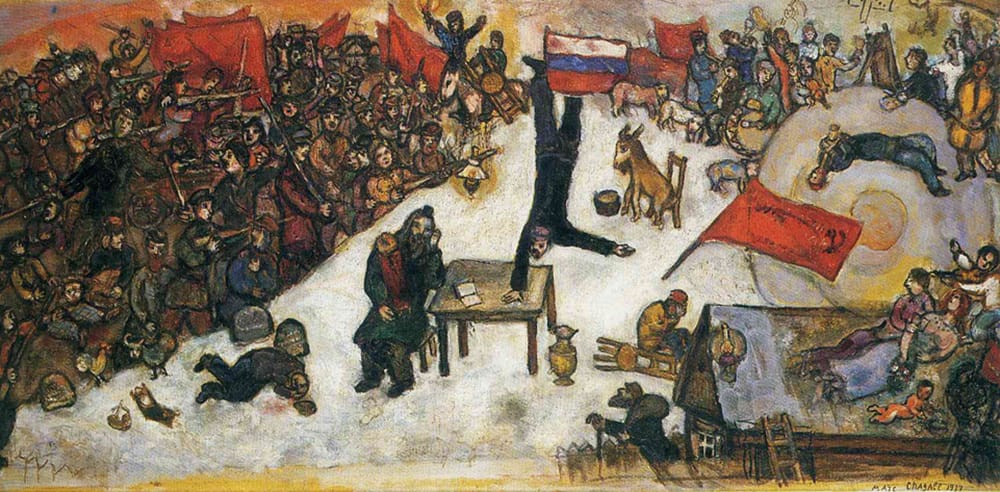
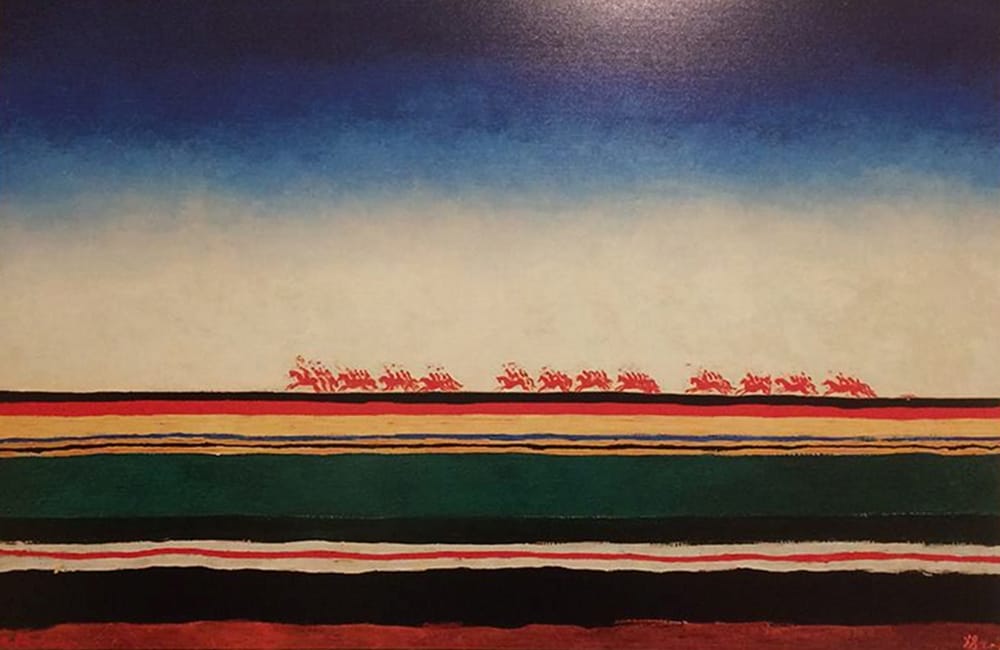
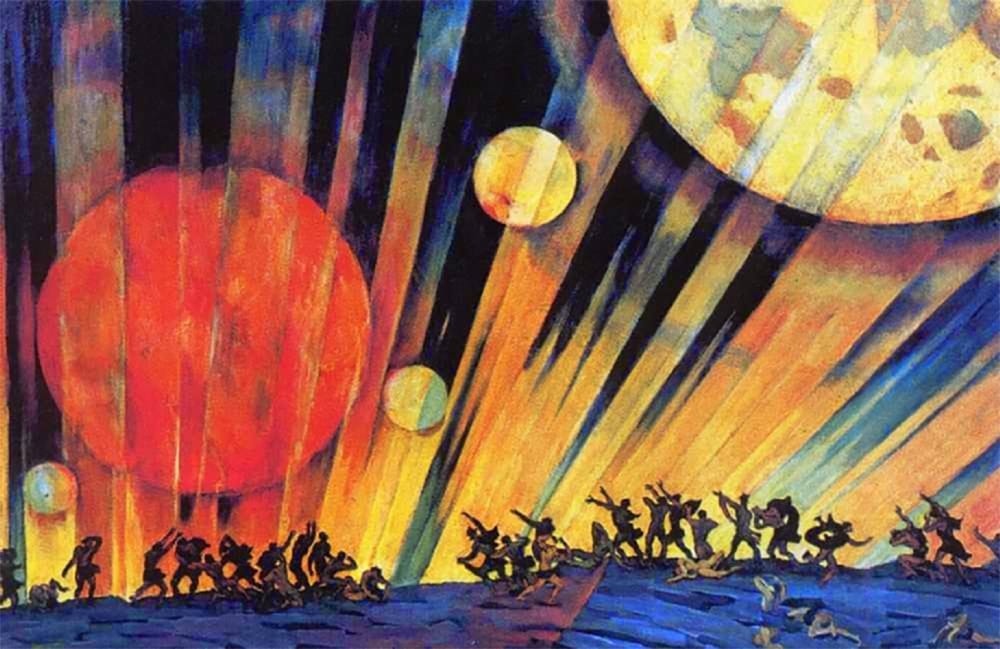
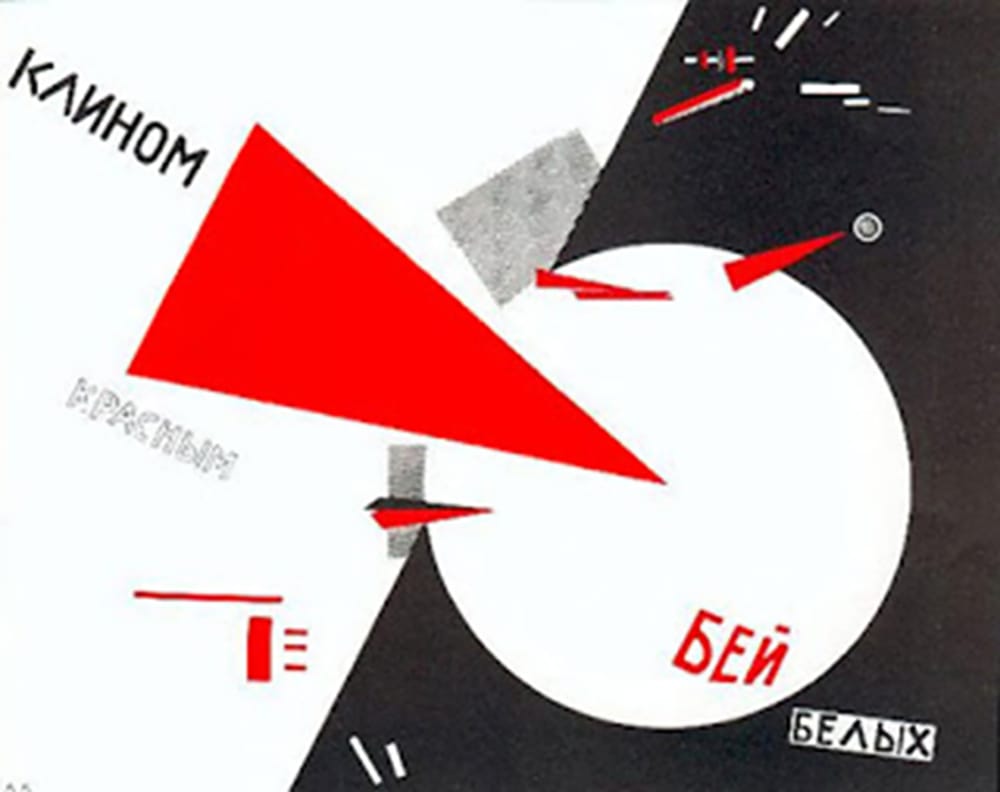
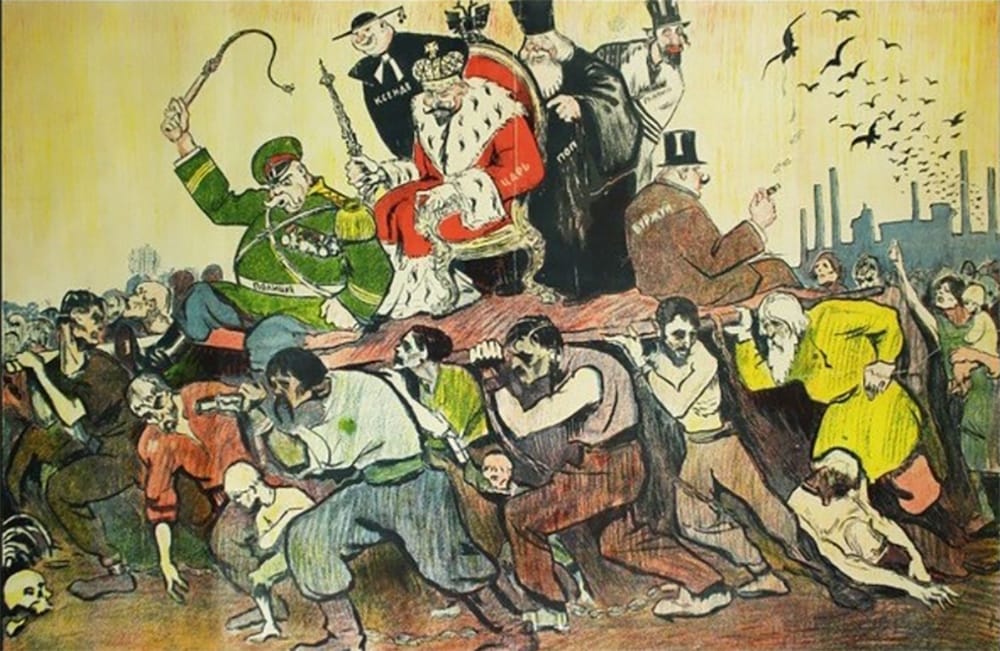
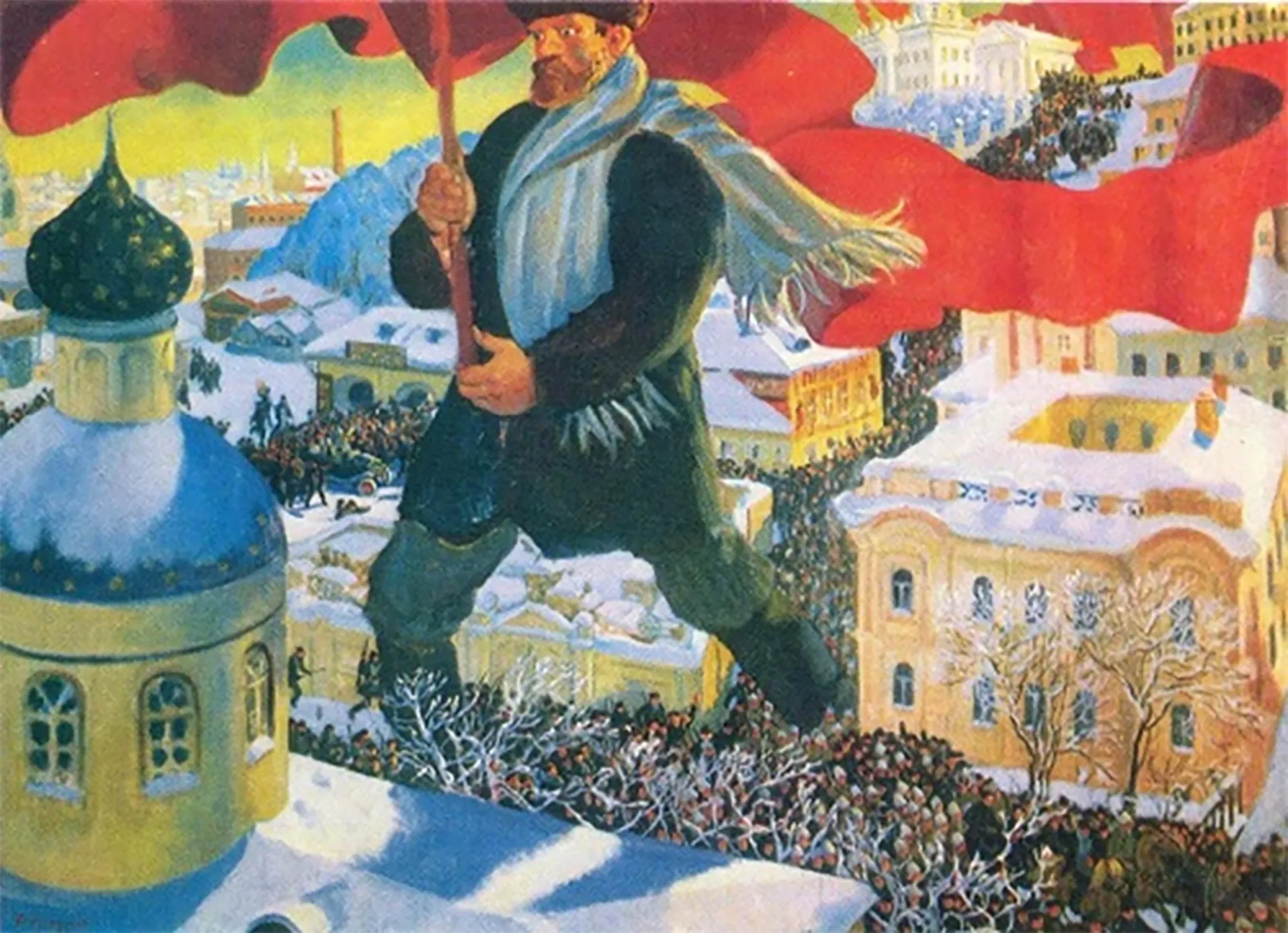
REVOLUTIONARY ART. From top left to bottom right: 1: “Revolution” by Marc Chagall depicts Lenin standing on his head, indicating that the serious business of revolution will result in a world of joy, fun and festivity, with the world turned upside down, to which he is pointing 2: Artist Kazimir Malevich is said to be as influential in his impact on modern art as he was radical. This work, rarely seen, depicts the Red Army in the civil war after 1917 3: “The new planet”, by Kostantin Yuon 4: "Beat the Whites with the Red Wedge" is a 1919 lithographic Soviet propaganda poster by Lazar Markovich Lissitsky 5: Soviet anti-war artwork
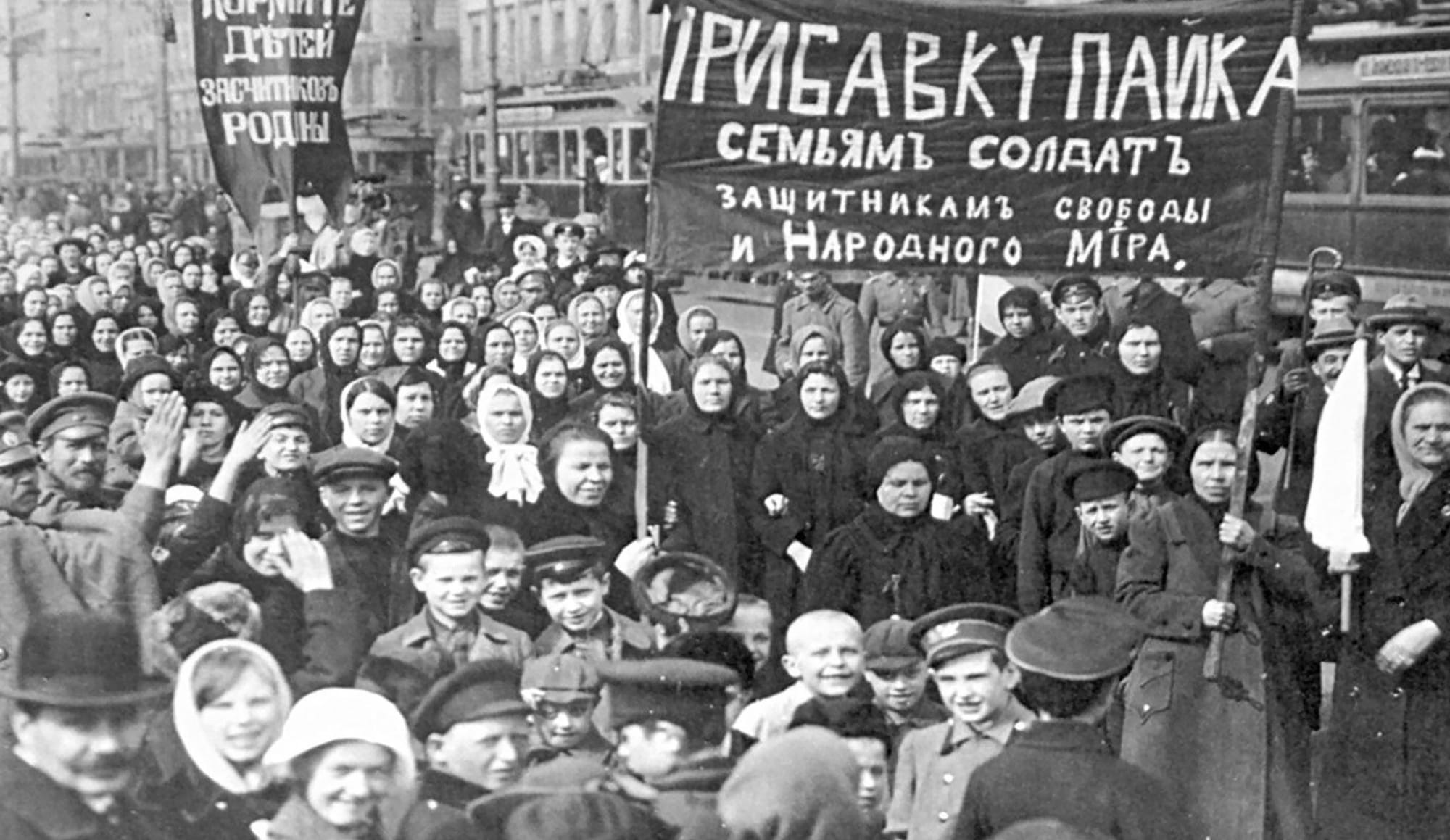
THE FEBRUARY REVOLUTION
“If future historians look for the group that began the Russian revolution, let them not create any involved theory. The Russian revolution was begun by hungry women and children demanding bread and herrings. They started by wrecking tram cars and looting a few small shops. Only later did they, together with workmen and politicians, become ambitious to wreck that mighty edifice the Russian autocracy.”
– Pitirium Sorokin, Leaves from a Russian Diary
“By providing, almost by accident, a large-scale instance of unpunished civil disorder, they [the working class women of Petrograd] demonstrated the hopeless inability of the government to preserve law and order at the centre of its power.”
– Richard Stites, The Women’s Liberation Movement in Russia
TWO PERSPECTIVES, ONE REALITY. These are the conditions that Vladimir Lenin, leader of the revolutionary Bolshevik Party, thought were necessary for a revolutionary situation: workers would not go on in the old way and the ruling classes could not continue to rule. As Leon Trotsky, the most important leader alongside Lenin in the October revolution, wrote: “The history of a revolution is for us first of all a history of the forcible entrance of the masses into the realm of rulership over their own destiny”.
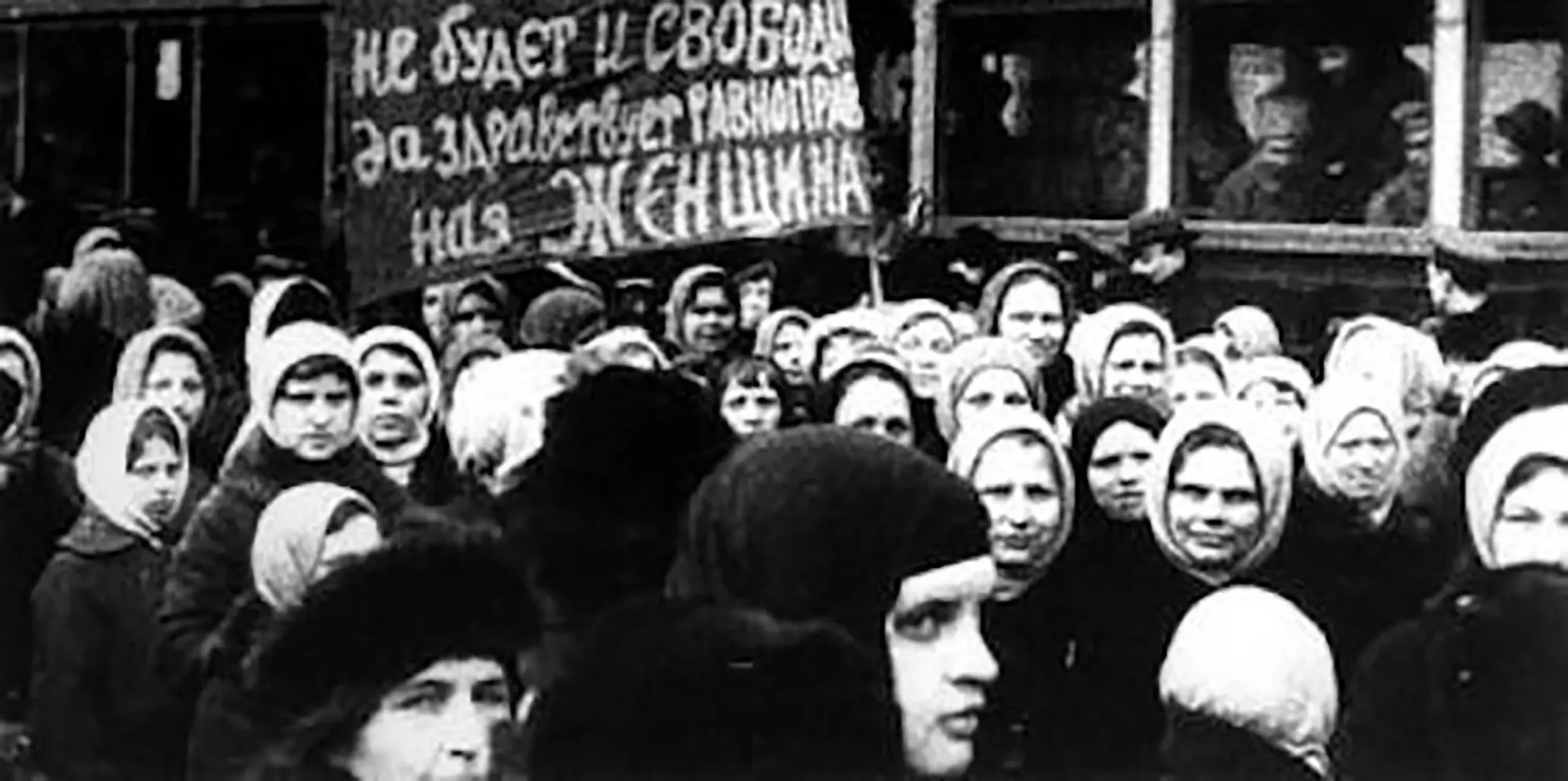
Our story begins when women workers of Petrograd took the first steps toward that destiny. It was International Working Women’s Day (IWD), 23 February (8 March). Before the morning was out, tens of thousands of women textile workers were on strike. Joined by housewives, they marched to the metal factories demanding that the (mostly male) workers join them. “We could hear women’s voices in the lane overlooked by the windows … ‘Down with high prices!’, ‘Down with hunger!’, ‘Bread for the workers!’”, recalled a worker in the Nobel engineering plant in the Vyborg district, the centre of working-class radicalism and militancy:
“The gates of No 1 Bol’shaia Sampsonievskaia mill were flung open. Masses of women workers in a militant frame of mind filled the lane. Those who caught sight of us began to wave their arms, shouting: ‘Come out!’, ‘Stop work!’ Snowballs flew through the windows. We decided to join the demonstration.”
By the end of the day, more than 100,000, a third of Petrograd’s industrial workforce, were on strike. The women had acted against the wishes of the revolutionary Bolsheviks who, conscious that any action could spark an uprising, worried that workers weren’t yet ready. Nevertheless a Bolshevik worker known only as Kayurov, wrote later “once there is a mass strike, one must call everybody into the streets and take the lead”. The Tsarina, wife of Tsar Nicholas II, dismissed their protest as “a hooligan movement”, informing Nicholas that “if the weather was cold they would probably stay at home”. But the next day, meetings, proclamations and marches continued; the numbers on strike swelled to 200,000 angrily demanding bread to feed their starving families. Thanks to police spies, some of the workers’ contributions to these momentous events are preserved in state archives. For example, a worker called Peter Tikhonov addressed a meeting:
“So, comrades … my opinion is this. If we cannot get a loaf of bread for ourselves in a righteous way, then we must … go ahead and solve our problems by force. Only in this way will we be able to get bread for ourselves. Comrades, remember this also. Down with the government! Down with the war!”
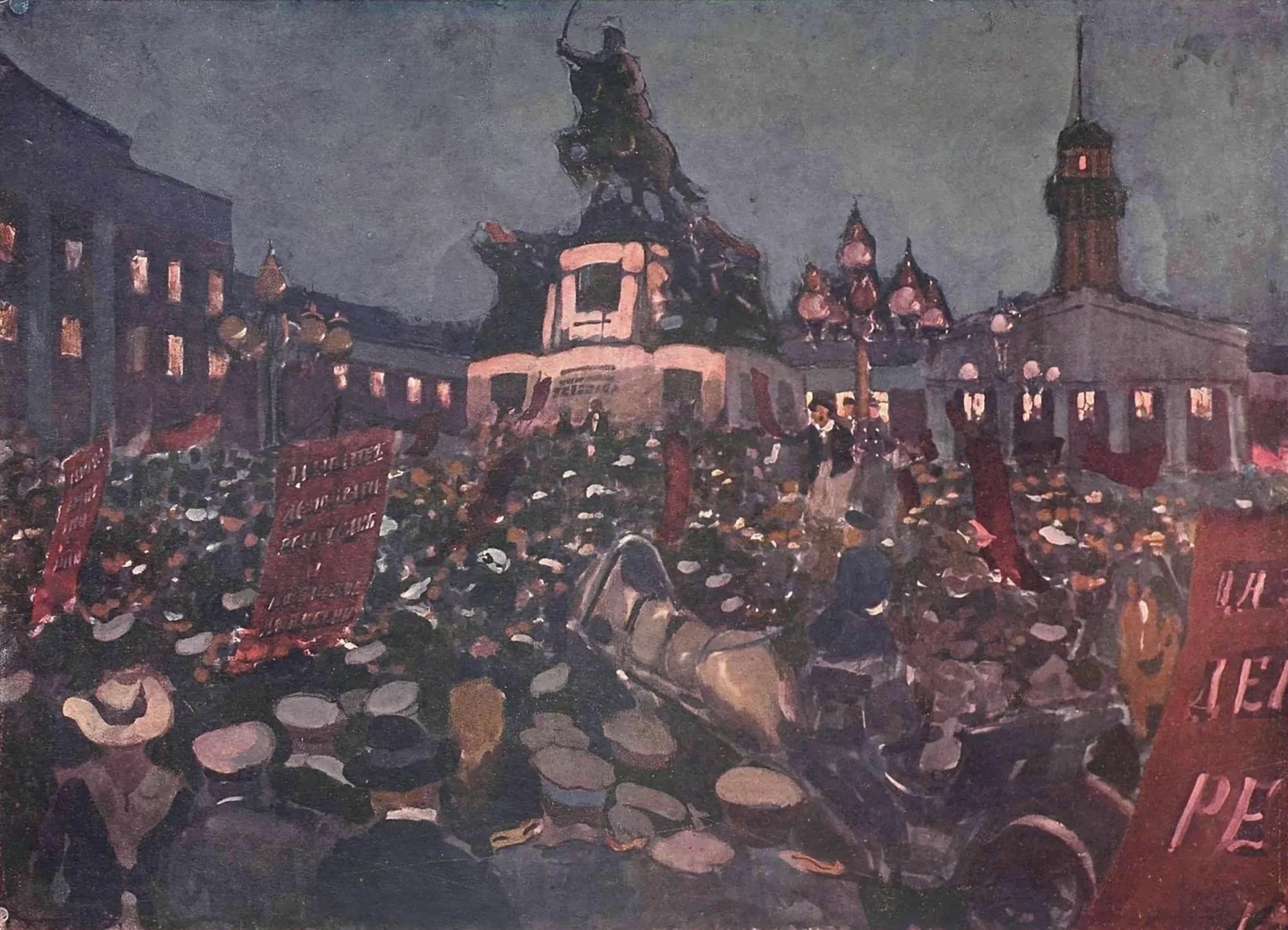
All accounts of these days talk of the “newly unfettered public life” and speak of the streets of Petrograd and Moscow as “one vast and ongoing meeting” in this society gagged for decades. Speakers on street corners drew huge crowds. Red flags fluttered everywhere, including over Palaces turned into meeting places for new organisations being created in the revolution. People wore red ribbons and raised red banners, creating a festive atmosphere. Talking, talking and more talking, reading everything people could find: posters plastered around the city, newspapers and leaflets. Everyone was singing, dancing and marching in demonstrations. Acts of spontaneous joy, which amounted to defiance, infuriated the rich and respectable. They complained that servants were unruly, spending their time going out decked in red ribbons, coming home at all hours, going out again and ignoring their employers’ wishes to be waited on hand and foot.
The revolt sent shock waves through the soldiers, many of whom were conscripted peasants. The veterans were worn out and disillusioned by the appalling conditions, and the slaughter at the front. Women such as Zhenia Egorova, secretary of the Bolsheviks in the Vyborg district, appealed to them to disobey their officers. The officers tried to discipline their men with the age-old tactic of sexist put-downs of the women, calling them old hags. But they were no match for the appeals of the courageous women to war-weary soldiers. Their demand, “Put down your bayonets – join us!”, struck at the soldiers’ hearts. The elite Cossacks wavered; without openly breaking discipline, they failed to force the crowds to disperse. “Standing stock still in perfect discipline, the Cossacks did not hinder the workers from ‘diving’ under their horses”, Trotsky described in his magnificent History of the Russian Revolution. “The revolution does not choose its paths; it made its first steps toward victory under the belly of a Cossack’s horse.”
An account of the afternoon of 25 February records that a young woman stepped out from the crowd confronted by Cossacks and walked slowly toward the troops. As she approached them, she took from under her cloak a bunch of red roses and offered it to the officer. His unexpected acceptance was an electric signal of both peace and revolution. Mikhail Slonimisky, a famous Russian writer, was a soldier and wrote about the experience:
“‘We’re going forward into the unknown!’ … [The young soldier next to me] uttered these words enthusiastically with pathos and with great hope … We indeed were marching forward into the unknown … A gendarme … fired a shot, but the rifle was instantly torn from his hands and he, pale and encircled by angry soldiers, begged, ‘Don’t kill me! I didn’t know you were having a revolution’.”
The soldiers, many with red ribbons tied to their bayonets, insurgents now and risking everything, would in the next days shoot some of their officers and the hated police who attacked workers’ demonstrations. But they refused to murder the workers. When exiled Bolshevik leader Alexandra Kollontai arrived, she was welcomed at the border by a soldier with a bright red ribbon fluttering on his chest. Officers who tried to force them to remove the red ribbons were arrested and detained, some even shot. These ribbons signified hope for a new society and represented a profound shift in class power. News of the rebellion sparked strikes in Moscow on 27 February. Within 48 hours, police stations had been wrecked by crowds of workers and students. Political prisoners were freed, and a workers’ council was created. In response, the government declared that the rioting by rabble must be put down. But a soldier, Shishilin, recalled, “By this time, the soldiers understood the word rabble in the opposite sense”. Many were now going to the city Duma building (a Tsarist parliament with a limited franchise) to find out how to join the revolution.
Five days after IWD, the Romanov autocracy of more than 300 years had been trampled under the feet of these “hooligans” backed by virtually the entire workforce of Petrograd followed by Moscow. The rebellion spread like wildfire to other urban centres, across the fertile plains, the frozen tundra and the mountainous Caucasus of the Russian empire. Nicholas was forced by his own generals to abdicate. This complete humiliation took place in a stranded railway car in Pskov, 300km south of Petrograd, because workers refused to move his train.
Women in the revolution
Most accounts of this episode, known as the “February revolution”, rightly emphasise the role of women workers. In most histories, they are largely absent for the rest of the year, except for one striking example: the reactionary women’s armed battalion, which tried to defend the Winter Palace in October. Yet more women stormed the palace, and some tens of thousands fought in the civil war to defend the soviet government. Contrary to this usual historical account, once women shook their chains of oppression, they took their part as fighters for liberation. Their involvement consistently grew, bringing with it a commensurate radicalisation among at least some layers. A strike by Petrograd laundresses in May involved 5,500 in 200 laundries, organised by their union set up during the February uprising.
BOLSHEVIK WOMEN (click to read)
These women are just a few of those who were Bolsheviks before, or joined during, 1917:
Nina Agadzhanova was on Bolshevik leadership bodies and was elected to the Petrograd soviet by the Vyborg district.
Elena Giliarova, aged 18, served as a nurse on the Russian-Turkish war front in 1915 and as a propagandist for the Bolsheviks among the troops. After the February Revolution, she was elected by the soldiers to represent them in the Petrograd soviet. She later played a role preparing women to fight in the Red Guards.
Petronelia Zinchenko, from a poor peasant family in the Lithuanian-Polish area of the empire, was working making sailors’ uniforms at the naval base at Kronstadt in February 1917. She was elected to the Kronstadt soviet and joined the Bolsheviks in August. In October, she organised the sailors to go to the capital and was responsible for keeping order in the fortress and for communications between Kronstadt and Petrograd.
Arishina Kruglova helped free political prisoners in February, organised Red Guards in her area and was a delegate to two district soviets. During October, she led raids on wealthy areas, searching for arms for the Red Guards and disarming the enemy.
Serafima Zaitseva joined the Bolsheviks aged 20 in 1915, working in metal factories. She joined the Red Guards in her factory and was in a contingent that stormed the post office in October and fought counter-revolutionaries on the outskirts of Petrograd.
A. E. Rodionova, a tram worker, learned to read and write under the tutorship of Bolsheviks in 1916. She wrote for and helped distribute Rabotnitsa. She concealed a cache of arms at the tram depot in July, when the provisional government tried to disarm workers. In October, she was entrusted with loading these into two trams and making sure they arrived at the Winter Palace for its storming. She was also entrusted with keeping the whole transport system in Petrograd running during the insurrection to safeguard the seizure of power.
Several Bolshevik laundresses played a critical role organising the different laundries. Their demands were those the revolution had raised, from the eight hour day to decent wages and conditions and respectful treatment. Petrograd’s militant workers mobilised to support them as they battled scabs and repressive bosses. By the end of May they had won a significant victory. In July, many women leapt ahead politically. The Bolsheviks were accused of being German provocateurs, their leaders were being jailed, and their presses shut down by the Provisional Government, But in some textile districts, there was a considerable influx of women workers into the Bolsheviks while they were losing hundreds of male members. Thousands of women flocked to meetings and lectures by Bolshevik orators, often spilling out of huge halls into the streets. Women who had just learnt to read and write contributed articles to the Bolsheviks’ paper for women, Rabotnitsa.
Votes in factory committees reflected the shift to the left. At the Treugol’nik Rubber Factory (two-thirds female) prior to July, the Socialist Revolutionaries (SRs) often had the upper hand at general assemblies. But the more radical Bolsheviks won support. The Kersten Knitwear Mill (87 percent female, largely semi-literate recent arrivals from villages) was represented exclusively by the SRs in the Soviet (workers’ council) until mid-September, when new elections gave the Bolsheviks 965 votes and the SRs 1,340. The more conservative Mensheviks didn’t even run a list. In October, some working women trained with Red Guards – workers’ armed militias – and participated in the fighting. Others created Red Cross divisions, organised lectures on the care of the wounded and in the factories, bands of nurses were organised. One young woman Bolshevik, A. E. Rodionova, was given charge of the tramways system to ensure materials and people got to where they were needed.
The seeds of revolt
In January, a police report noted that Russia’s working class was
“on the edge of despair … the slightest explosion, however trivial its pretext, will lead to uncontrollable riots … The inability to buy goods, the frustrations of queuing, the rising death rate owing to poor living conditions, and the cold and damp produced by lack of coal … have all created a situation where most of the workers are ready to embark on the savage excesses of a food riot.”
Report after report recorded the atmosphere of tension and class conflict:
“[M]others of families, exhausted from the endless queues at the shops, suffering at the sight of their sick and half-famished children, at this moment … constitute a mass of inflammable matter for which only a spark is sufficient to cause it to burst into flames.”
Was it any wonder? While workers and peasants suffered the most terrible privations and hundreds of thousands of men were sacrificed at the front, the rich made no secret of their war profits. During 1916, both female and male workers had been increasingly restive, confronted with rising food prices and shortages, and the repressive Tsarist regime. In December, almost a thousand women had walked off their shift in a munitions store where they worked beside better paid men, demanding a pay rise.
The year began with a mass strike on 9 January, the anniversary of the massacre of Petrograd workers on Bloody Sunday in 1905, by around 140,000 workers from at least 120 factories – 40 percent of the city’s industrial workers. This was followed by regular mass strikes involving many women. On 14 February, another strike of 84,000 closed more than 52 factories in the midst of fears by the middle class that there would be “clashes” at the re-opening of the Duma.
Rex Wade, a social historian who has tried to understand the revolution by looking at the actions of the workers, writes that “strikes and demonstrations became daily events, with student demonstrations at Petrograd’s higher educational institutions and strikes in other cities adding to the growing turmoil”. And on 22 February, the day before IWD, 30,000 workers had been locked out by management at the giant Putilov works, Russia’s largest factory. Women from the plant demonstrated at food warehouses. Workers who met with politicians in the Duma warned that this might be the beginning of a big political movement and that “something very serious might happen”.
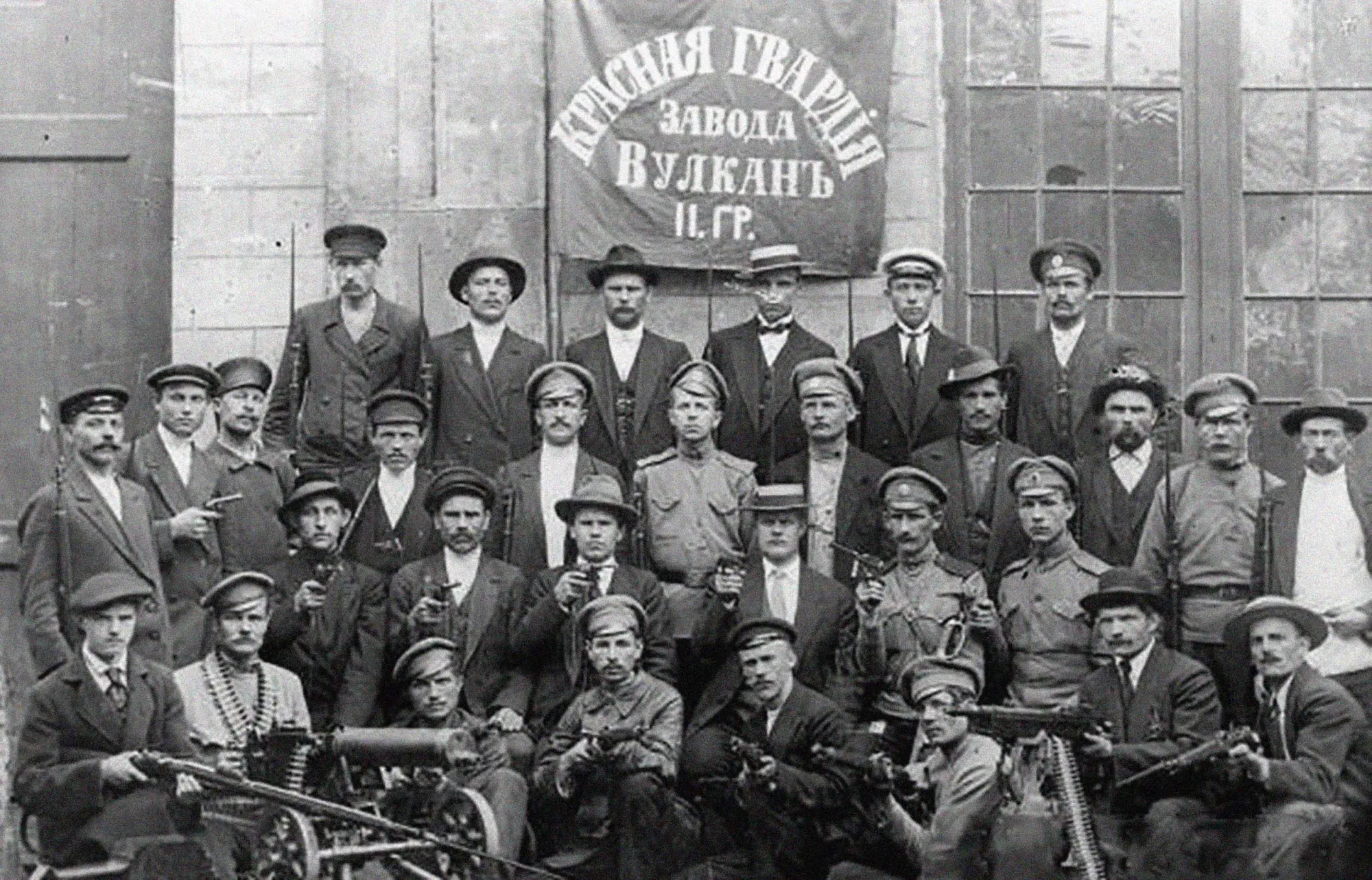
TROTSKY ON WAR PROFITEERING (click to read)
The Moscow textile company of the Riabushinskys returned a net profit of 75 percent; the Tver Company, 111 percent; the copper works of Kolchugin netted more than 12 million roubles on a basic capital of 10 million. Who better than Trotsky to describe the obscenity of war profiteering?
“Speculation of all kinds and gambling on the market went to the point of paroxysm. Enormous fortunes arose out of the bloody foam. The lack of bread and fuel in the capital did not prevent the court jeweller Faberget from boasting that he had never before done such a flourishing business. Lady-in-waiting Vyrubova says that in no other season were such gowns to be seen as in the winter of 1915-16, and never were so many diamonds purchased. The night clubs were brim full of heroes of the rear, legal deserters, and simply respectable people too old for the front but sufficiently young for the joy of life … A continual shower of gold fell from above.
“‘Society’ held out its hands and pockets, aristocratic ladies spread their skirts high, everybody splashed about in the bloody mud – bankers, heads of the commissariat, industrialists, ballerinas of the tsar and the grand dukes, orthodox prelates, ladies-in-waiting, liberal deputies, generals of the front and rear, radical lawyers, illustrious mandarins of both sexes, innumerable nephews, and more particularly nieces. All came running to grab and gobble, in fear lest the blessed rain should stop. And all rejected with indignation the shameful idea of a premature peace.”
The next day, a police agent reported, “the idea that an uprising is the only means to escape from the food crisis is becoming more and more popular among the masses”. The socialist organisations didn’t initiate the uprising. Nor was it purely spontaneous. Many of the political arguments, the initiative and foresight came from workers who had experienced the revolution of 1905 and its aftermath. They knew that certain things had to be prepared, such as winning the soldiers over. Textile workers regularly approached the soldiers to persuade them not to attack protests. A few days before IWD, the largely female staff at a trolley-car park sent a woman to the nearby regiment to ask the soldiers if they would fire on them if they came out. The soldiers’ answer was no, ensuring that on IWD the trolley-car workers joined the demonstration. Rex Wade writes:
“Especially important were the factory activists … Drawing on lengthy strike experience they quickly moved to the fore and provided the organisational skills and leadership for the demonstrations of the next few days. They organised the columns of workers as they marched from the factories and exhorted workers to demonstrate rather than simply going home. They gave impassioned speeches articulating worker grievances and demanding the overthrow of the regime. These activists helped organise the strike committees and other revolutionary organisations.”
Bolshevik women, for instance, organised strikes and mass meetings, including of male metal and tram workers, and helped soldiers free political prisoners. Many workers newly involved in radical actions wanted to keep escalating the street protests. Alexander Shlyapnikov, the leading Bolshevik in Petrograd, played a role in convincing them that they should approach the soldiers whose support was critical.
So the February revolution, while not “planned”, was not an inexplicable outburst of rage. It resulted from bitterness fuelled by the effects of the savage war. Many workers had lived through the 1905 revolution or just years of struggle. So the women, as well as male workers, had been preparing for the anticipated uprising, cognisant of the issues they faced.
The impact of the February revolution
The months between February and October reveal in all its complexity how workers, along with others who suffer injustice, can come to understand the true nature of the society that oppresses them and learn how to fight. The overthrow of the hated Tsar filled Petrograd’s workers and soldiers with elation and expectations. In the following months, in the words of Rex Wade, masses of people “burst forth with a dazzling display of self-assertiveness, public meetings and creation of new organisations”. Once they returned to the workplaces, there was an outpouring of hope for a new society, in declarations drawn up by general meetings. William Chamberlin, one of the earliest conservative historians of the revolution, had great insight into the process by which workers became radicalised. His account of the first months of the revolution gives a feel for the level of self-activity:
“What were the outstanding characteristics of the first period of the ‘deepening of the revolution’? Loosening of discipline in the army, increasingly radical demands of the industrial workers, first for higher wages, then for control over production and distribution, arbitrary confiscations of houses in the towns, and, to a greater degree, of land in the country districts, insistence in such non-Russian parts of the country as Finland and Ukrainia on the grant of far-reaching autonomy.”
Everything seemed turned on its head. The expectations were not just for political democracy while the social power of the capitalists remained. The workers of the Dinamo works summed up aspirations widely held:
“The people and the army went onto the streets not to replace one government by another, but to carry out our slogans. These slogans are ‘Freedom’, ‘Equality’, ‘Land and Liberty’ and ‘An End to the Bloody War’. For us, the unpropertied classes, the bloody slaughter [of World War One] is unnecessary.”
They created new ways of making their voices heard at every level of society: factory committees, trade unions and the beginnings of workers’ armed militias to keep order. They immediately set up workers’ councils, or soviets, drawing on the experience of the 1905 revolution. Everyone voted in elections for delegates to the committees regardless of sex, religion or background – except the ruling elite, who didn’t work and didn’t make the revolution. Factory committees dealt with everything from the soap in the washrooms, to fixing light bulbs, organising rosters, outlawing excessive overtime, disciplining unruly workers, controlling drunkenness, presenting cultural events and organising political discussions.
They led the fight for decent wages, equal pay for women, paid holidays, hot water and bath facilities in workplaces, support for the injured, sick and elderly, and maternity leave both before and after birth. When they couldn’t force employers to pay women equally, some of the most militant collected a levy from the best paid for funds to distribute to the lowest paid. They were determined to show that they were fighting for a decent world. John Reed, a US writer in Russia recorded his experiences in his wonderful book Ten Days that Shook the World. He said of the soviets, the centralised workers’ councils: “[N]o political body more sensitive and responsive to the popular will was ever invented”.
The revolution brought the reality of class rule and the exploitation it rested on out from the recesses of respectable society. Now they had toppled the central tyrant, workers set about overturning the tyranny of the workplace. One of the first things factory committees did was burn rule books with lists of punitive fines for minor misdemeanours; they destroyed black lists used to victimise militants, often with elaborate ceremonies. Hated managers and foremen were abducted, dumped in wheelbarrows, often with a bag over their heads, and thrown into the street or even rivers. Others were made to stand on tables and agree to change their ways after listening to a litany of their offences. Workers demanded respectful language, and an end to sexual harassment of women by foremen and managers. They were trying to assert their own humanity and dignity in contrast to the oppressive, demeaning conditions they had endured.
Above all, they wanted an eight-hour work day. It was a central demand to enable workers to participate in the social, political and cultural development which they craved and to which they felt entitled. Women played a prominent role in ensuring people didn’t work excessive hours, insisting that others had the right to jobs and that everyone should have time for leisure and to participate in the revolutionary activities. Students were brought in to teach workers to read and write. One young woman taught workers to read by printing Bolshevik slogans on a blackboard each day. John Reed immortalised these strivings for culture, knowledge and control over their lives. He told the world “all Russia was learning to read, and reading”:
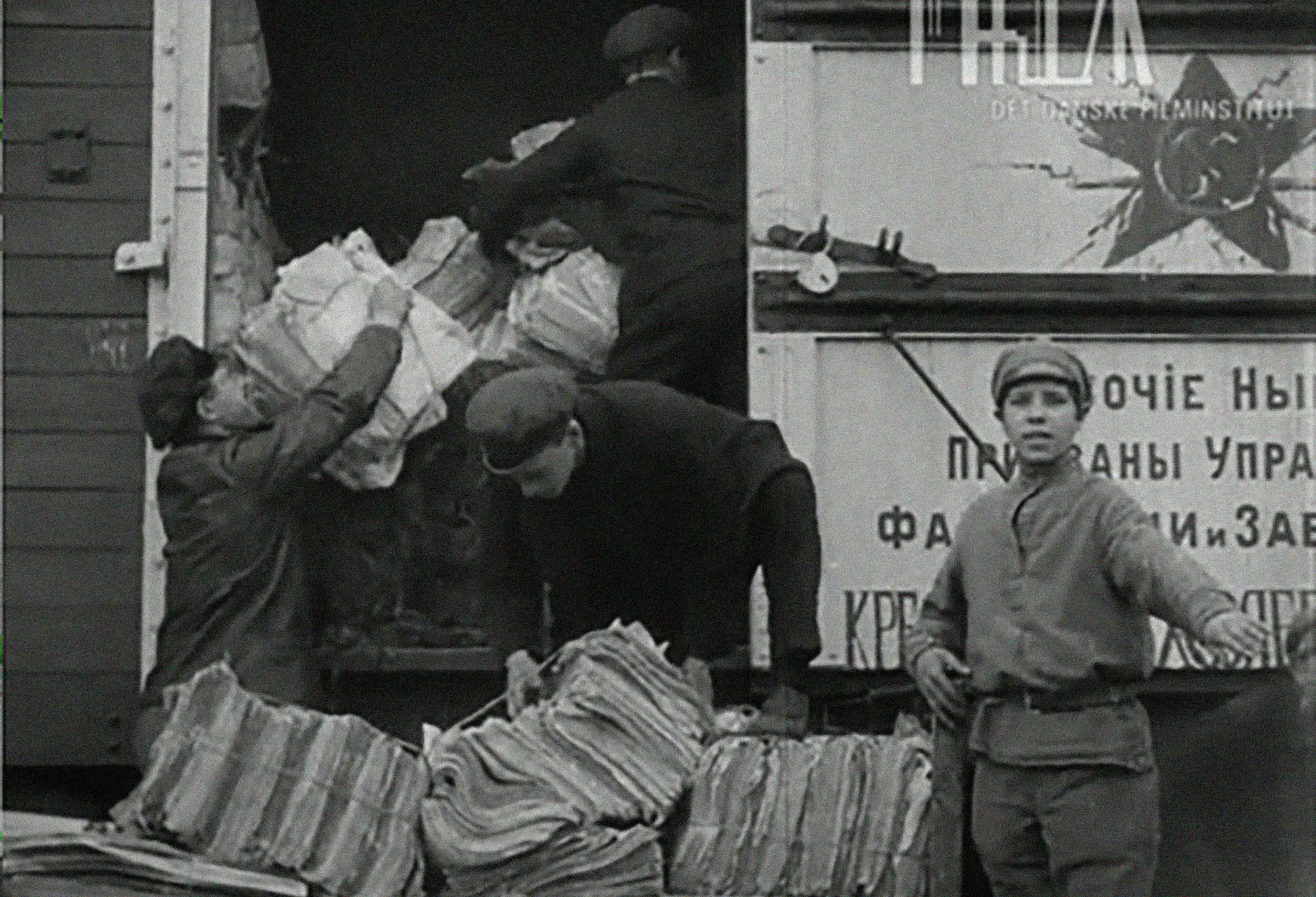
“[T]he first six months, went out every day tons, car-loads, train-loads of literature, saturating the land. Russia absorbed reading matter like hot sand drinks water, insatiable. And it was not fables, falsified history, diluted religion and the cheap fiction that corrupts – but social and economic theories, philosophy, the works of Tolstoy, Gogol and Gorky.”
He described arriving in Riga “where gaunt and bootless men sickened in the mud of desperate trenches; and when they saw us they started up. With their pinched faces and the flesh showing blue through their torn clothing, demanding eagerly, ‘Did you bring anything to read?’” Lectures, meetings, debates, in the factories, the barracks, in theatres or any other venue available were hugely popular. “What a marvellous sight to see the Putilov Factory pour out its forty thousand to listen to … anybody, whatever they had to say, as long as they would talk!”, Reed observed. Every street corner was a tribune, tram carriages, railway stations, wherever people gathered, could become the scene of impromptu debates.
FACTORY COMMITTEES AND THE SOVIETS (click to read)
Delegates to the factory committees could be recalled by the monthly workplace general assembly, to which they were required to report and in which final authority was vested. David Mandel, a historian of these committees, writes:
“[M]embers of the committees … viewed their ‘office’ as a means of effecting economic and social change. They … enjoyed no stability of tenure … they were not appointed by some impersonal organisation, but elected by and accountable to the workers.”
The factory committees were the closest to their constituents, and were initially the most pro-active and later some of the first to reflect the changing political positions as increasing numbers began to accept the Bolsheviks’ arguments. Delegates were elected to the soviets in workplaces, in the barracks and in peasant villages. They were recallable at any time and remained in the workforce or army. So, unlike our politicians, they shared the consequences of the decisions they voted for.
Delegates could not hide behind the actions of courts or bureaucrats. They had to take responsibility for their decisions and could be changed at elections every few months. Lenin put paramount importance on who had a majority in the soviets because, unlike factory committees, they were the bodies that could take central power from the provisional government.
Also, more than 2,000 trade unions mushroomed in 1917, holding elections and frequent meetings. They were especially important as a forum for workers in workplaces too small to have a viable committee.
There was no blueprint for which organisation had various responsibilities, and this was the subject of constant debate. Often, all of them intervened in a strike or met to discuss general political issues. Factory committees and unions fought for or at times simply imposed things such as meal breaks and sick leave; they demanded a say in hiring and firing. And they often imposed the eight-hour day.
In March, the Petrograd Association of Manufacturers signed an agreement with the city soviet to recognise the eight-hour day as the norm. This decree really only recognised the status quo imposed by the committees and workers themselves. There was recognition that factory closures were a means to dissipate the organised strength of workers. So committees would go to extraordinary lengths to keep them open. In one instance, they convinced a union to lend them some of its strike fund in order to buy fuel to keep production going. Others organised to redistribute fuel and materials to companies with shortages.
Moscow – with a workforce less dominated by the most politically advanced, such as metalworkers – was less radical. Here, while some factory committees implemented the eight-hour day, many argued that such a serious reform could be mandated only by the city soviet. Moderate Mensheviks insisted that the government had to legislate for it.
This was a test of the democratic structures and how much workers could influence their representative bodies. Several workplaces reported that a negative decision by the soviet would “dreadfully undermine” its authority. In the end, the soviet resolved to back the shorter day for all Moscow and to call on the government to introduce it for the whole of Russia.
It was not only workers who were asserting their rights, experimenting with new ways of living and giving their supposed superiors a taste of democracy. The soldiers, through elected committees, learned to stand up to their officers. When the government tried to enforce discipline in the army after February, the Petrograd soviet of workers’ deputies, even though it was dominated by conservative delegates, was forced by the sheer rage of the soldiers to pass what famously became known as “order number one”. It promoted a complete re-structuring of the army and the relationships between soldiers and officers. Disrespectful or demeaning address by the officers was forbidden, the soldiers’ committees recognised and the death penalty abolished.
Word spread like wildfire about the momentous events in Petrograd. Even the church was affected. Some of the hierarchy not overwhelmed with horror turned to a version of Christian socialism. One of the more radical clergy, Vvendenskii, was elected to the Petrograd soviet. He argued that “struggle on behalf of the poor is a basic principle of socialism, and it is our own Christian struggle”. The Orthodox Church created a “committee on Bolshevism in the church”. Morgan Philips Price, an English journalist in Russia, wrote of being in Samara, nearly 2,000 kilometres south-east of Petrograd:
“The revolution had penetrated into the sacred precincts of the monastery; the monks had gone on strike and had turned out the abbot, who had gone off whining to the Holy Synod … On enquiry into the ideas entertained by the monks for developing their little revolution, I found that they had already entered into an arrangement with the local peasantry. They were to keep enough land for themselves to work, and the rest was to go into the local commune. Thus a new monastic commune was in process of formation.”
He wrote to his wife on 13 March from Tiflis in the Caucasus:
“Most exciting times. I knew this was coming sooner or later but did not think it would come so quickly. Have been running about the Caucasus for last fortnight attending revolutionary meetings … Whole country is wild with joy.”
A week later, he reported in the Manchester Guardian that news of the dissolution of the Duma
“was the signal for revolt … The railwaymen of Tiflis and the oil workers of Baku prepared for a general strike … intense suppressed excitement all over the Caucasus … preparations were made for a great mass meeting at Tiflis on Sunday, March 18. That morning telegrams had been received ordering the abolition of the secret police, the release of all political prisoners, and the handing over of all civil affairs to the municipalities and rural councils.”
Exhilarating reports like this inspired workers in country after country with the hope that this was the beginning of a new world. The most far-flung, even backward corners of the Tsarist empire were brought to their feet, thrilled by the promise of a new society in which the oppressed would now determine their own future:
“Here had assembled almost every element in the multi-racial population of this part of the Empire. There were wild mountain tribes, Lesgians, Avars, Chechens and Swanetians in their long black cloaks and sheepskin caps. In the recesses of the Caucus range, where their homes lie, the eddies of the waves of revolution had swept. Sunk in patriarchal feudalism until recently, many of them did not know whether they were subjects of the Tsar of Russia or of the Sultan of Turkey. Yet they had come walking across miles of mountain tracks to pay their humble tribute to the great Russian Revolution.”
Georgian peasants, many influenced by modern Western thought, came in their wagons. They were joined by liberal Armenian merchants, Tartar peasants from the East Caucasus with their memories of the Persian revolutionary movement of 1908-09 and industrial workers with their potential social and economic power in the railways and oilfields. Side by side they stood with poets, students, doctors.
“Here in the great concourse of Caucasian peoples were standing side by side the most primitive and the most progressive types of the human race. For years they have been sunk in apathy, fatalism and scepticism and their racial feuds have been purposely fomented by the old government. Now the flood of their combined intellect and energy had burst forth and broken the rotten banks of privilege and oppression … a great concourse of medieval mountaineers and twentieth century proletariat, all inspired by one idea – brotherhood and freedom.”
The holidays institutionalised by the new provisional government were often socialist anniversaries – most notably May Day. The renaming of things began after February. To be associated with the old order was to be disparaged and threatened. One of the capitalist papers lamented: “Bourgeois. It seems that this word, with its abusive meaning, occupies a position between ‘scoundrel’ and ‘swine’, and its wide usage is explained, apparently, by its polemical convenience”. One contemporary summed up the atmosphere as “the fashion for socialism” – “the general aspirations of a huge number of Russians to declare themselves, no matter what, to be socialists, to the amazement of foreigners”. The financial newspapers repainted themselves with the protective colour of “realistic socialism”, while the banks tried to protect themselves by raising the red flag over their buildings.
This isn’t just a fantastic story from the past. The workers, soldiers and peasants provide us with confirmation of all that Marxists argue about how we can win human liberation. In one of their earliest books, Marx and Engels wrote a passage which would become the heart of Marxist philosophy:
“[R]evolution is necessary … not only because the ruling class cannot be overthrown in any other way, but also because the class overthrowing it can only in a revolution succeed in ridding itself of all the muck of ages and become fitted to found society anew.”
Lenin spelled out the transformative role of mass struggle:
“The real education of the masses can never be separated from their independent political, and especially revolutionary, struggle … Only struggle discloses to [the exploited class] the magnitude of its own power, widens its horizon, enhances its abilities, clarifies its mind, forges its will.”
The revolution illustrated these points with great drama and beauty. It demonstrated the confidence and initiative that the struggle of millions can generate among the oppressed; it confirmed the creativity and organisational genius that workers are capable of. The most oppressed were lifted up by the revolution, to make their voices heard, to help forge new attitudes. Workers threw off that muck of ages. As we’ve seen, women could organise and lead men, they took on roles which challenged the sexist stereotypes which in normal times trapped them in a cycle of oppression at work and in the family. And the national minorities, denied the right to independence, even to their own languages, gained the confidence to rise to their feet and demand their freedom.
AN UNFINISHED REVOLUTION
THE SEA OF RED AFTER IWD created the illusion that Russia was joyously united. But while workers were setting up democratic structures in the soviets and factory committees, the provisional government, made up of former members of the old Tsarist Duma, was essentially the government of the capitalist class and its supporters. As aspiring rulers, the provisional government and its capitalist backers were determined to prove their credentials as war mongers to the Allies, to say nothing of the need to hold sway over the vast empire’s territories, which contributed to their wealth and power. Russia under their rule would fight for their imperialist interests to the death of millions. On the home front, they wanted nothing more than the right to exploit workers, to manage the capitalist economy in their own interests and to modernise the political structures of Russia.
So there was a stand-off between the institutions of two competing social forces, the capitalists on one side and the workers, soldiers and peasants on the other. Guchkov, the minister of war, admitted to his chief of staff, general Alexeiev, “The government has no real power: the troops, the railroads, the post and telegraph are in the hands of the soviet. The simple fact is that the provisional government exists only so long as the soviet permits it”. Sukhanov, a member of the left wing of the Mensheviks, the moderate socialists, gives a picture in his memoirs:
“[A] victorious and profoundly democratic revolution … had made the working class the actual masters of the situation, while at the same time leaving untouched both the foundations of the bourgeois order and even the formal authority of the old ruling classes.”
This situation could not last indefinitely – either those living off the work of the vast majority would claw back control, or they would lose their power and the masses would organise a new society. Parasitical classes cannot share power with those they exploit. Both sides would recognise this reality. In his history of 1917, Miliukov, a leading figure of the provisional government, wrote that “the country was divided into two camps between which there could be no essential reconciliation or agreement”. The history of the months from February to October 1917 is about the struggle to resolve this situation of dual power.
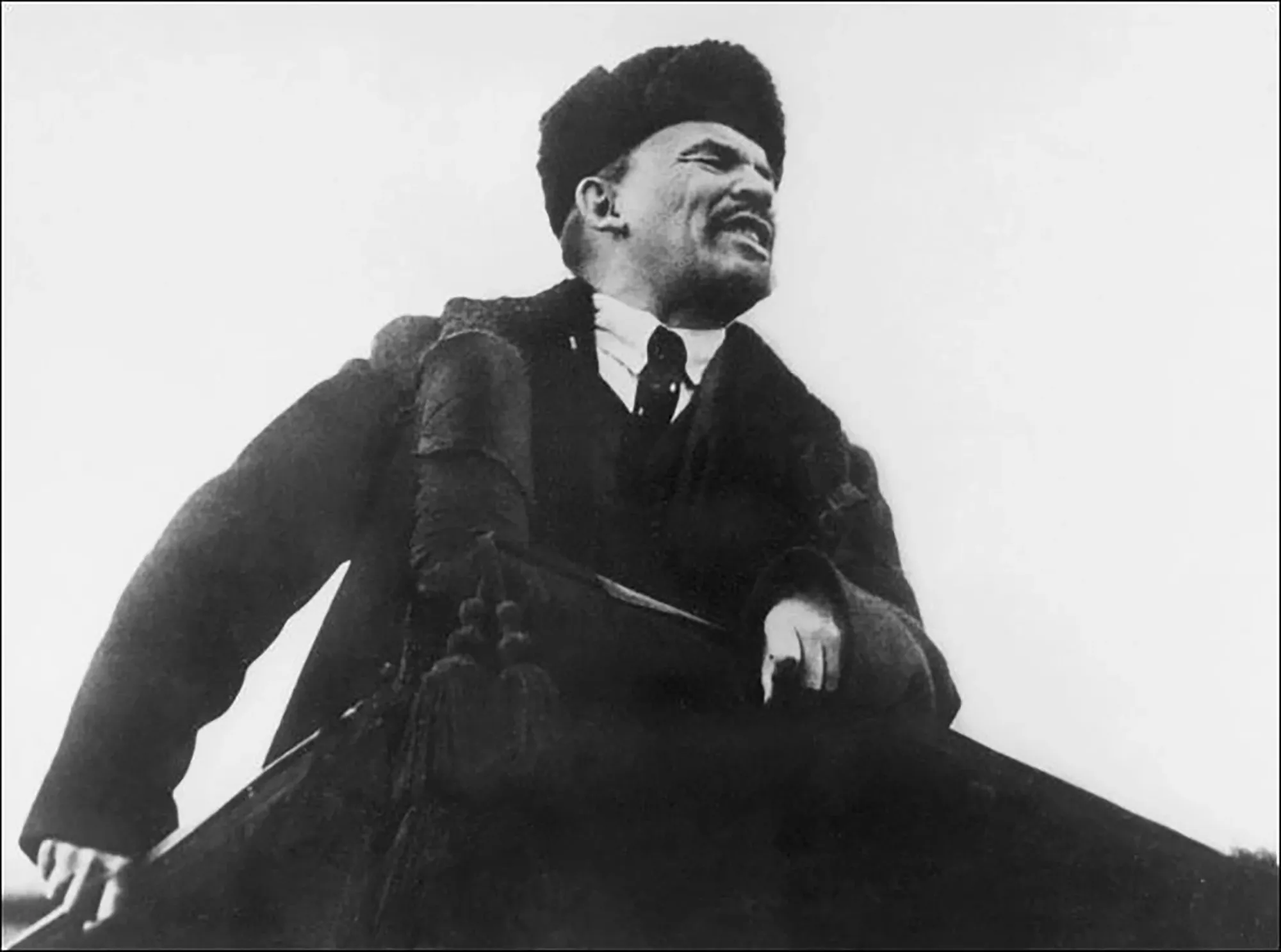
LENIN’S ARRIVAL (click to read)
The Menshevik president of the soviet greeted Lenin: “Comrade Lenin, in the name of the Petrograd soviet and of the whole revolution, we welcome you … But – we think that the principal task is the defence of the revolution”.
This “delicious but”, as the left Menshevik Sukhanov called it, led to an appeal to Lenin for unity – which meant unity on the question of continuing the war. Sukhanov remembered: “Lenin … stood there as though nothing taking place had the slightest connection with him”.
For one thing, he had been presented with a huge bouquet of flowers. Lenin disliked flowers in bouquets, so this only added to his awkward pose. Anyway, turning away from the soviet leaders he made this reply:
“Dear comrades, soldiers, sailors and workers! I … greet you as the vanguard of the worldwide proletarian army … The Russian revolution accomplished by you has prepared the way and opened a new epoch. Long live the worldwide socialist revolution!”
Sukhanov summed up the experience, probably from a somewhat dramatised memory:
“Suddenly, before the eyes of all of us, completely swallowed up by the routine drudgery of the revolution, there was presented a bright, blinding, exotic beacon obliterating everything we ‘lived by’.”
Lenin attacked the soviet majority, who were backing the provisional government, as “the same old opportunists, speaking pretty words but in reality betraying the cause of socialism and the worker masses”.
Raskolnikov, a leading Bolshevik among the sailors, later wrote that Lenin placed a Rubicon between the tactics of the leading Bolsheviks yesterday and in the coming weeks.
At the party conference of 24-29 April, three weeks after Lenin’s arrival, it was only a matter of endorsing his thesis that the soviets would have to take power. His position had already been endorsed by district after district. Ludmilla Stahl, an old Bolshevik, said at the Petrograd conference of 14 April that before Lenin’s return:
“We knew only the formulas of 1905. Seeing the independent creative work of the people, we could not teach them … Our comrades could only limit themselves to … parliamentary means, and took no account of the possibility of going further. In accepting the slogans of Lenin we are now doing what life itself suggests to us.”
When Lenin arrived from exile in early April, he caused a storm among not just his enemies, but also the Bolshevik leadership. The leaders in Russia before April, to the dismay of many of the worker members, supported the continuation of the war “to defend the revolution”, and gave support, albeit critical, to the provisional government. They withheld or censored Lenin’s frantic letters arguing for no support to the government or the war. At the welcome ceremony at the train station, Lenin declared: “We don’t need any government except the soviet of workers’, soldiers’ and farmhands’ deputies!” He didn’t argue that the soviets could take power immediately. At the Petrograd Bolshevik conference of 14 April, he argued:
“The government must be overthrown, but not everybody understands this correctly. As long as the provisional government has the backing of the soviet of workers’ deputies, you cannot ‘simply’ overthrow it. The only way it can and must be overthrown is by winning over the majority of the Soviets.”
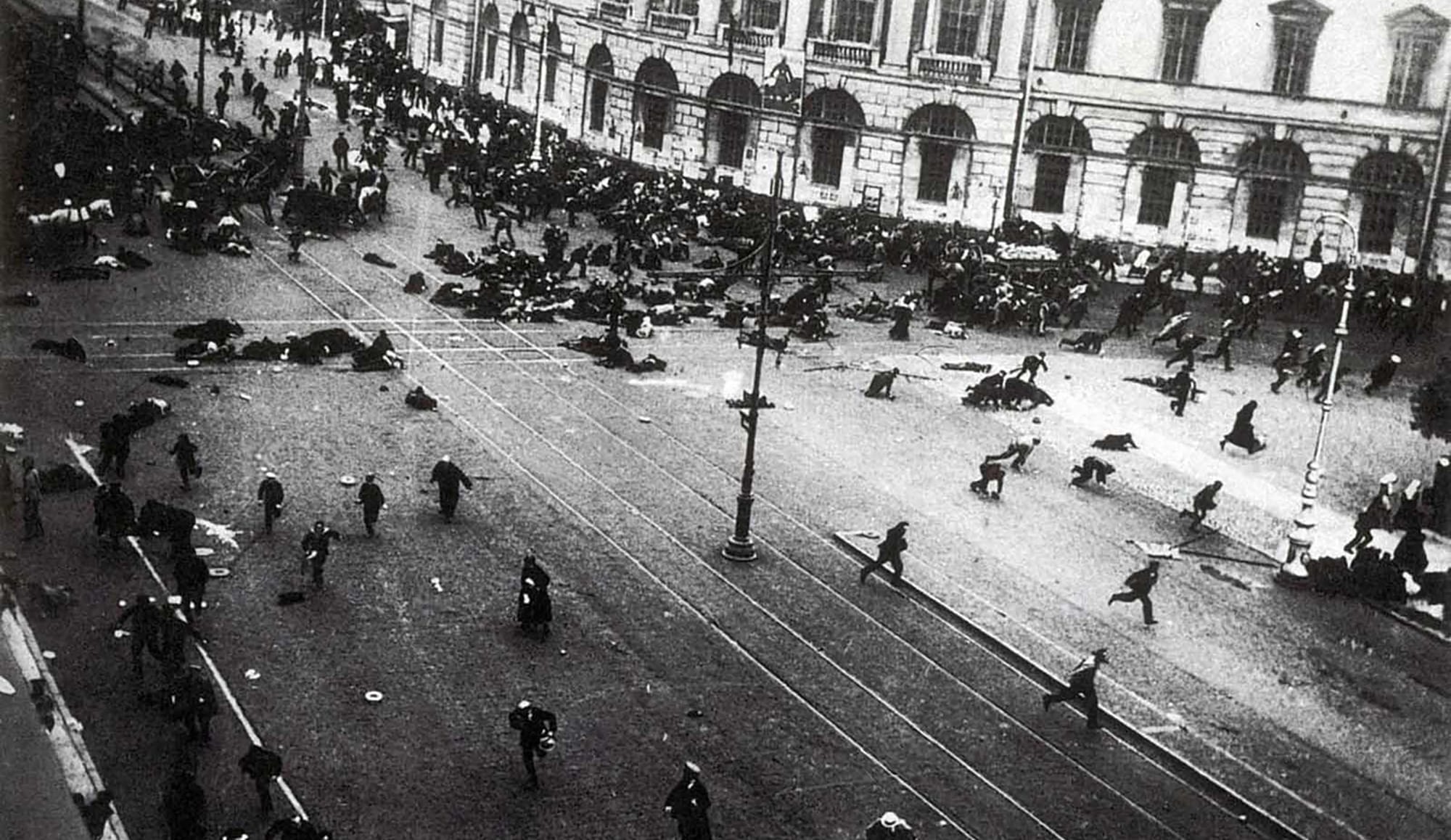
This presented them with the difficult task of explaining to workers and soldiers in Petrograd and Moscow that the only way they would get peace, the only way the peasants would get the land and workers the reforms they were fighting for was by transferring power to their soviets. But this was impossible until they had the backing of the countryside and wider layers of workers. In the next months, the workers and soldiers learned a vital lesson about class society and social change: the class divisions cannot be breached; those who exploit and oppress us will not peacefully allow workers to build a decent world. In April, a mass demonstration of workers and soldiers in Petrograd clashed with a pro-war mobilisation. Shots were fired, either in confusion or in anger, perhaps both, and the blood was shed for the first time since the February uprising. The facade of a united nation had been cracked open. Trotsky wrote:
“[T]wo worlds stood face to face. The patriotic columns called into the streets against the workers and soldiers by the Kadet Party consisted exclusively of the bourgeois layers of the population – officers, officials, intelligentsia. Two human floods – one for Constantinople, one for Peace – had issued from different parts of the town. Different in social composition, not a bit similar in external appearance, and with hostile inscriptions on their placards.”
By July, the workers and soldiers, yearning for peace, had witnessed the foreign minister inform the Allies that the revolution had strengthened Russia’s resolve to continue the war. They had seen the provisional government cynically sacrifice tens of thousands of lives in a doomed offensive at the front. And they had watched the slow progress on reforms. In frustration, the most militant in Petrograd staged an armed demonstration. The Bolsheviks, opposed to this premature threat of insurrection, used their authority to carry out a retreat, avoiding a complete rout. Nevertheless, they shouldered the blame for the attempted uprising. The government, backed by all those supporting capitalist rule, including the moderate socialists, told one of the biggest lies of history. They slandered the anti-capitalist Bolsheviks, the party whose only reason for existing was to overthrow all the world’s rulers, as being agents of the German government.
For a few weeks, the Bolsheviks were hounded on all sides, their leadership either in hiding or in jail and their printing presses shut down. However, time was on the Bolsheviks’ side. Their enemies could not be content with a witch hunt against the revolutionaries. They were determined to smash the power of the workers’ and soldiers’ soviets. Any move to do this would clarify the reality of dual power. At the same time as vilifying the Bolsheviks as German agents, the capitalists and generals were preparing to welcome the Germans into Petrograd to help crush the workers’ revolution. John Reed wrote of his experience mixing among these wealthy hypocrites:
“[A] large section of the propertied classes preferred the Germans to the revolution – even to the provisional government – and didn’t hesitate to say so. In the Russian household where I lived, the subject of conversation at the dinner table was almost invariably the coming of the Germans, bringing ‘law and order’.”
A capitalist known as the Russian Rockefeller openly mused in the right wing press that they might not need foreign troops to invade to rescue them from the revolution: “[T]he factories are closing down [mainly because of capitalists’ sabotage], and the Germans are advancing. Starvation and defeat may bring the Russian people to their senses”.
The Kornilov Coup
WHO WAS KORNILOV? (click to read)
General Lavr Georgiyevich Kornilov is described as having the “heart of a lion and the brain of a sheep”. He was something of a military hero, having escaped a prisoner of war camp, and the Russian media had talked him up. They were desperate for little victories to publish.
He was known as an authoritarian. While the death penalty was still illegal in the army, he had ordered deserting soldiers to be killed and their bodies to be laid across the path as an example. This was the perfect set of qualities to be the next dictator of Petrograd.
He stood for things such as: the slaughter of the most popular members of the soviet; the destruction of all organs of worker and soldier control; and extreme punishment of rebellious war industry workers (all industries at this time), including the death penalty in the railways.
He argued for the wholesale slaughter of political prisoners still locked up after the July Days, especially Trotsky, and including many fine worker revolutionaries. Trotsky would say later that if the workers’ revolution had lost, fascism would have been a Russian word.
The turning point came when a reactionary general, Lavr Georgiyevich Kornilov, prepared to stage a military coup. It galvanised masses of people into action, transforming the situation. Historian David Mandel describes it:
“[T]he news of Kornilov’s march on Petrograd broke on the working class districts on the night of 27-28 August in an atmosphere of pent up rage and frustration … the workers’ response was far from panic. In fact the howl of the factory horns announcing the emergency seemed to dispel in one swoop the sluggish, depressed mood of the preceding two months. There followed a show of enthusiasm, the like of which had not been seen since February.”
The response of the workers of Petrograd is an amazing testament to words written by Lenin:
“[T]he main source that nourishes [revolutionary Marxism] is precisely the spirit of revolt in the worker masses that … breaks through from time to time in desperate outbursts. These outbursts awaken to purposive life the widest strata of workers crushed by need and darkness. They disseminate in them the spirit of a noble hatred of the oppressors and the enemies of freedom.”
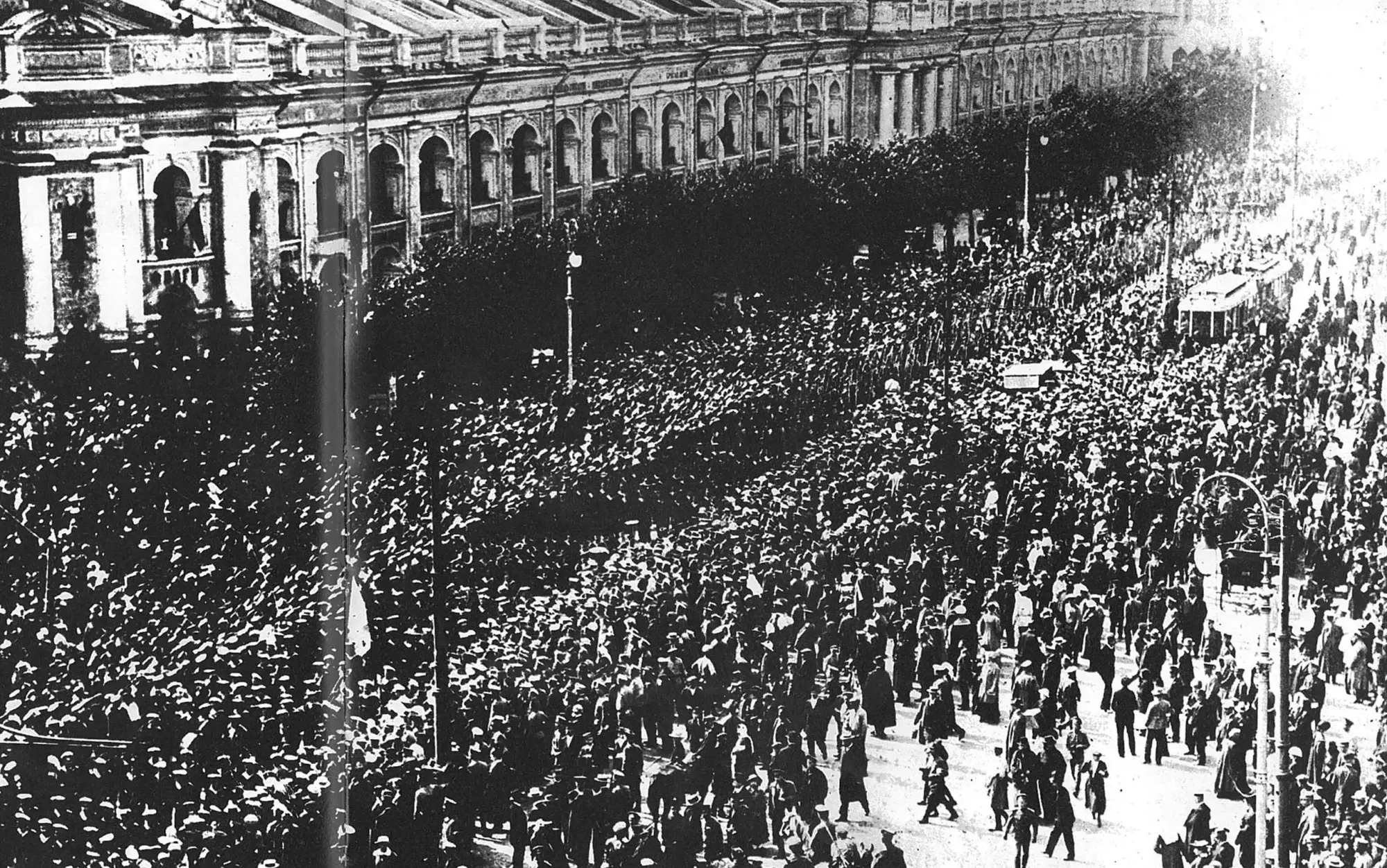
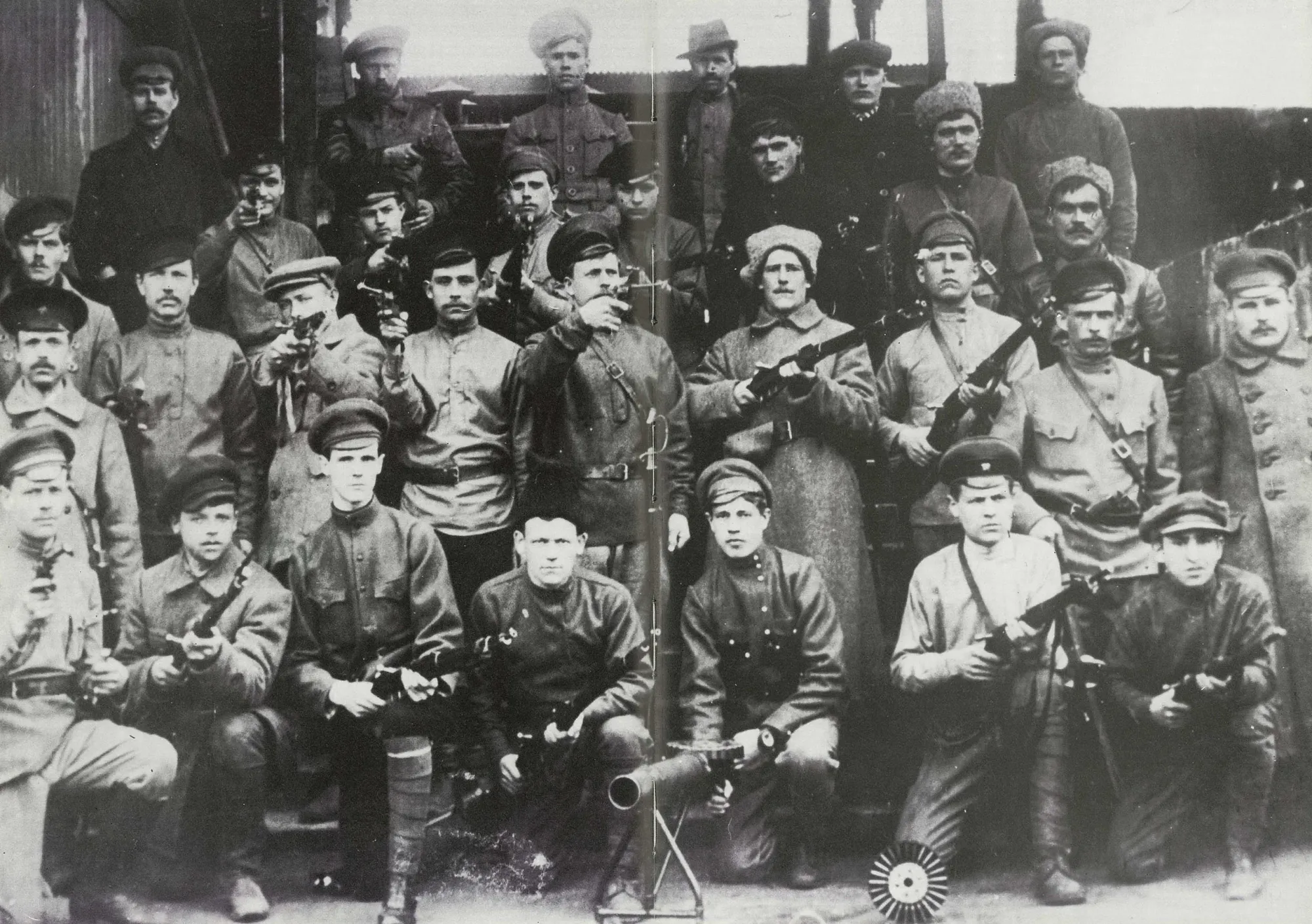
Under the energetic leadership of the Bolsheviks, the factory committees of Petrograd organised detachments of 40,000 Red Guards. A gunpowder works sent a load of grenades for distribution to workers and the Putilov steel works became a centre of resistance, working 16 hours a day to produce 100 cannons. Unarmed workers formed companies for trench digging, sheet metal fortification and barbed wire fencing. The railroad workers diverted troops from their destinations and sent artillery to the wrong places; workers even tore up some strategically important tracks. Kornilov couldn’t move out of his base because of this. The telegraphers kept the workers informed of Kornilov’s troop movements and held up his communications. Information intended for Kornilov often ended up pasted up as posters around the city for all to read. As Trotsky wrote, “The generals had been accustomed … to think of transport and communications as technical questions. They found out now that these were political questions”. In four days, “The insurrection had rolled back, crumbled to pieces, been sucked up by the earth”.
DEFENDING THE REVOLUTION (click to read)
The defeat of the Kornilov coup graphically illustrates how ludicrous is the common image of the Bolsheviks as elitists with little real support among workers. They were the only organisation capable of uniting workers across party lines to defend the revolution.
Kerensky, an SR liberal lawyer, prime minister from July, attempted to collude with Kornilov to stage a military coup. But he backed away from it when he realised he would be a victim of Kornilov along with the insurrectionary workers and soldiers.
He and all of the moderate socialists who backed his government were too discredited to mobilise the masses to defend the revolution. That task fell to the Bolsheviks, the only organisation in Russia that stood on the basis of clear principle and honesty, the only party dedicated to the victory of the workers, soldiers and peasants.
Semi-legal and persecuted, you might think they would be inclined to stand back and watch the demise of their persecutors. But Lenin was adamant: defend Kerensky, head of the government, from a military coup, but no political support for him. And defeat Kornilov by revolutionary means: arm the working class, mobilise the masses and use their power as workers to thwart this mortal threat to the revolution:
“We shall fight, we are fighting against Kornilov, just as Kerensky’s troops do, but we do not support Kerensky. On the contrary, we expose his weakness. There is the difference … We must say: now is the time for action; you SR and Menshevik gentlemen have long since worn these phrases threadbare. Now is the time for action; the war against Kornilov must be conducted in a revolutionary way, by drawing the masses in, by arousing them, by inflaming them. (Kerensky is afraid of the masses, afraid of the people.)”
The moderate socialist parties invited the Bolsheviks to tour their agitators – the party that was illegal and shunned only days before by all of them! It was obvious that if there was to be a mobilisation against the counter-revolution, the Bolsheviks would have to lead it. As Sukhanov observed:
“At that time, [the Bolshevik Party] was the only organisation that was large, welded together by elementary discipline, and united with the democratic rank and file of the capital. Without them the Military Revolutionary Committee was impotent … With the Bolsheviks … the Military Revolutionary Committee had at its disposal all organised worker-soldier strength, of whatever kind.”
They agreed on conditions. The political prisoners were released and the Bolsheviks organised the resistance unhindered.
However, the SRs and Mensheviks continued to participate in the reactionary provisional government. Kerensky, the SR prime minister, appointed himself as Kornilov’s replacement as supreme commander. He issued an order to the army and navy with general Alekseev, former chief of staff under the Tsar and now back in that position: “For the restoration of order I command: the cessation of all political struggle among the troops … The discontinuation immediately of the arbitrary formation of detachments under the pretext of combating counter-revolutionary action”. Only those under his control were permitted to arrest officers under suspicion, a direct attack on the political rights that the soldiers’ committees had established. The uproar was immediate, even Menshevik publications voicing disquiet.
The struggle had taken a giant step forward, but had not reached its destiny. The significance of that step was the light it cast on the situation for the workers and soldiers. As Lenin argued in a different context:
“[T]he great significance of all crises is that they unveil the hidden, cast aside the conventional, the superficial, the petty, sweep away the political rubbish, uncover the secret springs of the true class struggle that is going on.”
TROTSKY ON THE PROVISIONAL GOVERNMENT (click to read)
“Common gains, external defeats, and internal dangers, drew together the parties of the ruling classes. The Duma, divided on the eve of the war, achieved in 1915 its patriotic oppositional majority which received the name of ‘Progressive Bloc’. The official aim of this bloc was of course declared to be a ‘satisfaction of the needs created by the war’.
“On the left the social-democrats and Trudoviks did not enter the bloc; on the right the notorious Black Hundred groups. All the other factions of the Duma – the Kadets, the Progressives, three groups of Octobrists, the Centre and a part of the Nationalists, entered the bloc or adhered to it – as also the national groups: Poles, Lithuanians, Mussulmans, Jews, etc.
“In order not to frighten the tsar with the formula of a responsible ministry, the bloc demanded ‘a united government composed of men enjoying the confidence of the country’. The minister of the interior, prince Sherbatov, at that time characterised the bloc as a temporary ‘union called forth by the danger of social revolution’.
“It required no great penetration to realise this. Miliukov, the leader of the Kadets, and thus also of the oppositional bloc, said at a conference of his party: ‘We are treading a volcano … The tension has reached its extreme limit … A carelessly dropped match will be enough to start a terrible conflagration … Whatever the government – whether good or bad – a strong government is needed now more than ever before’.
“The hope that the tsar, under the burden of defeat, would grant concessions, was so great that in the liberal press there appeared in August the slate of a proposed ‘cabinet of confidence’ with the president of the Duma, Rodzianko, as premier (according to another version, the president of the Land Union, prince Lvov, was indicated for that office), Guchkov as minister of the interior, Miliukov, foreign minister, etc.
“A majority of these men who here nominated themselves for a union with the tsar against the revolution, turned up a year later as members of the ‘Revolutionary Government’. History has permitted herself such antics more than once. This time the joke was at least a brief one.”
OCTOBER
THE BOLSHEVIKS, now with a quarter of a million members, represented the most politically conscious and determined workers. They could now, unlike in July, carry the majority of workers, soldiers and poor peasants with them in the fight to transfer power to the soviets. But Lenin had to continue arguing inside the Bolsheviks about how to maximise their growing support. In frantic notes from his hiding place in Finland, he attacked the Bolshevik fraction for their compromising role in the Democratic Conference in mid-September. The moderate socialists were doing all they could to use the conference to lull the workers and soldiers into a false sense of security and to create an aura of consensus to dispel the atmosphere of crisis after the Kornilov threat. Lenin was clear on where the Bolsheviks should have their sights at this most critical juncture:
“The Bolsheviks should have walked out of the meeting in protest and not allowed themselves to be caught by the conference trap set to divert the people’s attention from serious questions. The Bolsheviks should have left two or three of their 136 delegates for ‘liaison’ work, that is, to report by telephone the moment the idiotic babbling came to an end and the voting began. They should not have allowed themselves to be kept busy with obvious nonsense for the obvious purpose of deceiving the people with the obvious aim of extinguishing the growing revolution by wasting time on trivial matters.
“Ninety-nine percent of the Bolshevik delegation ought to have gone to the factories and barracks; that was the proper place for delegates who had come from all ends of Russia and who... could see the full depth of the Socialist Revolutionary and Menshevik rottenness. There, closer to the masses, at hundreds and thousands of meetings and talks, they ought to have discussed the lessons of this farcical conference … Parliamentarism should be used, especially in revolutionary times, not to waste valuable time over representatives of what is rotten, but to use the example of what is rotten to teach the masses.”
Before the experience of the Kornilov revolt, the workers and soldiers would not have defended a new government. But now they had witnessed the treachery of the government and the compromising “socialists” who still sat in it. The task now was to prepare for a second insurrection in which the soviets should take power.
The insurrection
Historians like to point to a lack of mass mobilisations as “proof” that October was a coup carried out by the Bolsheviks. But this was not February. The soviets were already running most of society and the majority of the army had been won to support for transferring power to them. Wednesday, 25 October, is the day the revolution is celebrated, but by then the government had to all intents and purposes been overthrown. This is a fact ignored by the Bolsheviks’ detractors. They do not understand the insurrection as the culmination of nearly three weeks of preparations for transferring power. These weeks highlight the incredible wave of grass roots organising that swept the propertied classes from power.
A provocation by the provisional government began the final round of mobilisation, just as Trotsky anticipated. In the second week of October, the government announced plans to move the Petrograd garrison to the front, contrary to every understanding by the soldiers. Historian Alexander Rabinowitch catalogues the reaction: “Soldiers in Petrograd reacted to news of these orders with predictable vehemence. In unison, garrison troops proclaimed their lack of confidence in the provisional government and demanded the transfer of power to the soviets”. He writes of an “avalanche of anti-government resolutions adopted by garrison units”.
For a week, Petrograd was a hot house of mass meetings not just in the barracks but also in the factories. The streets were swamped by papers debating the latest moves. At the instigation of the Bolsheviks, on 15 October, soldiers were dispatched to the front to explain the political reasons for the garrison’s refusal to provide relief: they did not trust the motives of the provisional government, not that they wanted to avoid their responsibilities. This led to a conference of delegates from the front and the city garrison including representatives from the soviets. To the frustration of generals and the moderate socialists at this conference on 17 October, “the discussion was concerned as much with the need for transfer of power to the soviets, for peace, and for the long-suffering front-line soldier to return home, as it was with the question of getting new regiments into the trenches”.
The following day, the soldiers held a garrison conference and called for the transfer of power to the soviets. Not that they supported an uprising, but they would support any action to defend the soviets from the government and other reactionaries. A date of great significance is 22 October, Petrograd Soviet Day. There were concerts, speeches, mass meetings in factories around the city, huge gatherings in the streets and in public halls from morning till night, where old and young, women, men and children stood patiently for hours soaking up the words of Bolshevik orators such as Trotsky, Volodarsky, Lashevich, Kollantai, Raskolnikov and Krylenko.
Trotsky summed up the Bolsheviks’ main points: that the government was preparing to surrender Petrograd to the Germans rather than allow the soviets to rule, that the entire world would be engulfed by revolution if they took power, and that only a soviet regime could bring peace, distribute the land and defend true democracy. A journalist reported that when asked to pledge support for the soviet when it moved from words to deeds, the huge audience threw up its hands and chanted “We swear it!” Sukhanov also wrote of Trotsky’s appeals for a vow to carry through the revolution: “The vast crowd was holding up its hands. It agreed. It vowed”.
Three days earlier, Trotsky had won a victory at a mass meeting of the Peter and Paul Fortress, a strategically important military centre. The meeting in the fortress square went on for hours after Trotsky spoke. But the overwhelming majority voted that military orders should only be obeyed from the Military Revolutionary Committee. The Red Guards continued to drill, to be tutored in handling of arms and to patrol factories and streets, preparing to defend a soviet takeover. As Trotsky outlined, the whole situation was leading inexorably to rule by the working class:
“In the provincial industrial regions … armed workers would remove managers and engineers, and even arrest them. In the Urals … companies of Red Guards led by the old veterans established law and order. Armed workers almost unnoticeably dissolved the old government and replaced it with soviet institutions. Sabotage on the part of the property owners and administrators shifted to the workers the task of protecting the plants … Roles were here interchanged: the worker would tightly grip his rifle in defence of the factory in which he saw the source of his power. In this way elements of a workers’ dictatorship were inaugurated in the factories and districts some time before the proletariat as a whole seized the state power.”
In Petrograd, where the leadership of the provisional government and the influence of the compromising socialists was greatest, the Red Guards could not impose their will so easily. However, about 25,000 workers were at least partially armed. One worker recalled that now they drilled openly in parks and on the boulevards instead of in their homes. Another says of October, “the shops [meaning workplaces] were turned into camps … The worker would stand at his bench with knapsack on his back and rifle beside him”. From 10 October, with insurrection openly on the agenda, the Red Guards enrolled virtually every worker in some factories. The commanding staff were all elected. All were volunteers and knew each other, so this was a new form of military organisation emerging out of the revolutionary process.
On 22 October, the Red Guards held a mass conference to finalise their plans for the insurrection. Two days later, the Vyborg district soviet issued an order to “immediately requisition all automobiles … Take an inventory of all first-aid supplies, and have nurses on duty in all clinics”. And all the time, the Red Guards and other organisations were drawing in increasing numbers of non-Bolshevik workers.
Moscow was also moving to soviet power. In response to a wave of strikes, a factory committee initiated an idea that the Bolsheviks took up. The result was “Revolutionary Decree No 1”, adopted by the soviets. Workers and clerks in factories and shops would henceforth be employed or discharged only with the consent of the factory committees and all industrial disputes would be found in the workers’ favour. As Trotsky wrote, “This meant that the soviet had begun to function as a state power”.
LENIN ON INSURRECTION (click to read)
“An insurrection on 3-4 July would have been a mistake; we could not have retained power either physically or politically … because our workers and soldiers would not have fought and died for Petrograd. There was not at the time that ‘savageness’, or fierce hatred both of the Kerenskys and of the Tseretelis and Chernovs. Our people had still not been tempered by the experience of the persecution of the Bolsheviks in which the Socialist Revolutionaries and Mensheviks participated.”
Lenin understood that the workers’ trust in the Bolsheviks, their confidence to take power, would ebb away if it looked as if yet another party they looked to could do nothing but prevaricate. The danger was that the workers and soldiers would retreat into the struggle for individual survival and their revolutionary consciousness would subside, leaving the way open for a successful blow from the likes of Kornilov:
“In order for an insurrection to be crowned with success it should have the support, not of a conspiracy, not of a party, but of the advanced class; that first of all. The insurrection must rest on a popular revolutionary upsurge: that is second. The insurrection must come at the historic turning point of the expanding revolution, at the moment when the activity of the masses reaches its peak, and when the hesitation in the ranks of the enemy, and among the false friends of the revolution, the double-dealers and the faint hearts, reaches its peak. That is third. By thus posing the three conditions of insurrection, Marxism distinguishes itself from Blanquism.”
Faced with these developments, the government was increasingly isolated and paralysed. Trotsky wrote that in the final confrontation, “the weakness of the government exceeded all expectation”. And every effort by the government to shore up its position was interpreted by the workers and soldiers as an act of aggression:
“The raising of the bridges [by the government] was received by the population as an official announcement of the beginning of the insurrection … [The] struggle for the bridges assumed the character of a test for both sides … Only Dvortsovy Bridge remained several hours in the hands of the government patrols.”
At 5.30am on 24 October, a detachment of Junkers (reactionary soldiers) turned up at the Bolshevik printing presses; they smashed the equipment and sealed the building. The government seemingly had scored its first victory despite its weak position. A male and a female worker ran to Smolny, the soviet’s headquarters. If the Military Revolutionary Committee would give them the order, the workers would bring out the Bolshevik paper. The order was given, loyal regiments were sent for and the workers opened the building and set to work.
“The newspaper suppressed by the government came out under protection of the troops of a committee which was itself liable to arrest”, wrote Trotsky. “That was insurrection. That is how it developed.” Twelve hours later, when soldiers turned up at a printing plant to suppress the Petrograd Soviet paper Worker and Soldier, there was no need to ask. The printing workers, helped by two sailors, simply seized the car filled with printing paper, dispersed the aggressors and brought out the paper. Rather than intimidating people, the attempts to close the working class’ and soldiers’ press spurred on their organisation and confidence while strengthening the sense of common cause.
The days that shook the world
When the government tried to send to the front the garrison that had defended the revolution in Petrograd, when it moved to close the Bolshevik printing presses and drew up the bridges, it opened the floodgates to the insurrection. The preparation, the feverish debates and discussions in the streets, factories and barracks, had prepared vast numbers of workers and the soldiers to defend the soviet. They understood that the defeat of the Bolsheviks would mean the victory of the counter-revolution and the end of their hopes.
That is why 24 and 25 October look like a military exercise when taken out of the context of the previous weeks. There was no need of mass mobilisations. The only question remaining was who would prevail. Would the Bolsheviks’ actions to repel the attacks from the government galvanise the promised defence? They did. Trotsky paints a vivid picture of the city on the evening of 25 October, the day that would shake the international bourgeois world to its foundations:
“In the Vyborg district opposite the headquarters of the Red Guard a whole camp was created: the street was jammed full of wagons, passenger cars and trucks. The institutions of the district were swarming with armed workers. The soviet, the Duma, the trade unions, the factory and shop committees – everything in this district – were serving the cause of the insurrection. In the factories and barracks and various institutions the same thing was happening in a smaller way as throughout the whole capital: they were crowding out some and electing others, breaking the last threads of the old and strengthening the new … At continuous meetings fresh information was given out, fighting confidence kept up and ties reinforced. The human masses were crystallising along new axes; a revolution was achieving itself.”
The SRs maintained the majority support of the peasantry. But by September, more than half of their representatives had split with the main party. These left SRs joined the Soviet government in coalition with the Bolsheviks. In the Second All-Russian Congress of Soviets, beginning on the night of the insurrection, there was a large Bolshevik majority. The congress opened with 650 delegates; 390 were Bolsheviks, even though many weren’t members of the party. Overwhelming support for the insurrection was evident even among non-Bolsheviks. Asked for their view, 505 responded that they were for all power to the soviets. The Mensheviks and SRs had squandered their political capital from the February revolution. In the June congress they had 600 of 882 delegates. Now they had less than a quarter of the votes. And an overwhelming majority of these were “lefts” who veered toward the Bolsheviks. The delegates counted 900 before the end, but the proportion of Bolsheviks held steady. Morgan Philips Price, who originally opposed the Bolsheviks, argued:
“The government of M Kerensky fell before the Bolshevik insurgents because it had no supporters in the country. The bourgeois parties and the generals of the staff disliked it because it would not establish a military dictatorship. The revolutionary democracy lost faith in it because after eight months it had neither given land to the peasants nor established state control of industries nor advanced the cause of the Russian peace programme.”
TROTSKY ON THE MILITARY REVOLUTIONARY COMMITTEE (click to read)
“Attempting to kindle the patriotism of the masses by threatening the loss of Petrograd, the compromisers introduced into the soviet on October 9 a motion to create a ‘committee of revolutionary defence’ whose task should be to take part in the defence of the capital with the active cooperation of the workers.
“While refusing to assume responsibility for ‘the so-called strategy of the provisional government and in particular the removal of troops from Petrograd’, the soviet nevertheless had made no haste to express itself upon the substance of the order removing the soldiers, but had decided to test its motives and the facts upon which it was based.
“The Mensheviks had raised a protest: It is not permissible to interfere in the operative orders of the commanding staff. But it was only a month and a half since they had talked the same way about the conspiratorial orders of Kornilov, and they were reminded of this … To the extreme surprise of the compromisers, the Bolsheviks accepted the idea of a ‘committee of defence’…
“The Bolsheviks quite naturally seized upon this Menshevik project of a military committee, for there had been conversations often enough in their own ranks about the necessity of creating in good season an authoritative soviet committee to lead the coming insurrection. In the military organisation of the party they had even drawn up plans for such a body.
“The one difficulty they had not yet got over was that of reconciling an instrument of insurrection with an elective and openly functioning soviet, upon whose benches, moreover, sat representatives of the hostile parties. The patriotic proposal of the Mensheviks, therefore, came up most appropriately, and came up just in time to assist in the creation of a revolutionary headquarters – a body soon to be renamed ‘Military Revolutionary Committee’ and to become the chief lever of the revolution.”
The general opinion of the Bolsheviks’ opponents was that they would be easily overthrown. John Reed commented:
“That the Bolsheviki would remain in power longer than three days never occurred to anybody – except perhaps to Lenin, Trotsky, the Petrograd workers and the simple soldiers.”
There are always those who, like a writer in a conservative daily, sneer at Lenin’s idea that every cook can govern:
“Let us suppose for a moment that the Bolsheviks do gain the upper hand. Who will govern us then: the cooks perhaps, those connoisseurs of cutlets and beefsteaks? Or maybe the firemen? The stableboys, the chauffeurs? Or perhaps the nursemaids will rush off to meetings of the Council of State between the diaper washing sessions? Who then? Where are the statesmen? Perhaps the mechanics will run the theatres, the plumbers foreign affairs, the carpenters, the post office. Who will it be? History alone will give a definitive answer to this mad ambition of the Bolsheviks.”
This disbelief in the ability of workers to shape history casts its shadow over virtually all interpretations of the revolution. The lie that October was a coup, that the Bolsheviks opportunistically manipulated events to their own narrow purpose – these untruths rest on the elitist assumption that workers are easily duped by cynical leaders. They are used to discredit not just the Bolsheviks and the revolution, but the very idea of workers’ power. This is the real agenda behind historians’ inability – or refusal – to acknowledge that October was a popular revolution with the backing of millions of working people. This truth was summed up by Martov, Lenin’s long time political opponent, in a private communication in which he had no reason to tell anything but the truth:
“Understand, please, that before us after all is a victorious uprising of the proletariat – almost the entire proletariat supports Lenin and expects its social liberation from the uprising.”
After October
The Second All-Russian Congress of Soviets opened on 25 October. It was notable not only for its proclamations; its composition was strikingly different from the last one in June as was the political line up. These three aspects were all entwined. In June, intellectuals and army officers had been prominent. John Reed graphically described a very different situation now:
“[T]he new delegates come in – burly, bearded soldiers, workmen and black blouses, a few long-haired peasants. The girl in charge – a member of Plekhanov’s Edinstvo group – smiled contemptuously. ‘These are very different people from the delegates to the first Sezd’, she remarked. ‘See how rough and ignorant they look! The Dark People …’. It was true: the depths of Russia had been stirred, and it was the bottom which came uppermost now.”
That Menshevik woman, by talking to the revolution’s chronicler, inadvertently left a clue for history as to why the Mensheviks’ representation had plummeted from more than 200 delegates in June to less than 70. Their “aristocratic scorn” for the masses, in Trotsky’s words, meant they could never win the authority the Bolsheviks achieved.
The October revolution consolidated the gains since February for masses of people in Russia; but it was also a huge leap into the future. First were the decrees: a call to all the countries at war to start immediate negotiations for a just, democratic peace; all land to be “confiscated without compensation and become the property of the whole people and pass into the use of all those who cultivate it”; the enslaved national minorities of the Russian Empire given the right to independence, including secession; and workers’ control over production as the basis for the reorganisation of the economy for the good of the population.
Inspiring as they were, decrees could not solve the problems the revolutionary government faced: devastation caused by the war and deliberate sabotage by the owners of industry. And within months civil war until 1921 during which all the imperialist armies, including Australia’s, invaded to support the counter-revolutionary White Armies, to crush the revolution. Astonishingly this counter-revolution was defeated, a tribute to the workers’ democracy. It was a beacon of humanity, despite fighting a vicious war, compared to the anti-Semitic pogroms, massacres and reinstatement of the hated landlords by the White Army and its backers from the supposedly cultured and civilised Western powers. So the workers’ state engendered in the peasantry sufficient loyalty for them to reluctantly submit to the requisitioning of grain to feed the cities and the Red Army.
The tragedy was that the economy was in ruins and the workforce reduced to a fraction of its former power. By April 1918, the factory workforce in Petrograd was 40 percent of that in 1917, and it kept declining. The defeat of workers’ revolutions in the West left Russia devastated and isolated. The material basis for socialism – workers’ democratic power in the workplaces and sufficient production to provide a decent life for all – did not exist. Stalin, formerly a Bolshevik leader, oversaw the final counter-revolution. The monstrous, bureaucratic class rule he built trampled all the gains won by the workers’ democracy. Stalin’s claim to be building “socialism in one country” besmirched the revolution’s reputation, dragged its international spirit through the mud as he built an imperialist arsenal to compete with the West.
Yet before his counter-revolution, in the midst of war, economic collapse and international isolation, the soviet government instituted far reaching and radical changes, some of which we are yet to win in the richest democracies. As well as those already mentioned, in its first year, the soviet government decreed universal suffrage and abolished the right of inheritance. Marriage and divorce laws were taken out of the remit of the church or state. Illegitimacy was abolished as a legal concept, paid maternity leave before and after birth was enshrined in law. Communal kitchens and child care centres to free women from the burdens of the family proliferated. Literacy programs and education were a priority. People thirsted for reading matter, which was delivered in train loads with visiting libraries, public lectures and movie theatres. The start of the school year in 1918 had to be delayed because teachers, in the tradition of workers’ democracy, were still debating teaching methods!
The revolution demonstrates how the most oppressed are lifted up to participate in their own liberation in mass struggle. Millions of workers, soldiers and the oppressed became increasingly radical, serving at every level of activity in October.
As we celebrate the centenary of the revolution, the lessons we can learn from those workers are more relevant than ever. Just think about it: today, the most powerful country on earth has a repressive president surrounded by a rabble of lunatic neo-fascists, mass poverty amidst obscene wealth and spending on war machines. The similarities with Russia 1917 are eerily striking despite the differences. In a passage that easily translates into a description of the current president of the United States, Trotsky wrote of Tsar Nicholas II:
“This dim, equable and ‘well-bred’ man was cruel … At the very dawn of his reign Nicholas praised the Phanagoritsy regiment as ‘fine fellows’ for shooting down workers. He always ‘read with satisfaction’ how they flogged with whips the bob-haired girl-students, or cracked the heads of defenceless people during anti-Jewish pogroms. This crowned black sheep gravitated with all his soul to the very dregs of society, the Black Hundred hooligans [the equivalent of today’s fascists].”
We learn from the past so we can turn toward the struggles of the future. The Russian Revolution should inspire us to believe in our own strength. It teaches us that workers can unite, that the oppressed can rise up, that workers can come to see that they need to and can run society. That’s why the events of 1917 are worth celebrating.


