

During the three days I spent in Minneapolis, a week after the ICE murder of Alex Pretti forced the Trump administration to yank Border Patrol commander Gregory Bovino, it was clear that the federal occupation of the city was not over and that a clear-cut victory over ICE had not been achieved.
There was a confidence in the movement activists I spoke to—despite suffering two deaths at the hands of federal agents—that Minneapolis had created a political panic in the White House, with potentially disastrous political consequences for the Republican Party. And while Minneapolis certainly propelled forward a movement against ICE across the country, no-one I met thought the movement was over.
On the contrary, many people felt not only that organising on the community and workplace levels needed to deepen, but were waiting for the next shoe to drop under the new head of the federal occupation, the notorious White House “border czar”, Tom Homan. Homan recently announced the withdrawal of 700 federal agents from Minnesota, leaving 2,000 in place. He attributed this to “unprecedented cooperation” with state and local authorities.
Homan repeatedly declared that the Trump administration “is not surrendering”.
A city in political ferment
Visitors to Minneapolis immediately notice the frozen lakes and rivers. The successful and widespread community defence against ICE in such arctic conditions is remarkable even for hearty Minnesotans. The big march on 23 January, which attracted more than 50,000 people and possibly as many as 100,000, demonstrated how politicised and radicalised the population became during the ongoing federal occupation.
It’s obvious that Minneapolis is a city in political ferment. The type of widespread and sustained struggle involving “ordinary people” that we haven’t witnessed since the later years of the Vietnam War. Signs of this are everywhere. After Paul K-D, publisher of the Twin Cities Labor Report, picked me up at Union Station, we drove into Minneapolis to meet Kieran Knutson, the working president of Communication Workers of America (CWA) Local 7250, at a well-known pub called the Prodigal. It is located in the Whittier neighbourhood, where Alex Pretti, the VA nurse, was murdered by federal agents four days earlier.
I didn’t realise that Pretti was murdered in a commercial district promoted by the city as a tourism destination. The candlelight memorial dedicated to him was incredibly beautiful and solemn. There was a vigil happening where several people spoke, and we stopped by for a few minutes in the frigid temperatures. It’s worth noting that there are large and small posters of Renee Good and Pretti all over Minneapolis, another sign of how politicised daily life has become.
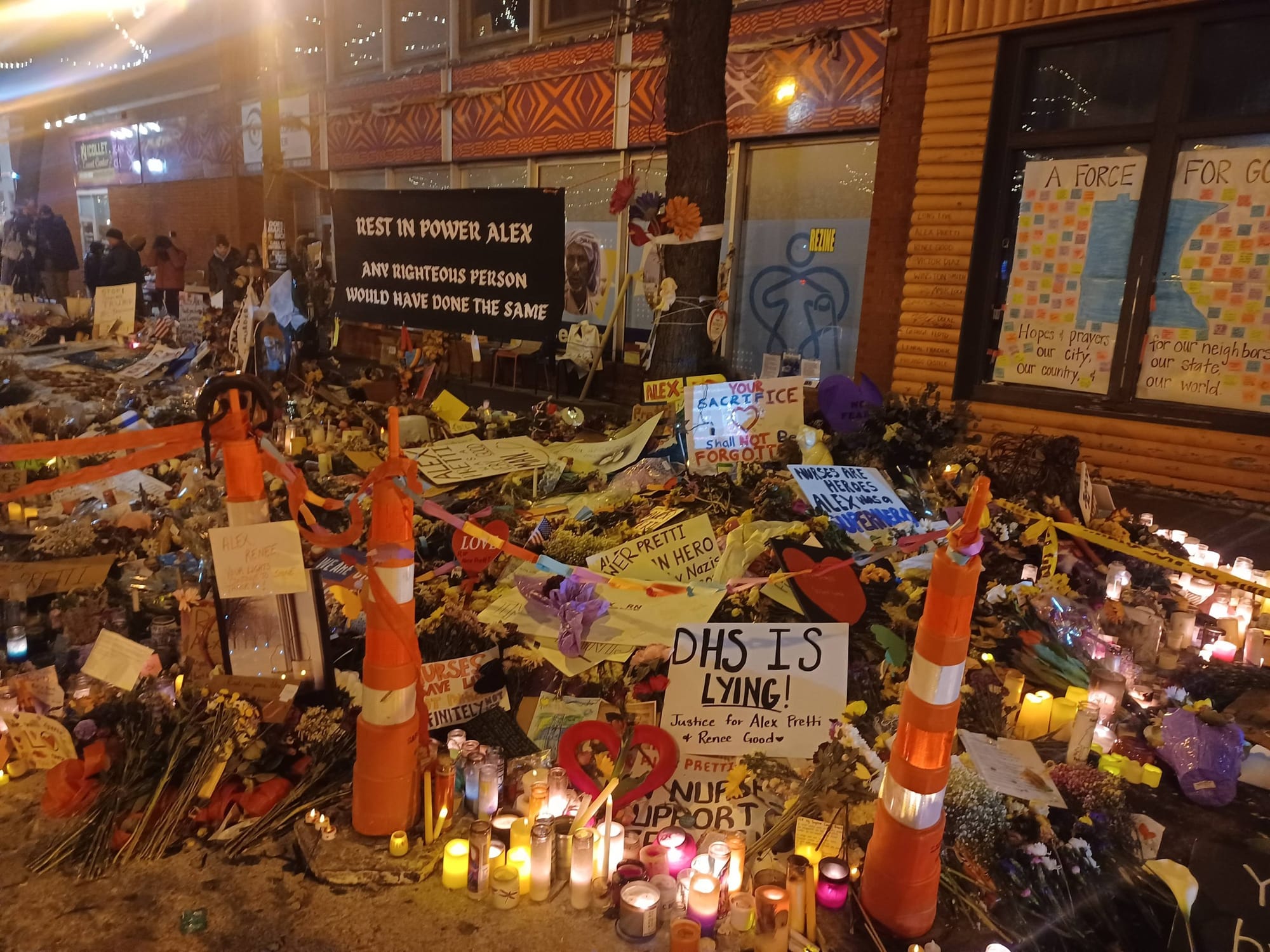
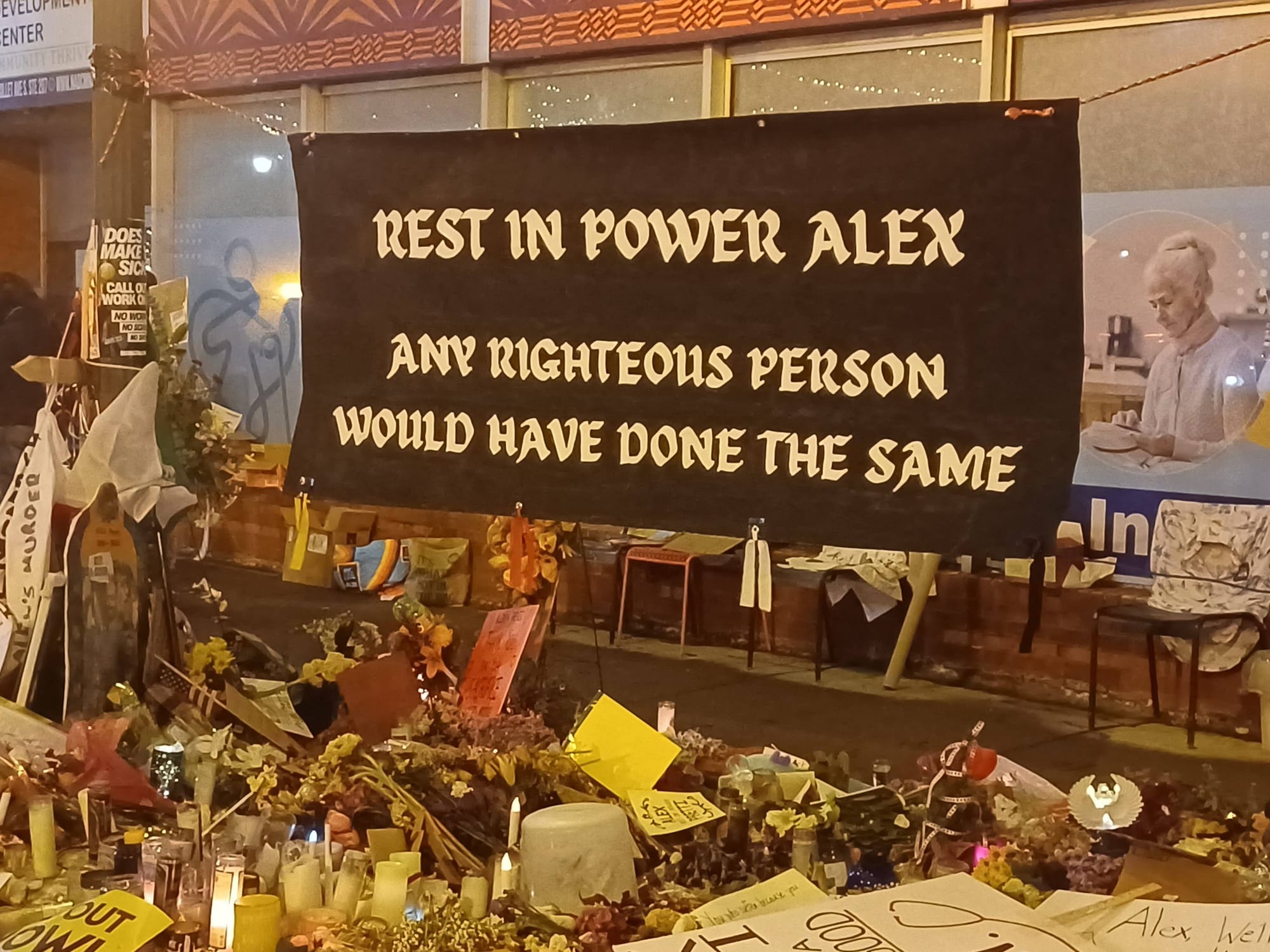
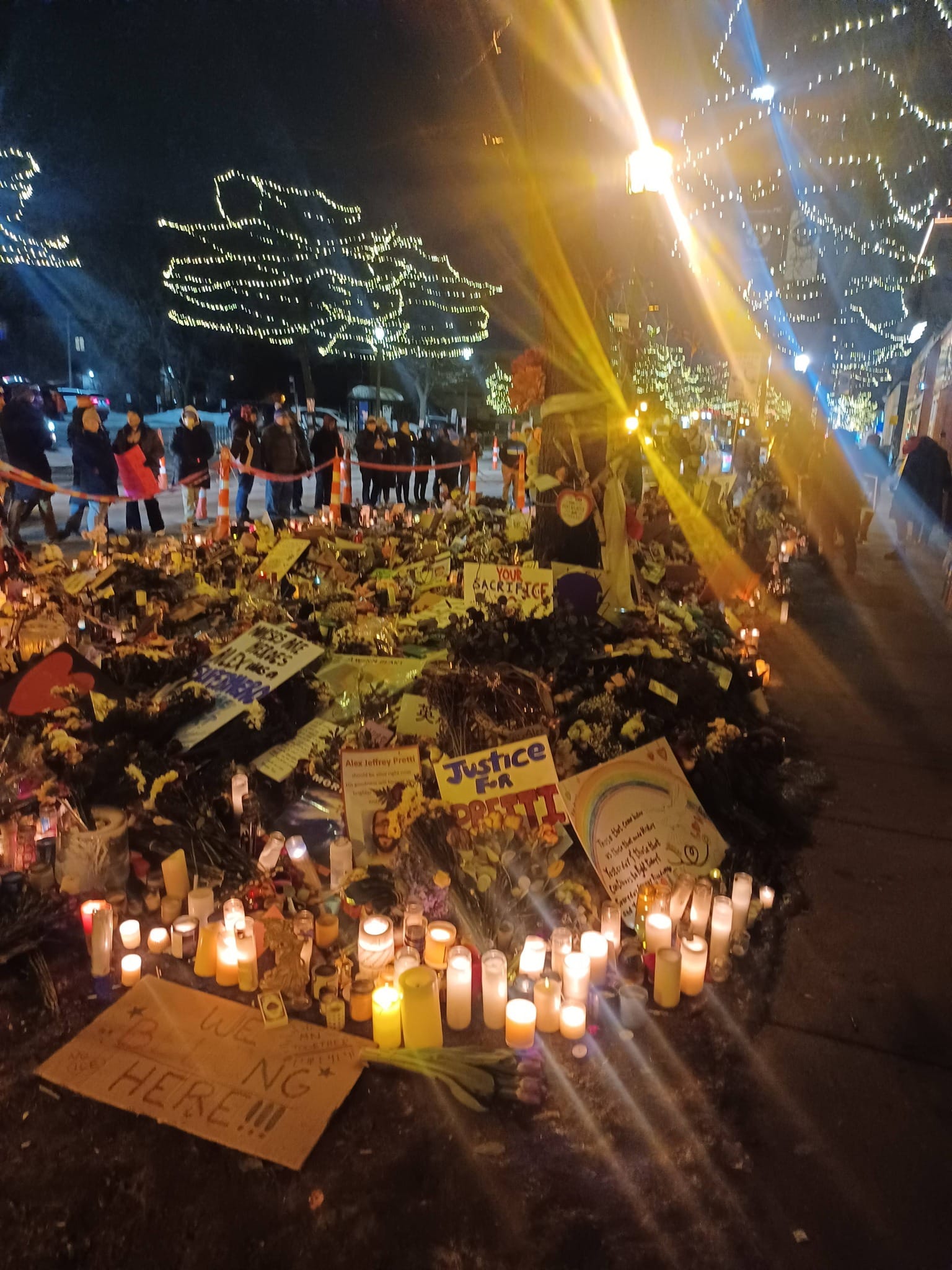
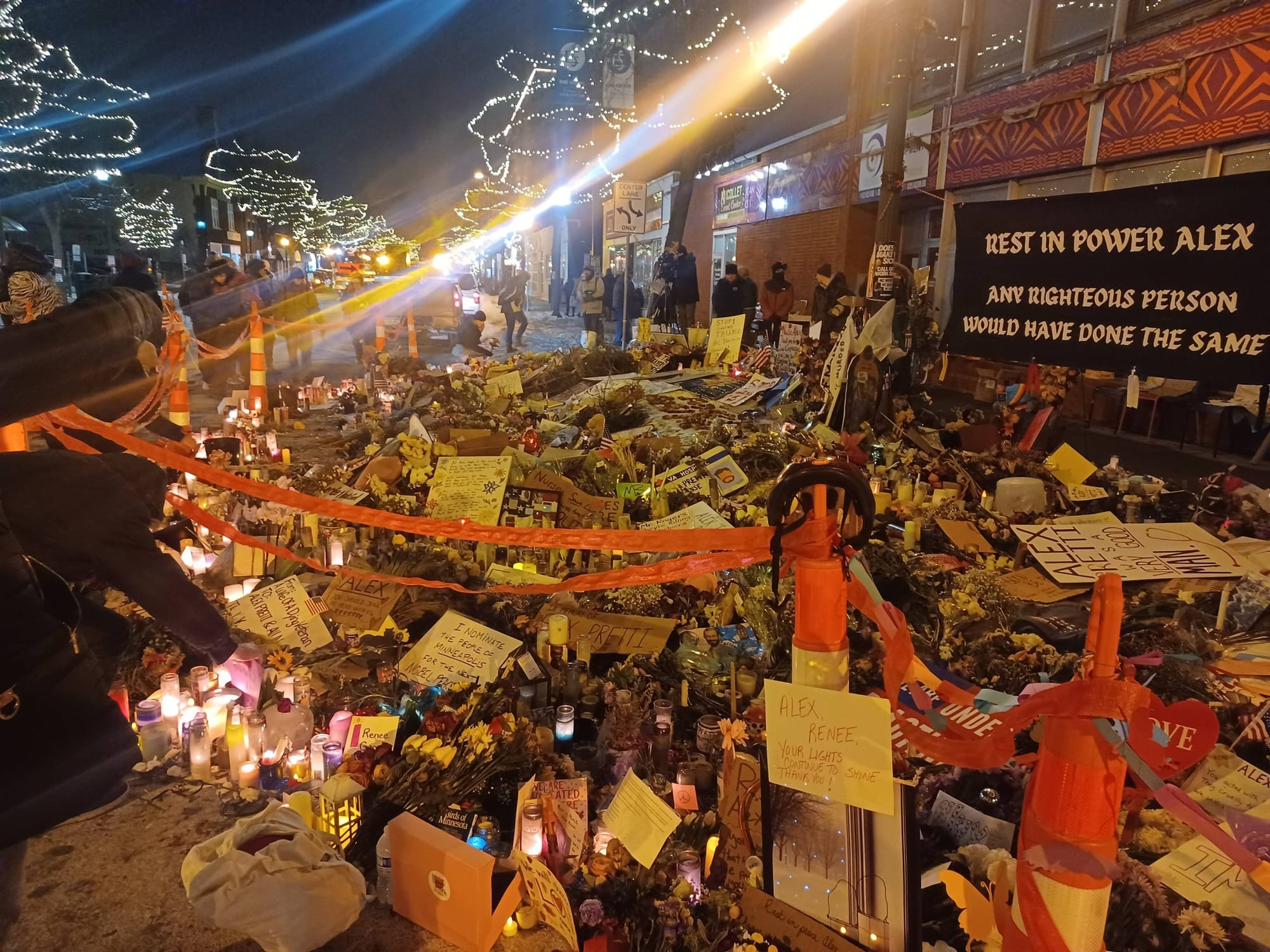
Memorial for Alex Pretti, a nurse murdered by federal agents in Minneapolis CREDIT: Joe Allen
The Whipple federal building
On my first full day in Minneapolis on Friday 30 January, Kieran took me to the daily, early morning pickets, involving a few hundred people at the Whipple federal building, the staging ground ICE and the Border Patrol’s operations in Minneapolis. The wind chill was well below zero degrees Fahrenheit (-18 degrees Celsius). The federal building is a nondescript looking structure just outside of Minneapolis. Every morning, hundreds of people picket and at times sit-in or block briefly Border Patrol and ICE convoys leaving the area. Because the Whipple building sits in an unincorporated territory, it’s policed by the Hennepin County Sheriff’s Department.
Despite the well-publicised clash between Trump and both Minnesota Governor Tim Walz and Minneapolis Mayor Jacob Frey, the sheriffs’ approach to the protests is a daily reminder of the cooperation between the Minnesota Democratic Party (formally known as the Democratic-Farmer-Labor Party) officials and the Trump administration. For example, there’s a long access road that connects the Whipple building to the adjacent highway leading into Minneapolis. It is lined with hundreds of concrete carriers, generally used for major highway construction projects, with high fencing on top to stop protesters from stopping ICE or Border Patrol vehicles. The cost of this can’t be cheap and may run into the hundreds of thousands, if not possibly millions of dollars, eventually.
During the short time I was there, 50 more protesters entered the road through an opening at the parking lot and marched as far as they could towards the Whipple building before the sheriff’s tactical squad slowly and gingerly pushed them back. The sheriff’s deputies with clubs in hand are all suited-up in tactical gear looking more like soldiers than cops. At first, I thought they were ICE: they all look the same these days.
I posted a reel of this encounter on my Facebook page. It’s common for every picket, rally or demonstration to have support staff to provide legal representation and medical aid, as well as hot coffee, water and hand warmers. National Guard trucks, built for service in Afghanistan and Iraq, were stationed in the parking lot. The Minneapolis resistance is well practised at this.
I noticed that a visible number of people at the Whipple protest wore highlighted vests branded “AFL-CIO” or “Union Peace Keeper”. Kieran told me that the protests at the federal building are one of the key places that the official trade union movement plays a role. He introduced me to a local Service Employees International Union 26 officer. I’m not surprised by this. Public-sector unions have historically been close to Walz, but this relationship has gotten rockier lately. I suspect the unions expected to play a moderating role in the protests. I was only there for an hour and didn’t see anyone arrested. However, later in the morning, the Sheriff’s Department announced it had arrested an undisclosed number of people. The Whipple building is notorious for the deplorable conditions suffered by those kidnapped by ICE and the BP.
Picketing target
Kieran then took me to the first of two protests I attended at two different Target stores. Target, the retail giant, is headquartered in Minneapolis. The retail chain started out in Minneapolis and blossomed into a global giant. Soon after the George Floyd uprising, it was one of the most prominent corporations to implement diversity, equity and inclusion (DEI) programs. However, soon after Trump was sworn into office, he launched a major political and legal attack on DEI. Target capitulated and dropped almost all of its diversity programs, which led to boycotts and protests across the country.
There is an ongoing campaign against Target, according to Paul K-D, “to get Target to stop collaborating with ICE. It’s being led by Unidos, a non-profit out here that has long been in a collaborative relationship with SEIU”. Target also contributed $1 million to Trump’s presidential inaugural fund to win his good graces. ICE arrested and injured Target workers on company property, notably in Richfield, a close suburb of Minneapolis.
The first Target protest I attended was in the Dinkytown section of Minneapolis, a commercial district where a large number of university and college students live. There I met veteran socialist and union activist Kip Hedges. The picket was about 60 people, a good mix of young and older activists, where Socialist Alternative (a US socialist group not aligned with Socialist Alternative in Australia) played an important and positive role. Many of the younger people there were Socialist Alternative activists and supporters. We protested outside for a while and then entered the store, chanting and protesting with signs and a bullhorn. The Target store had a hands-off policy—we pretty much did what we wanted and left the store after about fifteen minutes, and continued to picket outside.
The far right has been marginal to irrelevant during the federal occupation of Minneapolis; after all, many of them are in ICE. When the fascist YouTuber Jake Lang tried to hold a rally a few weeks ago, he was easily run off. Kieran did notice a camera crew with two guys trying to look tough across the street from the Target picket, and he and friend made it clear to them to stay on the other side of the street and not mess with anyone. They did. I’m sure a hit piece will show up on YouTube in the future.
The following day, Saturday 31 January, Paul K-D and I attended a sing-in and sit-in at the Target in Richfield. About 80 to 100 people attended the event. It was really fun. Once again, the store director, who in this case looked like a Special Forces veteran, again took a hands-off approach as people marched around the store.
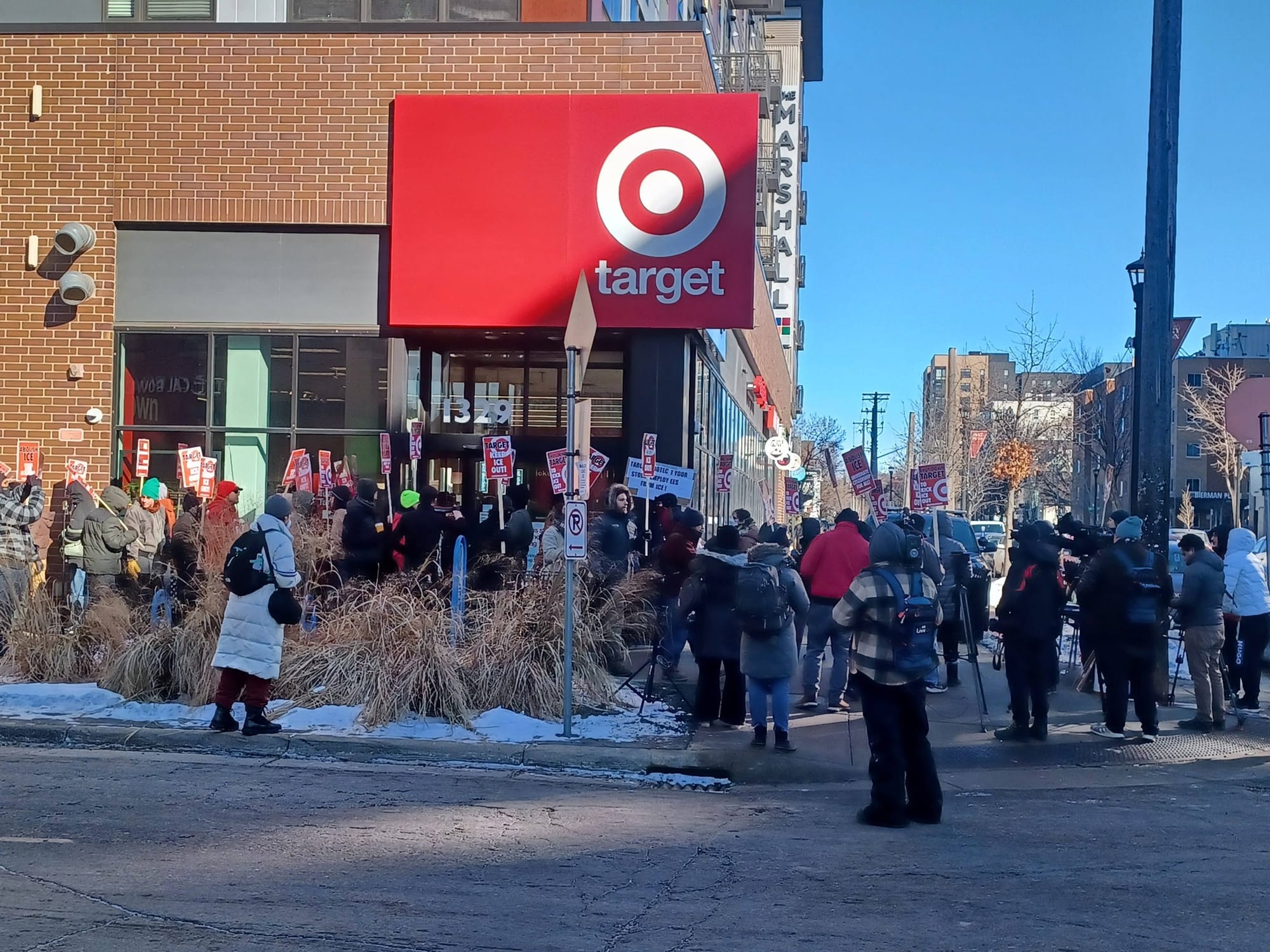
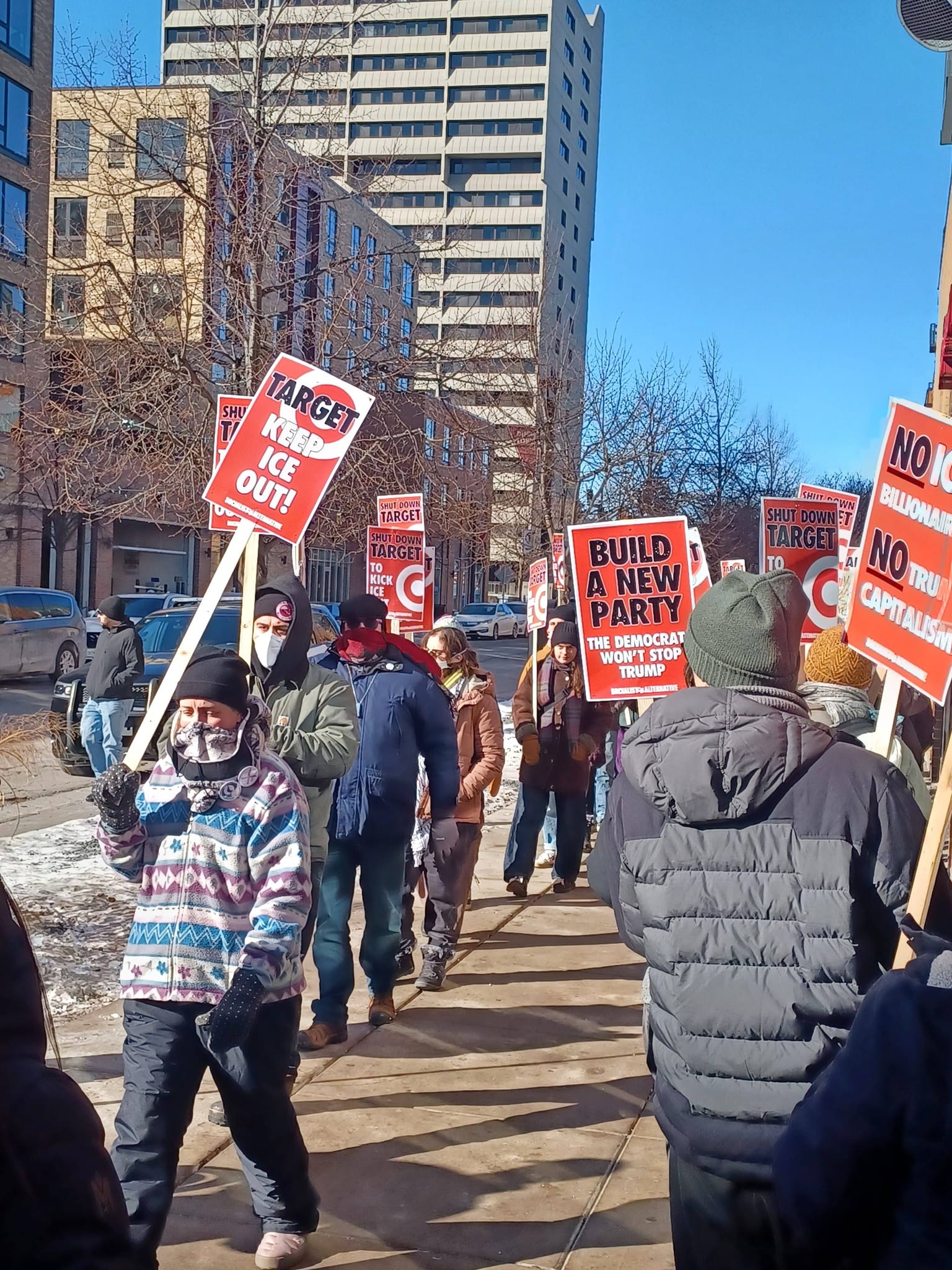
Protesting against Target in Minneapolis CREDIT: Joe Allen
The biggest event by far I attended was the big march on Friday 30 January, when 20,000 people, maybe more, came out to march on what was declared to be a second day of no work, no shopping. Many activists I spoke to were worried about the turnout because it was organised with only a few days’ notice, largely through groups linked to the Party of Socialism and Liberation.
Despite the fact that the march was half the size of the previous week, it was clear to me that it demonstrated the ongoing radicalisation of the population. And, again, despite the frigid temperature, people came, and thousands didn’t go to work or let out early to participate. The march was far more militant than anything I’ve been to in many years. I tried to capture the size and militancy with my phone.
Life during wartime
In between events, I spent a lot of time talking to people and going out into various Minneapolis neighbourhoods. Paul K-D and I visited one of the neighbourhood defence watches in the Powderhorn neighbourhood, which was quite a festive barricade with twenty or so people performing the Macarena. I visited the site of Renee Good’s murder, where a growing memorial is located. Many people were there when I stopped by. I also visited George Floyd Square, where the neighbourhood built a huge memorial. In each of the neighbourhoods I visited, there were posters on light posts that declared, “ICE kidnapped our neighbor here”. Another example of how daily life has been politicised in Minneapolis.
It is also a city under occupation. The Talking Heads’ old song “Life during wartime” kept popping into my head when Kieran and Paul shuttled me around the city. Driving down one of the main streets with a high concentration of Latino businesses, it was pointed out to me that some were completely shuttered, others were darkened as if to try not to attract too much attention from ICE, but everywhere you had to knock to be let in. One night, I joined Kieran and his family at a popular local diner. The place wasn’t very busy, but it took a long time to be seated. After we sat down, the restaurant manager came over and said, “Sorry for the delay, half of my staff is in hiding”.
Reviving the general strike
I’ll wrap up by saying it’s very important to understand what is happening in Minneapolis by listening to the people active there and what their political experience tells them about what happened and why, and at this point what happens next. Paul K-D’s “Twin Cities Labor Report” is a vital resource for everyone to follow. I think Paul K-D has the best take on the events of 23 January.
On 23 January, the Twin Cities held a mass day of action that came pretty close to being a real general strike. Hundreds of businesses closed their doors, and many others worked with skeleton crews. A rally in downtown may have drawn about 70,000, with more staying home due to the weather or keeping watch in their neighbourhood.
On the other hand, the economy did not fully shut down. My personal over/under for a successful event included a shutdown of Metro Transit and of substantial amounts of business in the suburbs on the high end, neither of those things happened. That’s important because while Minneapolis has really been the hotspot of ICE resistance, there are both huge immigrant populations and huge employment centres in the suburbs. A shutdown of the massive UNFI warehouse in Hopkins, for instance, would have shut down grocery deliveries to pretty much the whole state.
Where to go from here? According to Paul K-D:
“I hope that this action gives union members nationally the courage to start talking about political strikes and mass action outside of just voting. In order to be truly effective, though, this needs to happen at least five times the scale. That will take, for a start, the thousands of people who made this day a real thing going to their union meetings and explaining why it was so important and necessary. And it will take the unorganised workers who participated in organising unions at their shops bringing this energy into the labour movement. Actions like these only work when the rank and file are activated enough to push both their employer and their union leadership in the right direction.”
Organisation in the workplace is key. According to Kieran Knutson, his local union of telecom, satellite TV, home security and video game workers, 80 percent of the members were absent from work on 23 January. He also thinks that one of the next steps in the resistance in Minnesota is an assembly of all community defence groups and supporters to meet and decide what their next step is. We appear to be in a different place now. As the movement against ICE spreads across the country, we should remember that we are still at the beginning of a movement that could have a transformative impact on the working class and the left in this country and beyond.


