

It’s rare for aviation executives and prime ministers to party in Western Sydney. But the opening of Sydney’s second airport, Western Sydney International (WSI), was an unmissable photo opportunity. Attendees included Prime Minister Anthony Albanese, his predecessors Tony Abbott and Scott Morrison, Jetstar CEO Stephanie Tully and NSW Premier Chris Minns.
After the first passenger flight departed, the exodus back to the leafy Eastern Suburbs began, leaving behind the roar of turbo-fan engines that will only grow more frequent once the fanfare around the airport subsides.
The new airport is a monument to twenty-first century capitalism: a feat of human ingenuity, subordinated to corporate interests, with working-class people paying the price.
Background
Sections of business have long campaigned for a second major airport in Sydney.
The established Sydney Kingsford Smith Airport at Mascot is boxed in by residential suburbs and Botany Bay. A third runway was opened in 1994, but community protests won a night-time curfew and hourly flight limits.
Aviation is central to supply chains and corporate Australia wanted a new airport with minimal restrictions on its use.
After 60 years of proposals, disputes and false starts, the project was revived in 2012, with the release of the Joint Study on Aviation Capacity in the Sydney Region by the federal and New South Wales governments. Its co-authors included the incoming Business Council of Australia head, Jennifer Westacott.
The report warned Kingsford Smith airport would reach capacity by 2027 and unmet passenger and freight demand could cost as much as $60 billion by 2060. It argued the curfew “creates impediments for night-time movements of freight”, but that “an opportunity exists for a 24-hour freight facility to be established at a secondary airport”. Proximity to future warehousing and distribution centres made Western Sydney an enticing option.
Although the proposal for an airport at Badgerys Creek was rejected by the state and federal governments at the time, the Daily Telegraph immediately launched a renewed campaign for one. It was joined in its lobbying by the National Australia Bank, Harvey Norman, Crown Resorts, Channel 7 and executives from Western Sydney University. Backing was also secured from the peak body of local councils in Sydney.
The Sydney Business Chamber, Western Sydney, led by former Labor state minister and member for Granville David Borger, established the Western Sydney Airport Alliance to cohere a local campaign for the airport.
In 2014, Liberal Prime Minister Tony Abbott’s federal cabinet approved the proposal for an airport at Badgerys Creek.
Local residents objected. “Well, it’s going to make Western Sydney a nightmare to live in”, Geoff Brown, a 40-year resident of Penrith and member of the Western Sydney Conservation alliance, told the ABC at the time. “Growth and a fair go for Western Sydney doesn’t mean trashing the place, doesn't mean turning it into a wasteland of factories and industrial sites”, he said.
Abbott’s successor, Malcolm Turnbull manoeuvred to make the new airport a government-run project. The state and federal governments provided $29 billion in public funding. Meanwhile Western Sydney’s hospitals, schools and public housing continued to crumble.
Government control enabled a grander development plan, including the construction of a new CBD around the airport, Bradfield City. Part of Bradfield City’s purpose is military support, by “strengthening the defence industrial base through advanced manufacturing and semiconductor packaging”.
The government ensured businesses had direct input. “It’s not often you get to help design an airport from scratch,” former Qantas CEO Alan Joyce celebrated in 2019. WSI’s then-CEO warmly welcomed the freight industry: “Tell us what size facility you need, tell us what technology you want in it and how you want it designed to optimise your productivity”. Construction company Lendlease was another big winner, scoring a $644 million contract for the airport’s earth works.
Careful messaging trumpeted WSI’s economic benefits to a dubious public, while noise and environmental concerns were addressed through non-binding consultation. Naming the airport after Australia’s youngest female pilot, Nancy Bird Walton, and highlighting Indigenous culture and sustainability in its design, represented an attempt to further head off opposition.
Today
Cargo operations at WSI commenced on 26 July, and passenger services on 25 October. From November, WSI will also take over Kingsford Smith’s night freight operations. By 2063, the airport is projected to service 82 million passengers annually, and have a second runway.
Noise was already an issue by August.
Barry Garousse, whose family lives less than two kilometres from the new airport, told the ABC that he gets as little as two hours of uninterrupted sleep some nights. “[I] drive semi-trailers, heavy vehicles, which we gotta comply with fatigue laws. At the moment I don’t comply with fatigue laws,” he said.
The government’s promised noise insulation program is limited to adjacent suburbs and won’t process applications until April next year.
In July, Sydney’s redesigned airspace came into effect, concentrating multiple flightpaths for both airports over Western Sydney, particularly between Parramatta and Penrith. More flights have been routed over the city's poorest areas, while fewer flights will pass over its richest.
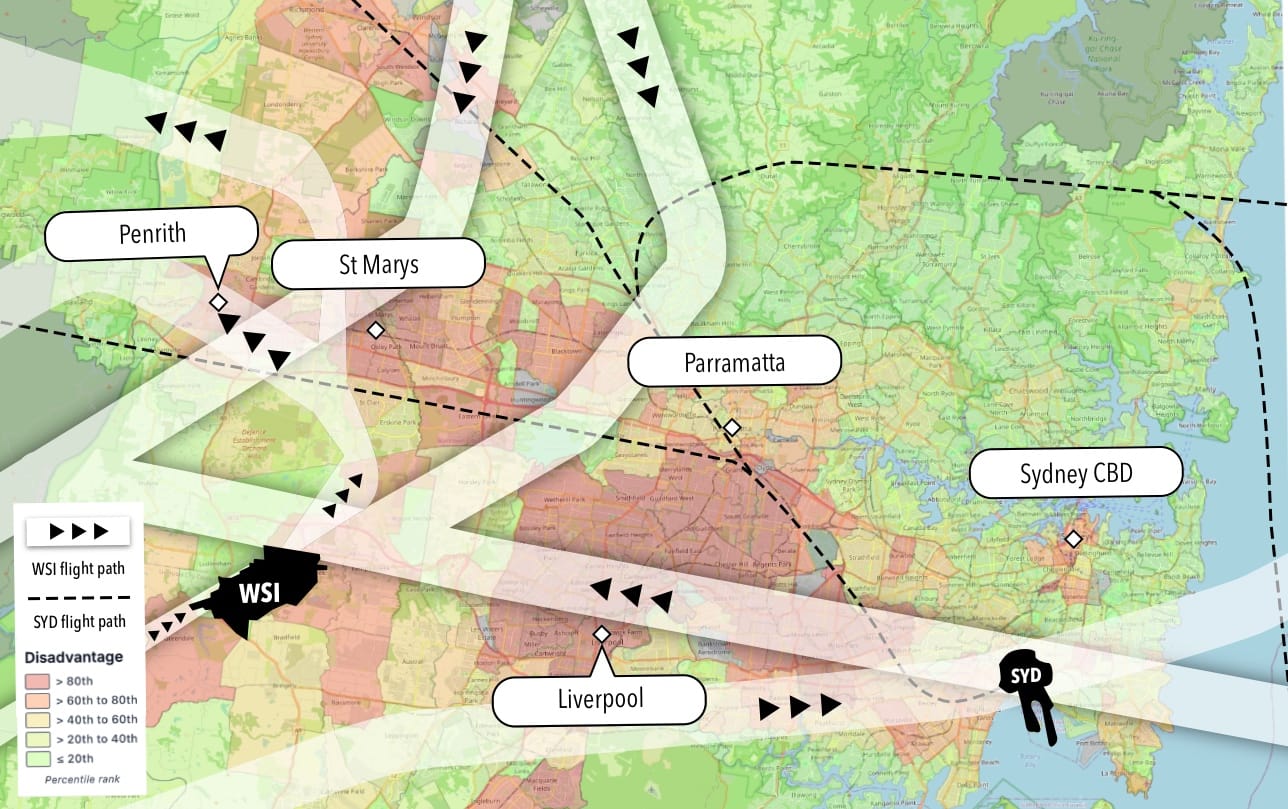
“Since August, it’s been giving us grief,” Gina, a St Mary’s resident, told Red Flag. “[T]rying to sleep with an aeroplane every half hour is cooked.”
Aircraft noise poses numerous health risks. The UK-based Aviation Environmental Federation found exposure “can lead to short-term responses such as sleep disturbance, annoyance, and impairment of learning in children, and long-term exposure is associated with increased risk of high blood pressure, heart disease, heart attack, stroke and dementia.”
It also poses a risk to nearby wildlife, including a not-for-profit animal sanctuary.
WSI’s noise abatement procedures “prefer” diverting night-time flights over the less-populated southwest approach—but only if conditions and flight numbers permit.
Traffic is also an issue—the airport’s train line won’t open until late 2027 or 2028.
Instead, private bus services can charge up to $55 one way. Ubers cost even more. A free shuttle bus from St Mary’s station runs every half hour, carrying 37 passengers per trip. It would take up to five buses with up to a two-hour wait to transport all 188 passengers on the first sold-out flight, assuming there’s no traffic.
This was not an oversight: roads were prioritised.
The initial plan in 2014 did not include a rail link, instead allocating $1.2 billion to upgrade major roads. The 2016 Airport Plan dismissed the need for rail services until “the mid-2040s”. Airport rail was only confirmed in 2018 as part of a line for the new Western Sydney CBD. However, construction only began in 2022.
But freight was sorted by 2019: “The airport’s freight precinct is set to have dedicated road access off the Northern Road, separating heavy vehicles from passenger traffic, which will enter the airport from the M12 on the opposite side of the site”.
Jet fuel will also be brought in by road, using up to 65 B-double tankers per day at full capacity. A dedicated pipeline was investigated in 2024, but may not be “economically feasible” until the 2030s.
Safety
Capitalism’s drive to cut costs and intensify work also jeopardises industrial safety, including in aviation.
Multiple “near misses” at Kingsford Smith airport began the day after freight operations commenced at WSI, totalling eleven incidents by 31 August.
The Australian Transport Safety Bureau’s preliminary report highlighted staff shortages, excessive workloads and noted controllers were “combining operational roles”, that is, doing two or more jobs at once.
Controllers had made anonymous complaints “regarding controller training, experience levels and overall preparation for the Sydney Basin airspace changes associated with the opening of the new Western Sydney International Airport”.
To cut costs during the pandemic, the private operator of air traffic control services, Air Services Australia, offered early retirement to controllers more than 56 years old. This eliminated the most experienced 15 percent of its workforce. Recruitment has increased, but decades of experience can’t be replaced overnight.
Those holding the system together are working under pressure, with some working up to 800 hours of overtime per year, or working ten days straight on a regular basis according to the association representing controllers.
But the bosses making decisions in corporate boardrooms are insulated from these problems. If anything, they’re determined to have fewer humans working in aviation.
WSI will be the first airport in Australia without a conventional control tower. Twenty-five cameras will feed video to a control centre seventeen kilometres away in Eastern Creek.
Anonymous sources told the Sydney Morning Herald in August that low video quality required slowing flight movements as a precaution. Controllers couldn’t just look through binoculars or out the window to confirm aircraft positions.
Loss of connectivity poses another risk. During April and September, a remote control facility in Philadelphia lost radar around Newark Airport for more than a minute due to damaged cabling and backup systems failing.
Some US airports have introduced AI systems to “advise” human controllers, with workers raising concerns about the reliability of summarised information and their ability to override AI guidance.
The politics of air travel
Working class people are locked out of decision making in capitalism. Democracy doesn’t extend to the workplace or the economy, including construction projects like WSI, Sydney’s toll roads, stadiums, countless luxury apartment blocks and data centres.
The only way we can influence anything is collectively: campaigning, protesting and going on strike. Sydney Airport’s curfew, for example, was won through mass protest in the 1990s, including thousands rallying at Leichhardt oval and a 10,000-strong blockade of the airport. This curfew was an important improvement in living standards for those living near the airport, which are not wealthy areas.
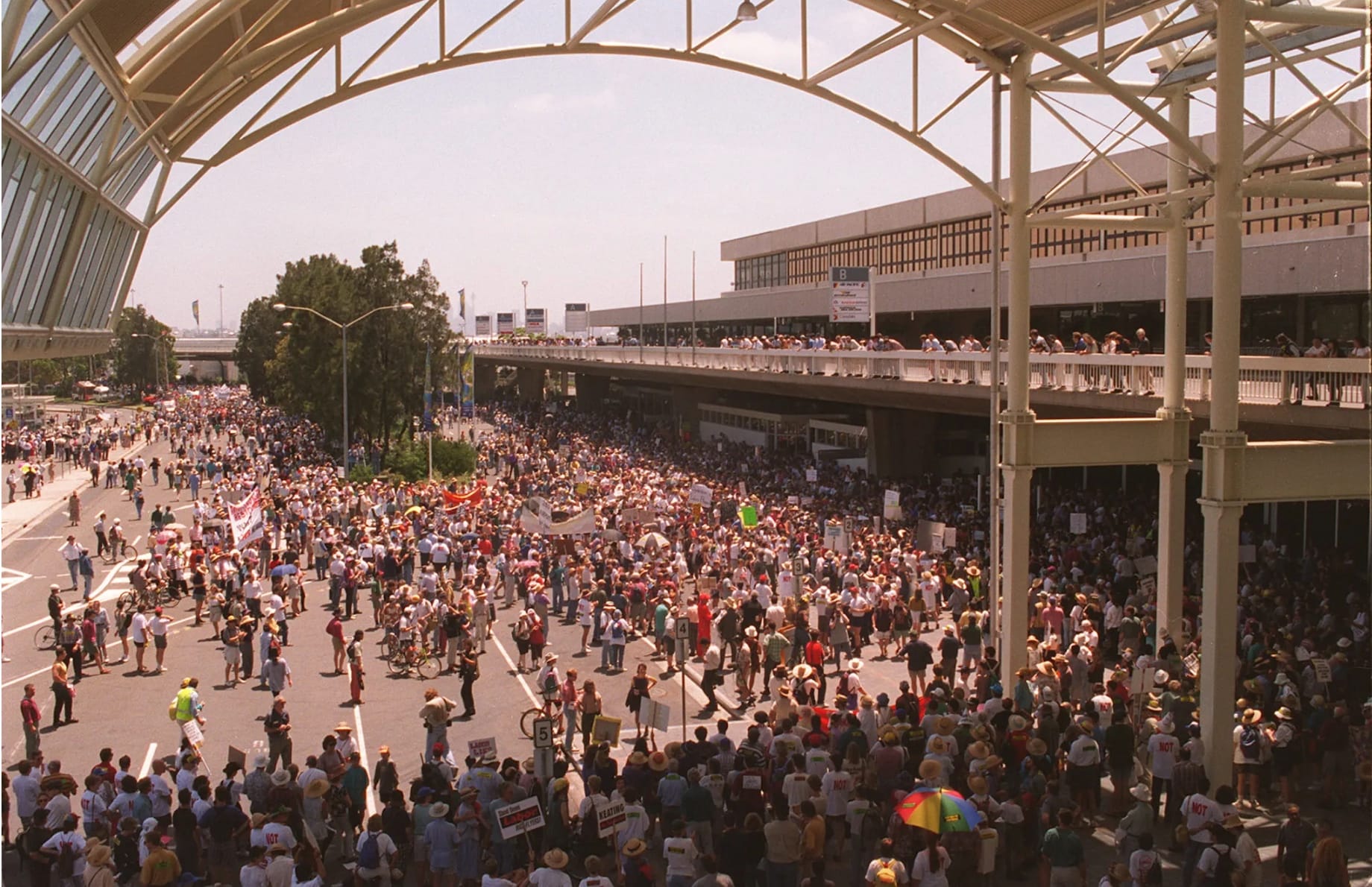
The health and lives of western Sydney residents matter as much as anyone else’s. Demanding a curfew and compensation, as was paid to residents near Kingsford Smith airport in the 1990s, should be the bare minimum. This will take serious public pressure and industrial muscle.
In recent months, hundreds of airport ground staff have struck to improve wages and conditions, meaning safer skies for everyone. Flight disruptions showed the potential power aviation workers have.
Aviation has helped make satisfying human need possible by moving resources and people around the world at unprecedented speed. But capitalism’s profit-driven logic limits the possibilities. In a socialist society, where workers democratically control the economy, safety and sustainability would be prioritised over profit.
Airports could be built away from cities, connected by rapid transit. Planned production could reduce excess flights from competing airlines, empty flights and unnecessary business travel. Destructive industries that add to travel volume, like the military, could and should be abolished Homes surrounding airports could be designed or upgraded with the best possible noise insulation.
But capitalism will not forgo profits just so people can live decent lives. To win anything, from a decent night’s sleep to a decent society, we’ll need to fight them together and make a lot of noise of our own.


